Virginia SOL 3.7.d
The Standard
- 3.7
- The student will apply history and social science skills to describe the geographic, political, economic, and social structures and innovations of ancient Rome by
describing the arts and innovations
Virginia Standards of Learning for History and Social Science
Teacher's field guide
What This Standard Means
What Students Need to Do
- Students identify arts and innovations from ancient China, such as calligraphy, silk, bronze work, paper, and the compass. They describe how each was made or used and how it affected daily life.
What Mastery Looks Like
- Students can name several examples and explain their uses in trade, travel, communication, or artistic expression. They can use an image or object as evidence for their explanation.
Common Misconceptions
- Students may assume every famous Chinese invention appeared at the same time or came from one inventor. They may view art as decoration only, missing calligraphy, silk weaving, and bronze work.
How to Assess It
- Exit ticket: Choose paper, silk, the compass, or calligraphy. Identify it as an art, an innovation, or both, then explain one way it changed daily life.
Lesson moves
Ways to Teach It
Float a magnetized needle on cork in water, then have students explain how a compass helps travelers choose direction.
Show silk, bronze, paper, and calligraphy images, then ask: Which changed daily life most, and why?
Play a card sort matching paper, silk, compass, and calligraphy to communication, trade, travel, or artistic expression.
Have students inspect a book, map app, or silk item and trace its link to an ancient Chinese idea.
Free download
Printable 3.7.d Worksheet
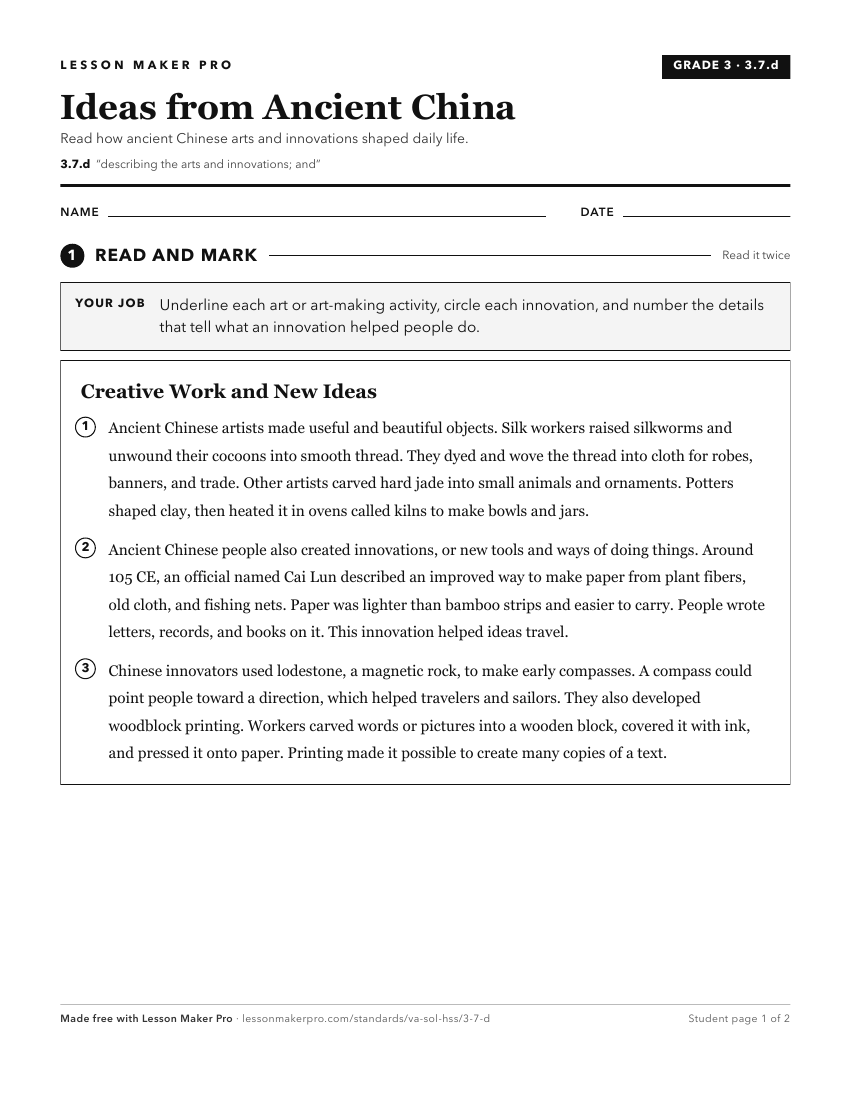
A ready-to-print activity worksheet aligned to 3.7.d, with an answer key for the teacher on its own page. No account needed.
PDF, US Letter, prints cleanly in black and white.
Download the worksheetKeep exploring
Related Standards
Turn this exact standard into a lesson
Grade, subject, topic, and the complete standard are prefilled. Create one free, no account needed.
Also for this standard:Make a WorksheetMake a QuizMake a Sub Lesson