Virginia SOL 3.6.e
The Standard
- 3.6
- The student will apply history and social science skills to describe the geographic, political, economic, and social structures and innovations of ancient Greece by
identifying and explaining the architecture and its influence in the world today.
Virginia Standards of Learning for History and Social Science
Teacher's field guide
What This Standard Means
What Students Need to Do
- Students identify Roman features such as arches, domes, columns, aqueducts, and amphitheaters. They explain how these designs appear in modern buildings, bridges, stadiums, and water systems.
What Mastery Looks Like
- Students can name a Roman feature in an image and describe its purpose. They can compare it with a modern structure and explain how the Roman design influenced it.
Common Misconceptions
- Students may label any old building or any building with columns as Roman. They may notice similar shapes without explaining how the design serves the same purpose today.
How to Assess It
- Show pictures of a Roman arch and a modern arched bridge. Ask students to name the shared feature and explain how the Roman design influenced the bridge.
Lesson moves
Ways to Teach It
Build an arch with blocks, remove the center support, and record what keeps the structure standing.
Compare the Colosseum with a modern stadium, then discuss which design features builders still use and why.
Play a card matching game that pairs Roman arches, domes, aqueducts, and amphitheaters with modern examples.
Examine a photo of the Virginia State Capitol and identify architectural features connected to ancient Rome.
Free download
Printable 3.6.e Worksheet
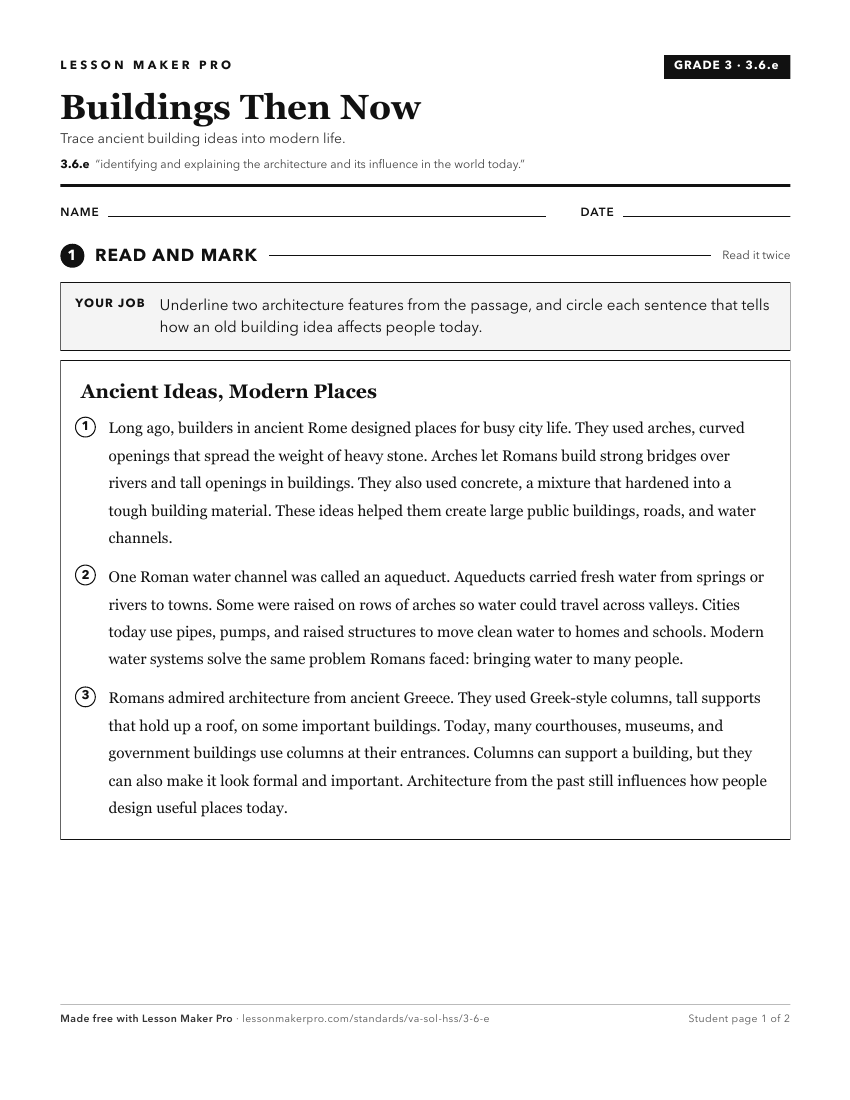
A ready-to-print activity worksheet aligned to 3.6.e, with an answer key for the teacher on its own page. No account needed.
PDF, US Letter, prints cleanly in black and white.
Download the worksheetKeep exploring
Related Standards
- 3.4.e
identifying and explaining the architecture and its influence in the world today
- 3.8.e
identifying and explaining the architecture and its influence in the world
- 3.5.e
identifying and explaining the architecture and its influence in the world today
- 3.7.e
identifying and explaining the architecture and its influence in the world today
Turn this exact standard into a lesson
Grade, subject, topic, and the complete standard are prefilled. Create one free, no account needed.
Also for this standard:Make a WorksheetMake a QuizMake a Sub Lesson