Virginia SOL 9.RL.3.A
The Standard
Describe how the historical or social function of a text depends on its context (e.g., cultural, situational, historical, geographical).
Virginia Standards of Learning for English · Integration of Concepts
Teacher's field guide
What This Standard Means
What Students Need to Do
- Students connect a literary work to the time, place, culture, audience, and situation surrounding it. They explain how that context shaped what the work did for its original community.
What Mastery Looks Like
- Students identify relevant details about the time, place, culture, audience, or situation. They explain how those details shaped the text’s role, using specific evidence from the text and context.
Common Misconceptions
- Students may summarize the story’s setting instead of identifying the conditions surrounding its creation. They may list dates or events without explaining their effect on the text. They may also confuse a modern reader’s reaction with the text’s original public role.
How to Assess It
- Give students a short poem and a three-sentence context note. Ask them to name one historical or social function and explain how one context detail shaped it.
Lesson moves
Ways to Teach It
Print a poem and four context cards; groups match the likely context, then annotate lines that support the match.
Ask, "How would this text’s purpose change if published in another place or decade?" Students answer with two specific details.
Play Context Detective: teams draw a text clue and a context clue, then earn points by explaining the connection.
Compare a current protest song with an older protest poem, noting how each audience, event, and place shapes its public role.
Free download
Printable 9.RL.3.A Worksheet
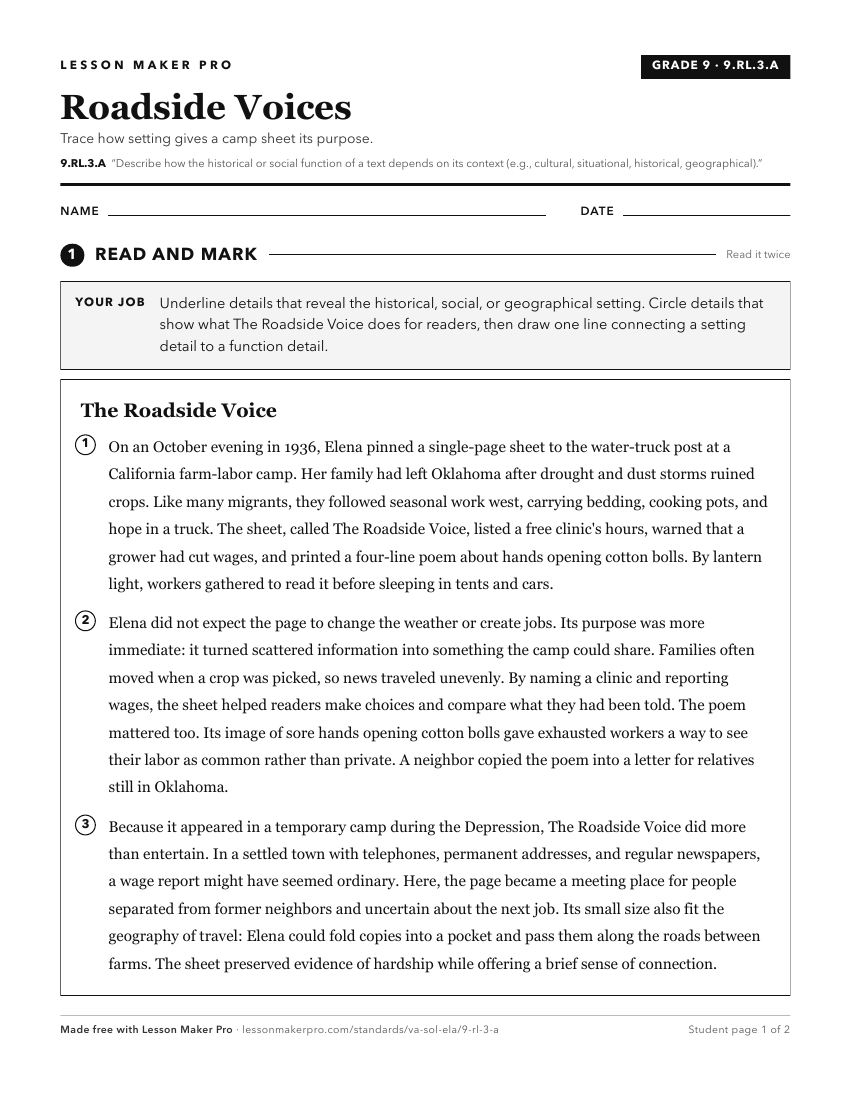
A ready-to-print activity worksheet aligned to 9.RL.3.A, with an answer key for the teacher on its own page. No account needed.
PDF, US Letter, prints cleanly in black and white.
Download the worksheetKeep exploring
Related Standards
- 6.RL.3.A
Describe how the interactions between individuals, settings, events, and ideas within a text influence one another.
- 11.RL.3.A
Explain the influence of the historical and cultural context on form, style, and point of view of texts that represent diverse voices and perspectives.
- 11.RL.3.C
Analyze how authors’ attitudes, viewpoints, and beliefs reflect larger historical, social, or cultural contexts.
- 10.RL.3.A
Explain and analyze the influence of the historical and cultural context of a text on its form, style, characters, and point of view.
Turn this exact standard into a lesson
Grade, subject, topic, and the complete standard are prefilled. Create one free, no account needed.
Also for this standard:Make a WorksheetMake a QuizMake a Sub Lesson