Virginia SOL 9.RL.2.C
The Standard
Explain the point of view and distinguish between what is implied or intended because of the use of hyperbole, irony, sarcasm, and understatement.
Virginia Standards of Learning for English · Craft and Style
Teacher's field guide
What This Standard Means
What Students Need to Do
- Students determine a narrator’s or speaker’s viewpoint and explain meaning that is not stated directly. They use context to show how exaggeration, irony, sarcasm, or understatement communicates attitude and intent.
What Mastery Looks Like
- Students identify the narrator’s or speaker’s viewpoint and separate literal wording from intended meaning. They explain how hyperbole, irony, sarcasm, or understatement reveals attitude, using specific evidence from the text.
Common Misconceptions
- Students may treat the narrator’s views as the author’s views. They may read sarcasm or understatement literally, confuse irony with coincidence, or label any exaggeration as hyperbole without explaining its effect.
How to Assess It
- Give students a short sarcastic or ironic passage. Ask them to identify the speaker’s viewpoint, explain the intended meaning, and cite two context clues.
Lesson moves
Ways to Teach It
Give pairs four labeled cards and short passages to sort by hyperbole, irony, sarcasm, or understatement, then require a written justification.
Ask students to rewrite a sarcastic line literally, then explain what the original wording reveals about the speaker’s viewpoint.
Play Context Clue Challenge, where teams identify the intended meaning of projected lines and point to the clue that proves each answer.
Compare three product reviews using exaggeration, sarcasm, and understatement, then discuss how each reviewer’s attitude shapes the reader’s response.
Free download
Printable 9.RL.2.C Worksheet
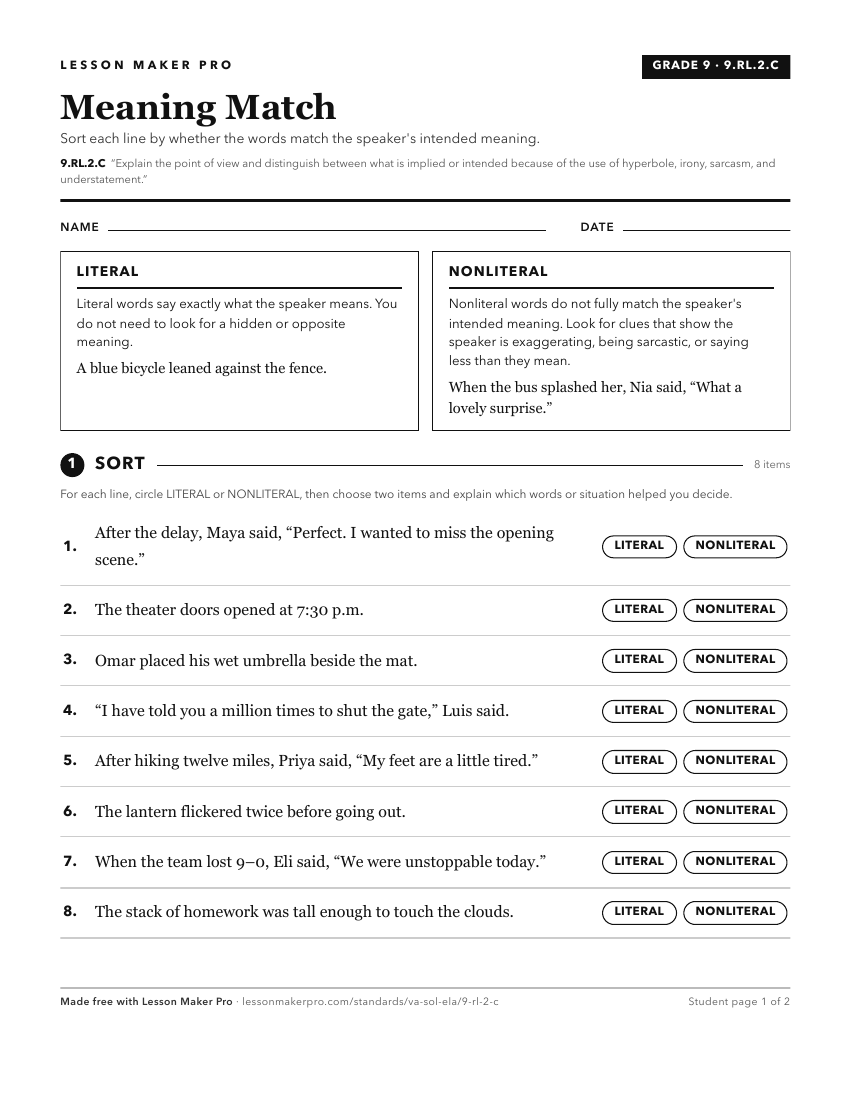
A ready-to-print activity worksheet aligned to 9.RL.2.C, with an answer key for the teacher on its own page. No account needed.
PDF, US Letter, prints cleanly in black and white.
Download the worksheetKeep exploring
Related Standards
- 10.RL.2.D
Analyze point of view and distinguish between what is directly stated in a text from what is implied or intended because of the use of satire, irony, sarcasm, a...
- 10.RI.2.C
Analyze the author’s purpose and impact of literary techniques such as hyperbole, analogy, and paradox as they appear in texts.
- 11.RL.2.D
Analyze the use of satire, sarcasm, irony, and understatement to differentiate between what is directly stated and what is implied.
- 12.RL.2.C
Evaluate the use of satire, sarcasm, irony, and understatement to differentiate between what is directly stated and what is implied.
Turn this exact standard into a lesson
Grade, subject, topic, and the complete standard are prefilled. Create one free, no account needed.
Also for this standard:Make a WorksheetMake a QuizMake a Sub Lesson