Virginia SOL 12.RL.2.C
The Standard
Evaluate the use of satire, sarcasm, irony, and understatement to differentiate between what is directly stated and what is implied.
Virginia Standards of Learning for English · Craft and Style
Teacher's field guide
What This Standard Means
What Students Need to Do
- Students recognize when a speaker or writer means more than the words directly say. They identify the technique and judge how it creates humor, criticism, tone, or character insight.
What Mastery Looks Like
- Students cite exact words, explain both the literal and intended meanings, and correctly name the technique. They explain how the choice shapes tone, criticism, humor, or characterization.
Common Misconceptions
- Students may label any humorous passage as satire or any unexpected event as irony. They may miss that sarcasm targets someone, while understatement makes a serious situation sound smaller. Some identify the device but do not explain its effect.
How to Assess It
- Display: “Brilliant planning,” Mara said, staring at the collapsed stage. Ask students to name the device, explain the implied meaning, and describe its effect.
Lesson moves
Ways to Teach It
Give pairs quote cards to sort as satire, sarcasm, irony, or understatement, then have them underline clues and explain each implied meaning.
Ask students to rewrite a sarcastic or ironic line literally, then discuss what tone and meaning the direct version loses.
Run a four-corners game where students classify projected examples, move to a labeled corner, and defend their choice with textual evidence.
Analyze a satirical headline or advertisement, then identify its target, literal claim, implied criticism, and intended audience reaction.
Free download
Printable 12.RL.2.C Worksheet
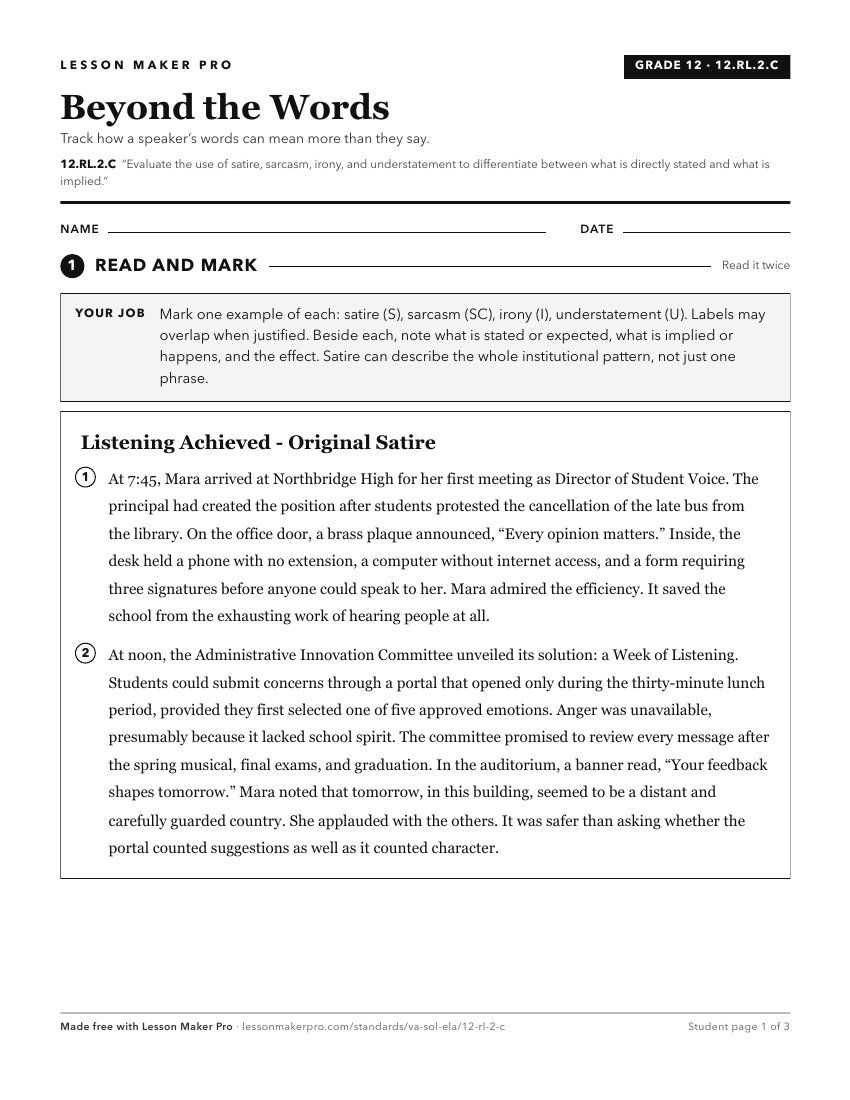
A ready-to-print activity worksheet aligned to 12.RL.2.C, with an answer key for the teacher on its own page. No account needed.
PDF, US Letter, prints cleanly in black and white.
Download the worksheetKeep exploring
Related Standards
- 9.RL.2.C
Explain the point of view and distinguish between what is implied or intended because of the use of hyperbole, irony, sarcasm, and understatement.
- 10.RL.2.D
Analyze point of view and distinguish between what is directly stated in a text from what is implied or intended because of the use of satire, irony, sarcasm, a...
- 11.RI.2.C
Recognize and analyze the author’s purpose and impact of ambiguity, contradiction, paradox, oxymoron, irony, sarcasm, overstatement, and understatement in infor...
- 11.RL.2.D
Analyze the use of satire, sarcasm, irony, and understatement to differentiate between what is directly stated and what is implied.
Turn this exact standard into a lesson
Grade, subject, topic, and the complete standard are prefilled. Create one free, no account needed.
Also for this standard:Make a WorksheetMake a QuizMake a Sub Lesson