Virginia SOL 9.RL.2.B
The Standard
Explain how an author’s specific word choices, syntax, tone, and voice shape the meaning of the text.
Virginia Standards of Learning for English · Craft and Style
Teacher's field guide
What This Standard Means
What Students Need to Do
- Students examine diction, sentence structure, tone, and narrative voice in a literary passage. They explain how those choices guide interpretation, emphasis, and emotional response.
What Mastery Looks Like
- Students select precise evidence, identify the technique, and explain its effect on tone, voice, or meaning. They can compare a revised sentence with the original and describe what changes.
Common Misconceptions
- Students may name a tone without citing the language that creates it. They may confuse tone with mood, or treat sentence length and punctuation as decoration rather than meaning-making choices.
How to Assess It
- Give students a short passage and ask: Identify one language or sentence-level choice, name the tone it creates, and explain how it shapes meaning. Require one quoted detail.
Lesson moves
Ways to Teach It
Give pairs cut-up versions of one sentence, then have them reorder the words and compare how each arrangement changes emphasis and tone.
Ask students to annotate three striking phrases, then write: What attitude does the narrator reveal through these choices?
Play Tone Detective with passage cards, students name the tone, underline two clues, and earn a point only for a supported explanation.
Compare two headlines about the same event and discuss how verbs, sentence structure, and detail selection guide readers toward different interpretations.
Free download
Printable 9.RL.2.B Worksheet
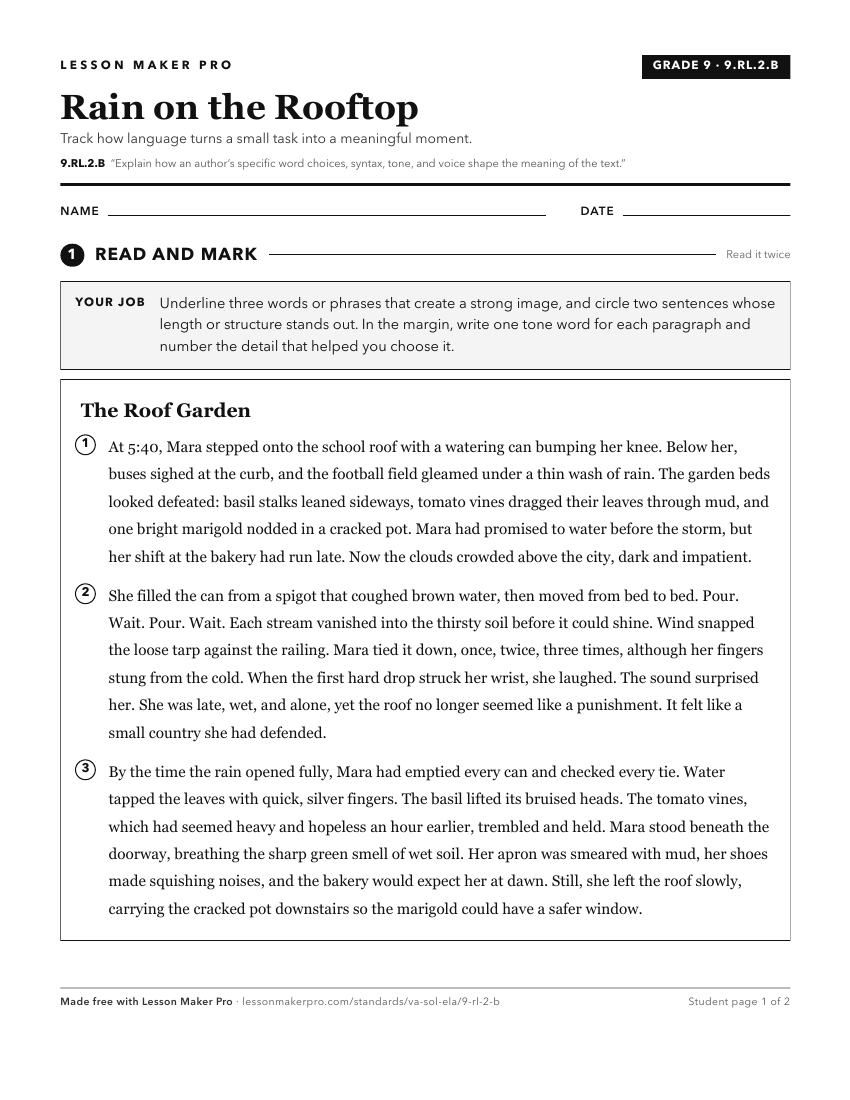
A ready-to-print activity worksheet aligned to 9.RL.2.B, with an answer key for the teacher on its own page. No account needed.
PDF, US Letter, prints cleanly in black and white.
Download the worksheetKeep exploring
Related Standards
- 10.RL.2.C
Analyze how authors use specific word choices, syntax, tone, and voice to convey the author’s intent and viewpoint.
- 7.RL.2.B
Analyze how the elements of an author’s style (e.g., word choice, sentence structure, dialogue, figurative language, imagery) are used to influence and develop ...
- 8.RL.2.B
Analyze how the elements of an author’s style (e.g., dialogue, sentence structure and word choices) are used to influence and develop tone and voice.
- 11.RL.2.B
Evaluate how authors use specific word choices, syntax, tone, and voice to convey the author’s intent and viewpoint.
Turn this exact standard into a lesson
Grade, subject, topic, and the complete standard are prefilled. Create one free, no account needed.
Also for this standard:Make a WorksheetMake a QuizMake a Sub Lesson