Virginia SOL 11.RL.2.B
The Standard
Evaluate how authors use specific word choices, syntax, tone, and voice to convey the author’s intent and viewpoint.
Virginia Standards of Learning for English · Craft and Style
Teacher's field guide
What This Standard Means
What Students Need to Do
- Students identify telling diction, sentence patterns, tonal shifts, and features of a speaker’s voice. They explain how those choices shape the reader’s understanding of purpose and viewpoint.
What Mastery Looks Like
- Students can select precise words or sentence structures, describe their effects, and connect those effects to a defensible interpretation. They can also explain how tone and voice shape the reader’s response.
Common Misconceptions
- Students often name the tone without citing words or sentence patterns that create it. They may confuse the narrator’s viewpoint with the author’s viewpoint or assume intent without enough evidence.
How to Assess It
- Give students a short passage and ask: Which two language choices most clearly reveal purpose or viewpoint? Explain each choice’s effect in three sentences.
Lesson moves
Ways to Teach It
Cut a short passage into sentence strips, then have pairs rearrange its syntax and compare how each version changes emphasis and tone.
Read two contrasting narrator passages and discuss: Which specific choices make one voice trustworthy and the other doubtful?
Play Tone Shift: teams replace three words in a neutral paragraph to create resentment, admiration, or fear, then justify each choice.
Compare a school announcement with a political speech, marking loaded words and sentence patterns that reveal audience, purpose, and viewpoint.
Free download
Printable 11.RL.2.B Worksheet
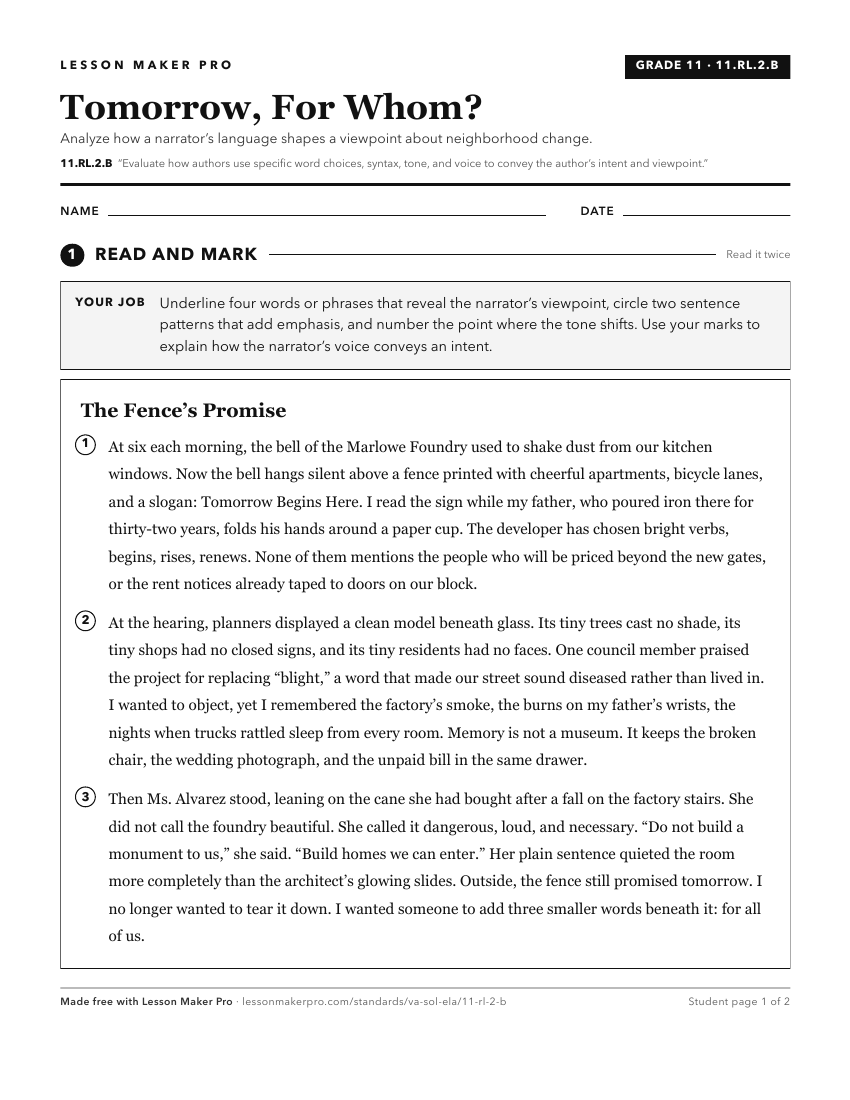
A ready-to-print activity worksheet aligned to 11.RL.2.B, with an answer key for the teacher on its own page. No account needed.
PDF, US Letter, prints cleanly in black and white.
Download the worksheetKeep exploring
Related Standards
- 10.RL.2.C
Analyze how authors use specific word choices, syntax, tone, and voice to convey the author’s intent and viewpoint.
- 7.RL.2.B
Analyze how the elements of an author’s style (e.g., word choice, sentence structure, dialogue, figurative language, imagery) are used to influence and develop ...
- 5.RL.2.B
Analyze the author’s use of language (e.g., synonyms, figurative language, sensory words, dialogue, dialect) and their impact on understanding characters, setti...
- 8.RL.2.B
Analyze how the elements of an author’s style (e.g., dialogue, sentence structure and word choices) are used to influence and develop tone and voice.
Turn this exact standard into a lesson
Grade, subject, topic, and the complete standard are prefilled. Create one free, no account needed.
Also for this standard:Make a WorksheetMake a QuizMake a Sub Lesson