Virginia SOL 7.RV.1.G
The Standard
Use general and specialized word-reference materials, print and digital, to identify word origins and derivations, pronunciations, precise meanings, and their parts of speech.
Virginia Standards of Learning for English · Vocabulary Development and Word Analysis
Teacher's field guide
What This Standard Means
What Students Need to Do
- Students select a dictionary, glossary, pronunciation guide, or etymology source based on the question they need to answer. They read entry labels and symbols to determine a word's history, formation, pronunciation, exact meaning, and grammatical use. They compare sources when one entry is incomplete.
What Mastery Looks Like
- Given an unfamiliar word, a student can find and cite the needed information in print and digital sources. The student chooses the meaning that fits the sentence, names the part of speech, and explains how the word developed. The student also pronounces the word accurately.
Common Misconceptions
- Students often choose the first definition instead of the meaning that fits the sentence. They may confuse a word's origin with its root meaning or assume one word always has the same part of speech. Pronunciation symbols and labels such as archaic, informal, noun, and verb may be overlooked.
How to Assess It
- Exit ticket: In the sentence "The alarm was barely audible," use a print dictionary and an online etymology source to record audible's pronunciation, origin, formation, part of speech, and context-fit meaning.
Lesson moves
Ways to Teach It
Set up stations with a print dictionary, subject glossary, pronunciation guide, and etymology website, then have students complete a word profile card.
Ask students to compare two dictionary entries for the same word and explain which source gives more useful information for a specific sentence.
Play a reference-tool race where teams draw question cards and choose the best source to find each answer accurately.
Have students examine medicine labels or appliance manuals, then use specialized glossaries to clarify unfamiliar terms and explain their meanings in context.
Free download
Printable 7.RV.1.G Worksheet
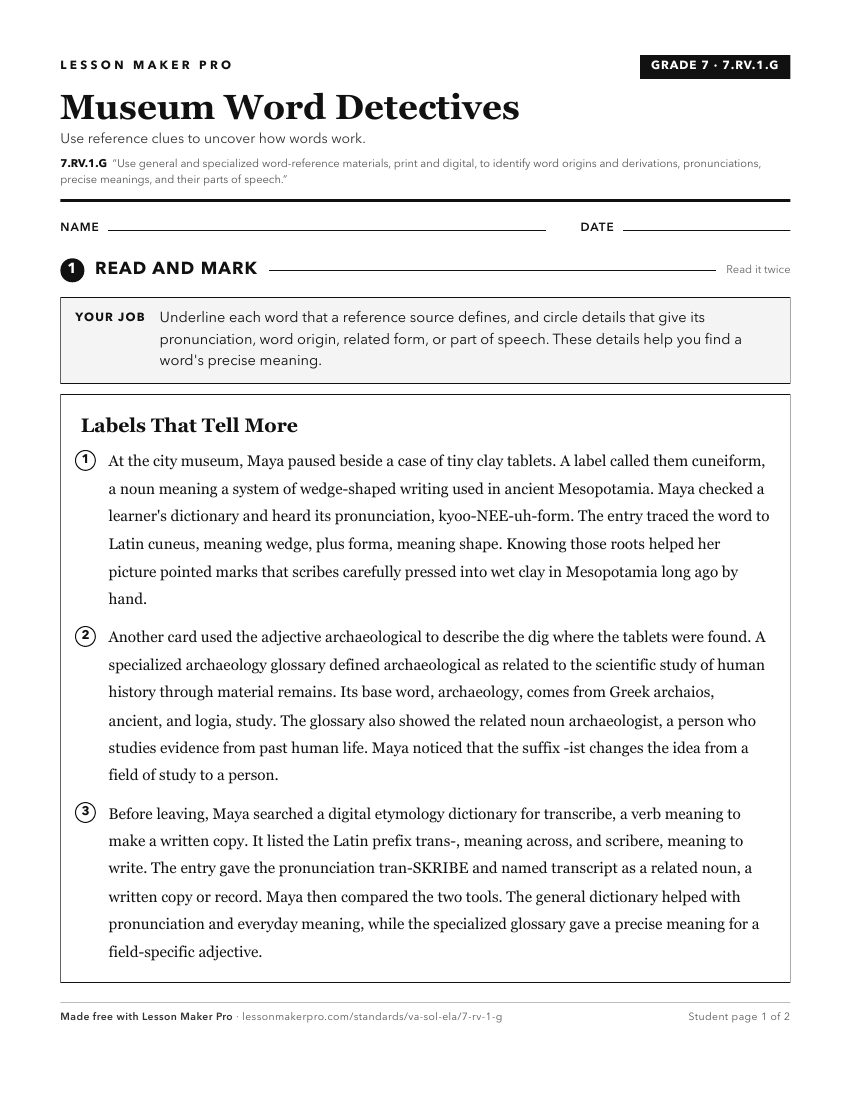
A ready-to-print activity worksheet aligned to 7.RV.1.G, with an answer key for the teacher on its own page. No account needed.
PDF, US Letter, prints cleanly in black and white.
Download the worksheetKeep exploring
Related Standards
- 6.RV.1.G
Use general and specialized word-reference materials, print and digital, to identify word origins, derivations, and pronunciations.
- 5.RV.1.J
Use glossaries, beginning dictionaries, and thesauruses, both print and digital, to determine or clarify the meaning of words and phrases.
- 3.RV.1.I
Use glossaries, beginning dictionaries and thesauruses, both print and digital, to determine or clarify the meaning of words and phrases.
- 8.RV.1.G
Use general and specialized word-reference materials, print and digital, to determine pronunciation, etymology, derivations, and parts of speech.
Turn this exact standard into a lesson
Grade, subject, topic, and the complete standard are prefilled. Create one free, no account needed.
Also for this standard:Make a WorksheetMake a QuizMake a Sub Lesson