Virginia SOL 6.W.1.D
The Standard
Write reflectively in response to text(s) read to demonstrate thinking with details, examples, and other evidence from the text(s).
Virginia Standards of Learning for English
Teacher's field guide
What This Standard Means
What Students Need to Do
- Students explain how a reading shaped, challenged, or confirmed their thinking. They support that reflection with relevant details, examples, or quotations from the text.
What Mastery Looks Like
- Students state a clear thought, reaction, or change in perspective. They choose relevant details or quotations and explain how that evidence shaped their thinking.
Common Misconceptions
- Students may summarize the reading instead of explaining their own thinking. They may give a personal reaction without evidence, or insert a quotation without explaining how it supports the reflection.
How to Assess It
- Ask: “What idea from today’s reading changed or strengthened your thinking?” Require four sentences, one text detail, and an explanation connecting the detail to the response.
Lesson moves
Ways to Teach It
Give students sticky notes to mark a surprising line in a printed text, then explain how that line affected their thinking.
Discuss, then write: Which character’s choice made you rethink fairness, and what two details led you to that view?
Play Evidence Match: groups pair reflection claims with quotation cards, then explain why each quotation supports the claim.
Read two short product reviews, then write which review changed your buying decision and cite the detail that mattered.
Free download
Printable 6.W.1.D Worksheet
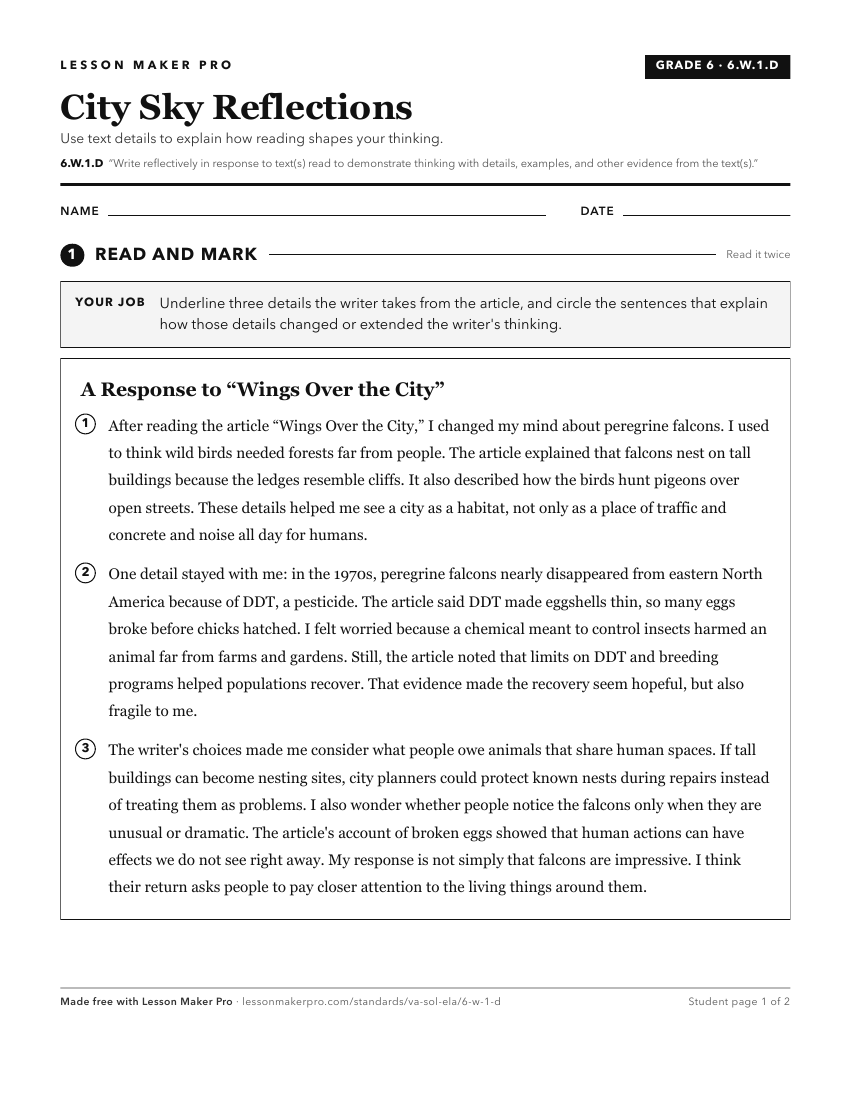
A ready-to-print activity worksheet aligned to 6.W.1.D, with an answer key for the teacher on its own page. No account needed.
PDF, US Letter, prints cleanly in black and white.
Download the worksheetKeep exploring
Related Standards
- 7.W.1.D
Write reflectively in response to reading to demonstrate thinking with details, examples, and other evidence from the text(s).
- 8.W.1.D
Write reflectively in response to reading to demonstrate thinking with details, examples, and other evidence from the text(s).
- 9.W.1.B
Write reflectively in response to readings in which students compare two or more texts with details, examples, and other textual evidence to support an idea or ...
- 10.W.1.C
Write reflectively in response to readings in which students compare two or more texts with details, examples, and other textual evidence to support an idea or ...
Turn this exact standard into a lesson
Grade, subject, topic, and the complete standard are prefilled. Create one free, no account needed.
Also for this standard:Make a WorksheetMake a QuizMake a Sub Lesson