Virginia SOL 6.RI.2.C
The Standard
Explain how an author establishes and conveys a perspective or purpose in an informational text.
Virginia Standards of Learning for English · Craft and Style
Teacher's field guide
What This Standard Means
What Students Need to Do
- Students identify what an author wants readers to think, feel, understand, or do. They explain how word choice, tone, evidence, and structure communicate that goal or viewpoint.
What Mastery Looks Like
- A student states a precise purpose or viewpoint, not just the topic. The student cites relevant words, selected details, or structural choices and explains how they shape the reader’s response.
Common Misconceptions
- Students may confuse the topic with the author’s purpose or assume that factual writing is always neutral. They often name a tone but do not connect it to specific words, details, or text structure.
How to Assess It
- Exit ticket: Give students one paragraph from an article. Ask, “What does the author want readers to think or do, and which two choices reveal that goal?”
Lesson moves
Ways to Teach It
Give pairs a printed article and three highlighters to mark loaded words, selected facts, and lines that reveal the author’s goal.
Ask students to write: What does the author want readers to think or do, and which two choices create that effect?
Play Purpose Detective: teams match anonymous passages to purpose cards, then earn points by citing one word or detail as proof.
Compare two news reports about the same school event and discuss how headlines, images, and chosen details shape each version.
Free download
Printable 6.RI.2.C Worksheet
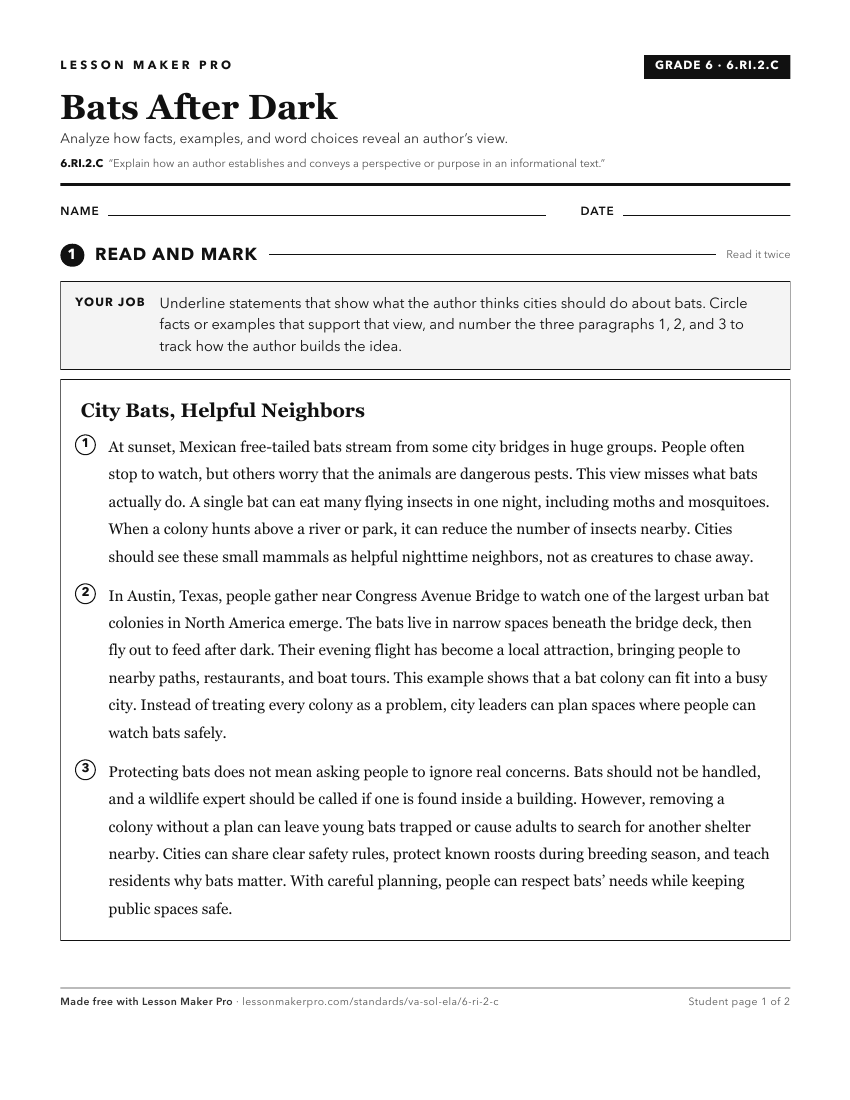
A ready-to-print activity worksheet aligned to 6.RI.2.C, with an answer key for the teacher on its own page. No account needed.
PDF, US Letter, prints cleanly in black and white.
Download the worksheetKeep exploring
Related Standards
- 5.RI.2.C
Determine the author’s purpose(s) and describe how the author’s perspective (e.g., beliefs, assumptions, biases) influences the meaning of the text.
- 8.RI.2.C
Analyze how an author establishes and conveys a perspective or purpose in a text and acknowledges and responds to conflicting evidence or viewpoints.
- 7.RI.2.C
Analyze how an author’s purpose(s) reflects the author’s perspective (e.g., beliefs, assumptions, biases) and influences the meaning of an informational text.
- 6.RI.2.B
Explain how an author’s word choice, organizational pattern, and language structure convey the author’s purpose.
Turn this exact standard into a lesson
Grade, subject, topic, and the complete standard are prefilled. Create one free, no account needed.
Also for this standard:Make a WorksheetMake a QuizMake a Sub Lesson