Virginia SOL 2.LU.1.D
The Standard
Use frequently occurring conjunctions to signal simple relationships (e.g., and, but, or, so, because).
Virginia Standards of Learning for English · Grammar
Teacher's field guide
What This Standard Means
What Students Need to Do
- Students connect two ideas with a word that shows how the ideas relate. They choose a conjunction to show addition, contrast, choice, result, or reason.
What Mastery Looks Like
- Students combine two complete ideas with a conjunction that matches the meaning. They can choose words such as “but,” “so,” or “because” to show contrast, result, or reason.
Common Misconceptions
- Students may use “and” for every connection, even when ideas contrast or show a reason. They may confuse “because” with “so” or write incomplete thoughts after a conjunction.
How to Assess It
- Give students two sentences: “Mia wore boots. It was raining.” Ask them to combine the ideas using one conjunction and explain their choice.
Lesson moves
Ways to Teach It
Give pairs sentence strips and conjunction cards, then have them build and read five joined sentences that make sense.
Ask students to complete and explain: “I wanted to play outside, but…” and “I stayed inside because…”
Play Conjunction Match by having students pair two idea cards with the best card labeled and, but, or, so, or because.
Read classroom signs or lunch choices, then rewrite two examples using “or” for choices and “because” for reasons.
Free download
Printable 2.LU.1.D Worksheet
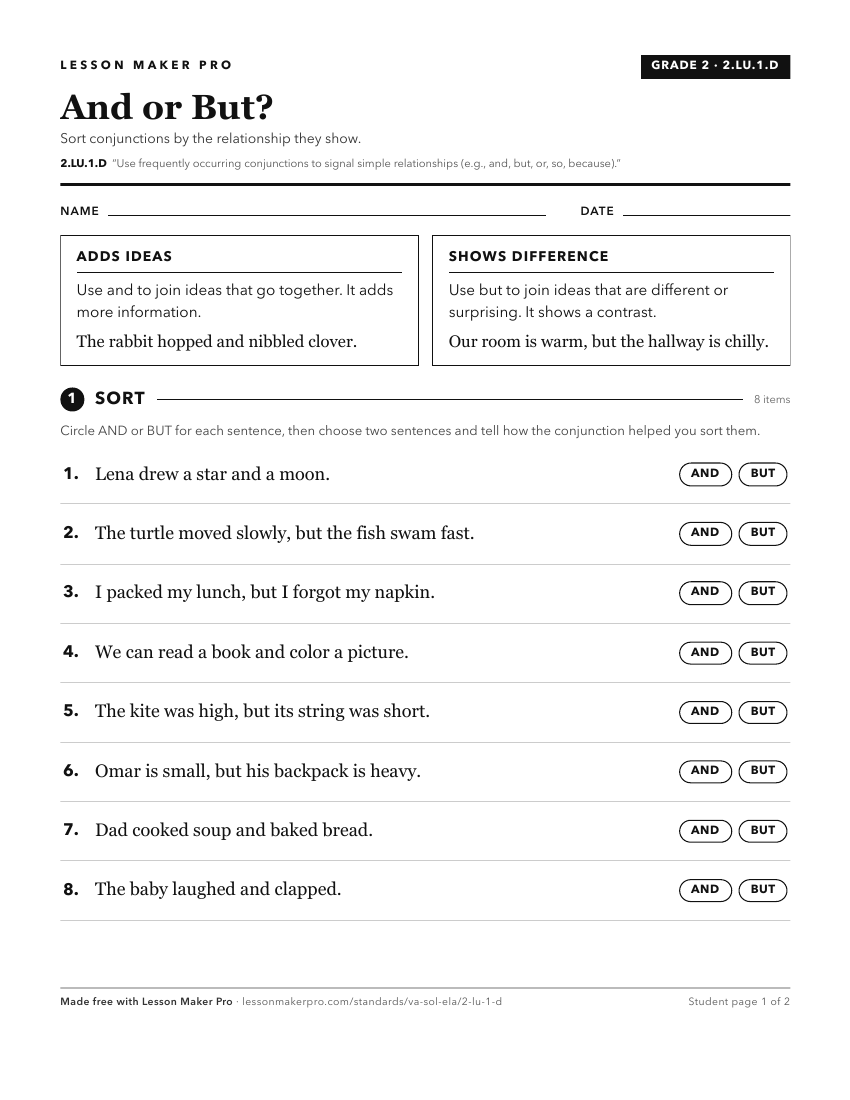
A ready-to-print activity worksheet aligned to 2.LU.1.D, with an answer key for the teacher on its own page. No account needed.
PDF, US Letter, prints cleanly in black and white.
Download the worksheetKeep exploring
Related Standards
- 4.LU.1.B
Use coordinating (e.g., and, but), subordinating (e.g., although, because) conjunctions to join words and phrases in a sentence.
- 5.LU.1.C
Use interjections, prepositional phrases, and coordinating and subordinating conjunctions in writing to join words and phrases in a sentence.
- 9.LU.2.A
Use commas and semicolons to distinguish and divide main and subordinate clauses to link two or more closely related independent clauses when writing.
- 10.LU.1.D
Use subordination, coordination, apposition, and other devices to indicate the relationship between ideas clearly.
Turn this exact standard into a lesson
Grade, subject, topic, and the complete standard are prefilled. Create one free, no account needed.
Also for this standard:Make a WorksheetMake a QuizMake a Sub Lesson