Virginia SOL 2.FFR.3.D
The Standard
Use knowledge of affixes (e.g., suffixes, prefixes) to decode words.
Virginia Standards of Learning for English · Phonics and Word Analysis: The student will apply phonetic principles to read and spell words.
Teacher's field guide
What This Standard Means
What Students Need to Do
- Students spot a familiar base word inside a longer word and separate any beginning or ending word part. They use those parts to pronounce the whole word and check that it makes sense in the sentence.
What Mastery Looks Like
- A student can read words such as unhappy, replay, helpful, and slowly by naming the base word and attached part. The student blends the parts smoothly and self-corrects when the result does not fit the sentence.
Common Misconceptions
- Students may treat the whole word as unfamiliar instead of finding the base word. They may confuse a prefix with the first syllable or read endings such as ed and s only one way. Some remove letters that belong to the base word, such as taking er from her.
How to Assess It
- Give students this sentence: “The player replayed the game.” Ask them to circle each base word, box attached parts, then read the sentence aloud.
Lesson moves
Ways to Teach It
Give pairs base-word cards and prefix and suffix tiles; students build six words, split each into parts, and read each word aloud.
Write, “How does adding un to happy change what you read and what the word means?” and have students explain with a partner.
Play Affix Match: students draw a base card and an affix card, keep real words, and read each winning combination.
Hunt through classroom labels, book covers, and a lunch menu for longer words, then underline the base and circle attached parts.
Free download
Printable 2.FFR.3.D Worksheet
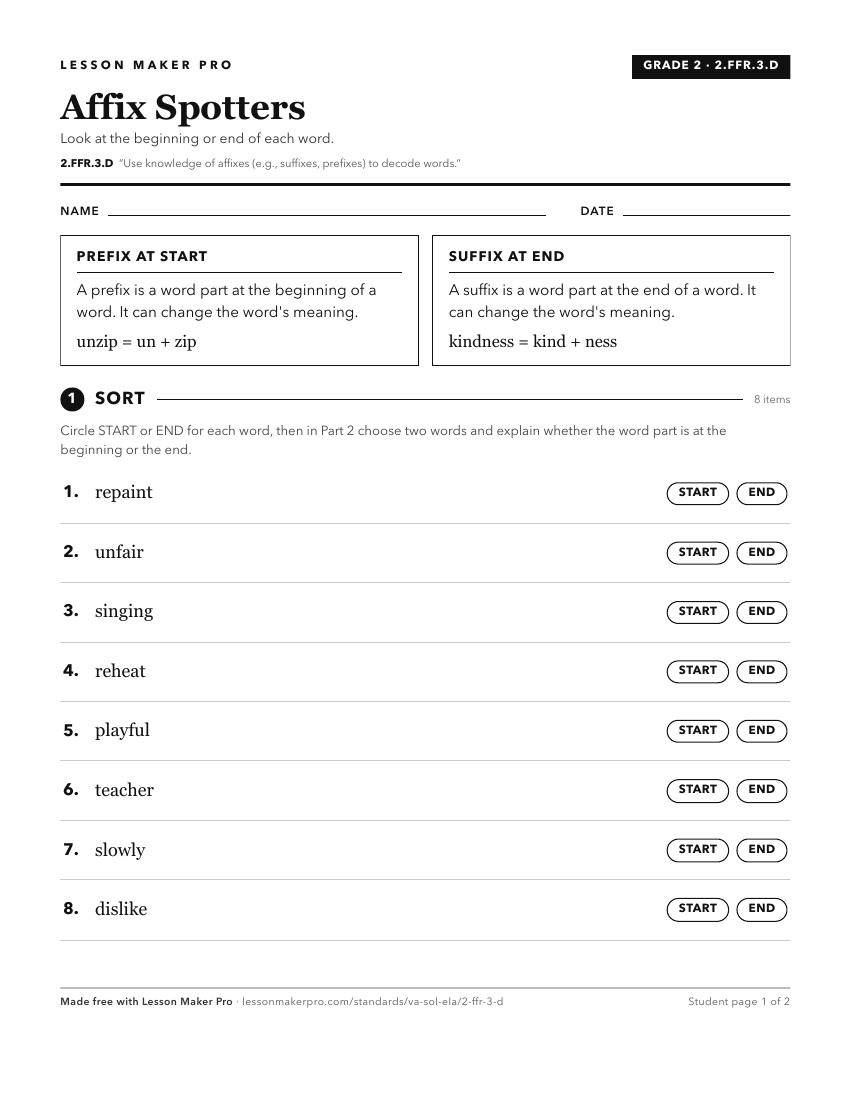
A ready-to-print activity worksheet aligned to 2.FFR.3.D, with an answer key for the teacher on its own page. No account needed.
PDF, US Letter, prints cleanly in black and white.
Download the worksheetKeep exploring
Related Standards
- 3.FFR.3.C
Use knowledge of affixes (e.g., suffixes, prefixes) to decode and encode words.
- 4.FFR.3.B
Use knowledge of morphology (suffixes, prefixes, root/base) to decode words.
- 2.FFR.3.C
Use knowledge of syllabication and syllable types to decode words.
- 5.FFR.3.B
Use knowledge of morphology (suffixes, prefixes, root/base) to decode words.
Turn this exact standard into a lesson
Grade, subject, topic, and the complete standard are prefilled. Create one free, no account needed.
Also for this standard:Make a WorksheetMake a QuizMake a Sub Lesson