TEKS Math 1.4.B
The Standard
write a number with the cent symbol to describe the value of a coin
Texas Essential Knowledge and Skills for Mathematics
Teacher's field guide
What This Standard Means
What Students Need to Do
- Students recognize the value of a penny, nickel, dime, or quarter. They record the value as 1¢, 5¢, 10¢, or 25¢, with the symbol after the number.
What Mastery Looks Like
- Given either side of a penny, nickel, dime, or quarter, students write its value correctly. They place the ¢ symbol after the number without adding a dollar sign.
Common Misconceptions
- Students may think a larger coin always has a greater value, so they value a nickel above a dime. They may write ¢ before the number, use $, or write 0.5¢ for a nickel.
How to Assess It
- Show a penny, nickel, dime, and quarter in mixed order. Have students write each value using a number and the ¢ symbol.
Lesson moves
Ways to Teach It
Give pairs real or plastic coins to sort onto cards labeled 1¢, 5¢, 10¢, and 25¢.
Show a dime and a nickel, then ask students to write which is worth more and explain how they know.
Play coin-value memory by matching coin picture cards with value cards labeled 1¢, 5¢, 10¢, and 25¢.
Set up a class store where each item costs one coin, and students label each price with the correct cent amount.
Free download
Printable 1.4.B Worksheet
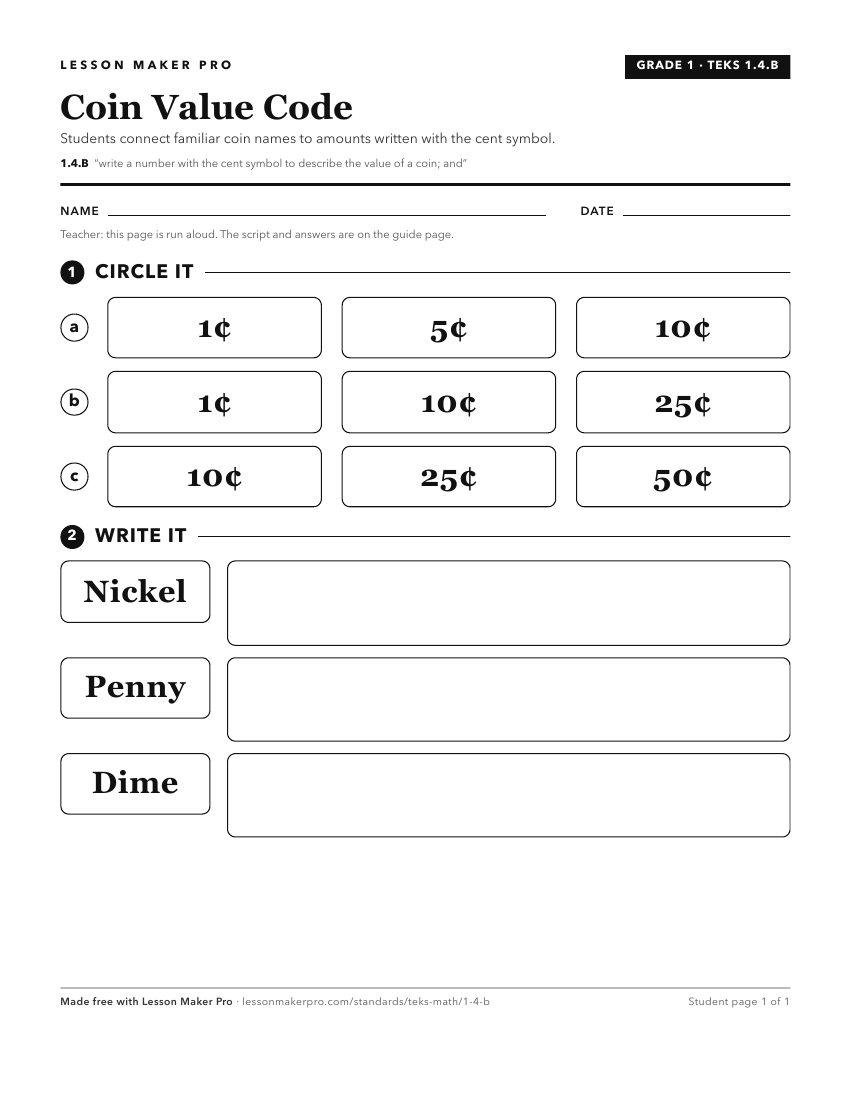
A ready-to-print activity worksheet aligned to 1.4.B, with an answer key for the teacher on its own page. No account needed.
PDF, US Letter, prints cleanly in black and white.
Download the worksheetKeep exploring
Related Standards
- 4.2.B
represent the value of the digit in whole numbers through 1,000,000,000 and decimals to the hundredths using expanded notation and numerals
- 2.5.B
use the cent symbol, dollar sign, and the decimal point to name the value of a collection of coins.
- 5.2.A
represent the value of the digit in decimals through the thousandths using expanded notation and numerals
- 3.4.C
determine the value of a collection of coins and bills
Turn this exact standard into a lesson
Grade, subject, topic, and the complete standard are prefilled. Create one free, no account needed.
Also for this standard:Make a WorksheetMake a QuizMake a Sub Lesson