TEKS ELAR K.10.C
The Standard
revise drafts by adding details in pictures or words
Texas Essential Knowledge and Skills for English Language Arts and Reading
Teacher's field guide
What This Standard Means
What Students Need to Do
- Students reread a draft and notice where a reader may need more information. They add to the drawing or words to make the people, place, action, or message clearer.
What Mastery Looks Like
- A student can return to a draft and add a relevant person, place, action, object, or describing word. The student can explain how the new detail helps the reader.
Common Misconceptions
- Students may think revising means fixing spelling, erasing everything, or making a clean copy. They may add decorative pictures or words that do not help the reader understand the message.
How to Assess It
- Give students a recent draft and say, “Add one picture detail or word that helps your reader learn more.” Ask each student to explain the addition.
Lesson moves
Ways to Teach It
Have students place a sticky note on a draft, then draw or write one new detail that makes the message clearer.
Show a simple draft and ask, “What could the writer add so we know more about who, where, or what happened?”
Play Detail Detective by reading short drafts aloud and having students choose a helpful detail card to add to each one.
Create classroom signs, then revise each sign with a picture or extra word that helps visitors understand what to do.
Free download
Printable K.10.C Worksheet
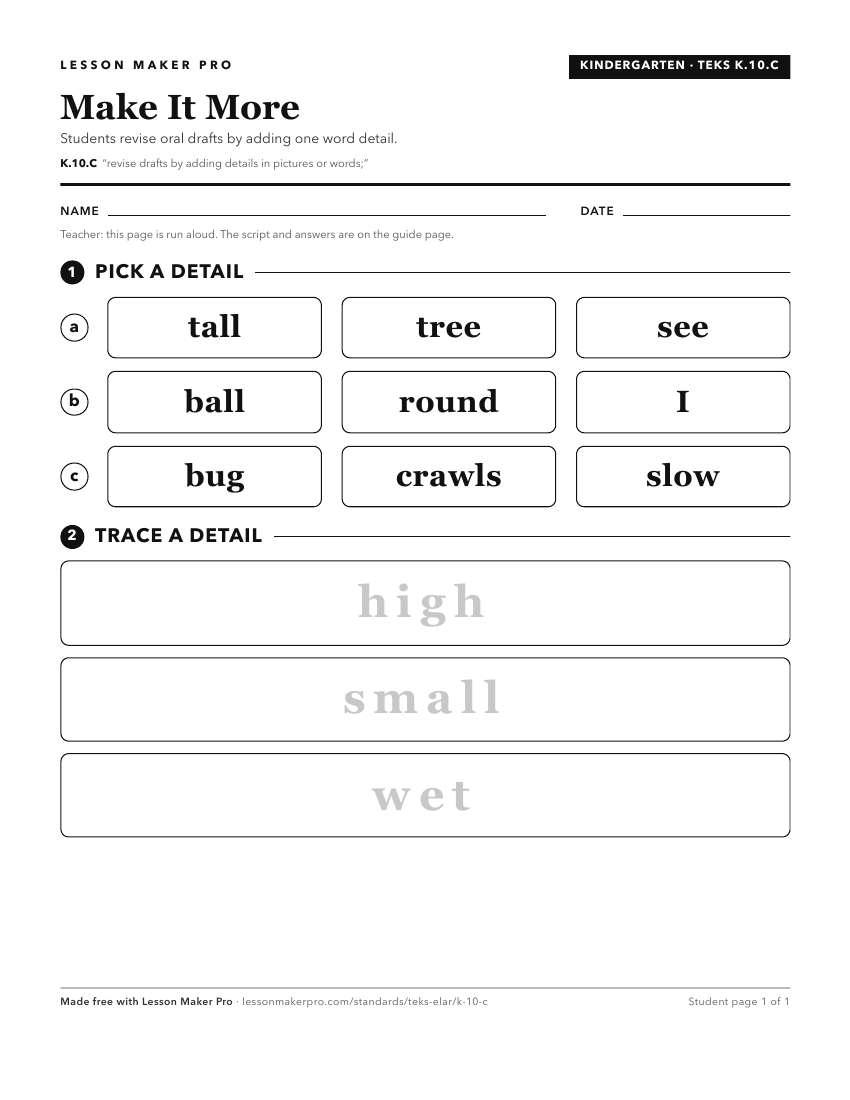
A ready-to-print activity worksheet aligned to K.10.C, with an answer key for the teacher on its own page. No account needed.
PDF, US Letter, prints cleanly in black and white.
Download the worksheetKeep exploring
Related Standards
- 1.11.C
The 1st Grade version of this standard.
- 5.11.C
revise drafts to improve sentence structure and word choice by adding, deleting, combining, and rearranging ideas for coherence and clarity;
- 4.11.C
revise drafts to improve sentence structure and word choice by adding, deleting, combining, and rearranging ideas for coherence and clarity;
- 3.11.C
revise drafts to improve sentence structure and word choice by adding, deleting, combining, and rearranging ideas for coherence and clarity;
Turn this exact standard into a lesson
Grade, subject, topic, and the complete standard are prefilled. Create one free, no account needed.
Also for this standard:Make a WorksheetMake a QuizMake a Sub Lesson