TEKS ELAR 8.8.E.iii
The Standard
identifying the intended audience or reader
Texas Essential Knowledge and Skills for English Language Arts and Reading · The student recognizes and analyzes genre-specific characteristics, structures, and purposes within and across increasingly complex traditional, contemporary, classical, and diverse texts.
Teacher's field guide
What This Standard Means
What Students Need to Do
- Students determine which group a writer hopes to persuade. They use clues such as word choice, examples, evidence, tone, and assumed knowledge to explain their choice.
What Mastery Looks Like
- Students name a specific target group, such as parents, voters, or middle school athletes. They support the choice with details from the writer’s language, evidence, tone, or appeals.
Common Misconceptions
- Students may name everyone who could read the text instead of the group the writer aims to persuade. They may rely only on the topic and ignore tone, evidence, vocabulary, and assumed knowledge.
How to Assess It
- Give students a short argumentative paragraph and ask, “Who is the target reader? Cite two clues from the text that support your answer.”
Lesson moves
Ways to Teach It
Give groups printed ads, editorials, and campaign flyers to sort by target reader, then highlight the clues that guided each choice.
Compare two arguments about school uniforms and write how each writer changes tone and evidence for students, parents, or administrators.
Play Audience Detective by reading short arguments aloud while teams identify the target reader and earn points for citing a matching clue.
Examine a local public service message and discuss how its language, images, and placement aim to persuade a particular community group.
Free download
Printable 8.8.E.iii Worksheet
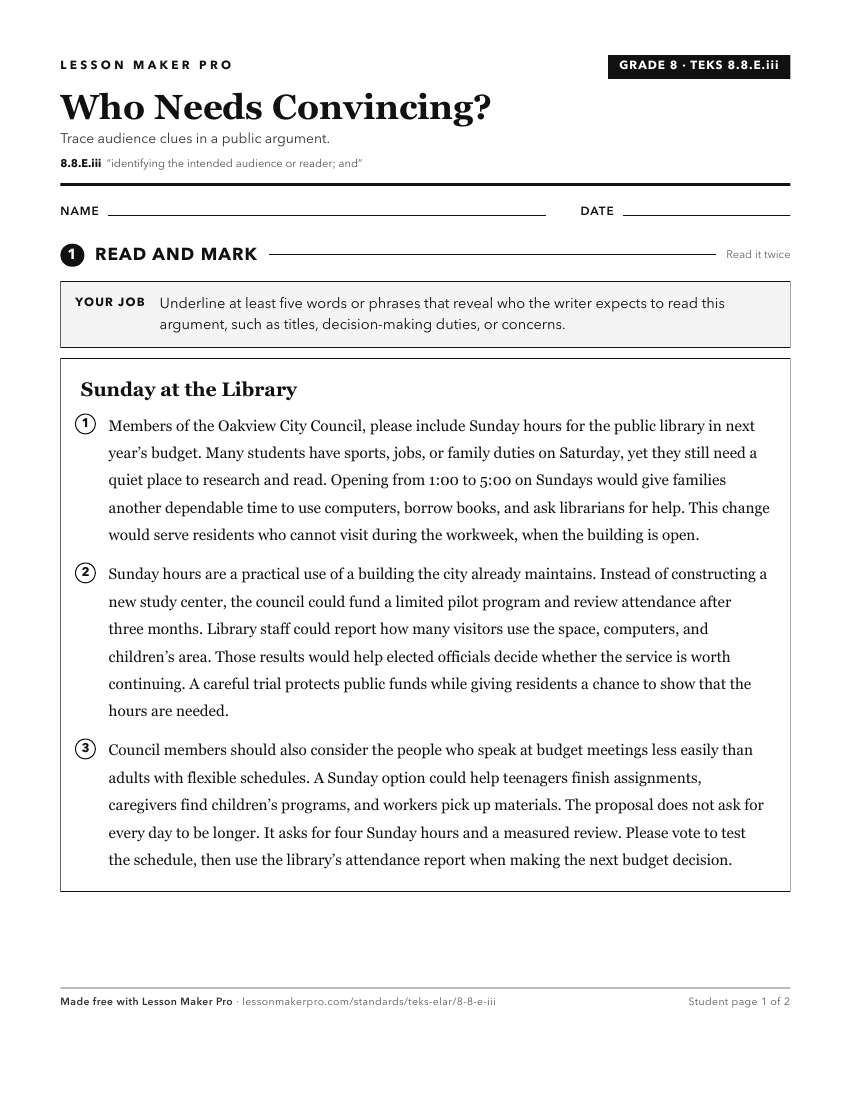
A ready-to-print activity worksheet aligned to 8.8.E.iii, with an answer key for the teacher on its own page. No account needed.
PDF, US Letter, prints cleanly in black and white.
Download the worksheetKeep exploring
Related Standards
Turn this exact standard into a lesson
Grade, subject, topic, and the complete standard are prefilled. Create one free, no account needed.
Also for this standard:Make a WorksheetMake a QuizMake a Sub Lesson