TEKS ELAR 8.8.D.ii
The Standard
features such as footnotes, endnotes, and citations
Texas Essential Knowledge and Skills for English Language Arts and Reading · The student recognizes and analyzes genre-specific characteristics, structures, and purposes within and across increasingly complex traditional, contemporary, classical, and diverse texts.
Teacher's field guide
What This Standard Means
What Students Need to Do
- Students locate notes and citations in informational texts and explain what information each one adds. They connect claims to sources and consider whether readers can verify the evidence.
What Mastery Looks Like
- Students can explain why an author included a note or citation in a specific passage. They can trace a claim to its listed source and comment on whether that source supports the claim.
Common Misconceptions
- Students may confuse footnotes with endnotes or skip both as unimportant. They may think every citation proves a claim is reliable, even when the cited source is weak or unrelated.
How to Assess It
- Give students a short paragraph with one footnote and one citation. Ask them to explain what each feature adds and how a reader could check the source.
Lesson moves
Ways to Teach It
Give pairs a printed article, sticky notes, and source cards to match each claim with its footnote, endnote, or citation.
Ask students to write: How does this note change or deepen your understanding of the paragraph?
Play Citation Detective by having teams race to find the author, title, date, and source connected to selected claims.
Compare citations in a news article and a social media post, then decide which claims are easier to verify and why.
Free download
Printable 8.8.D.ii Worksheet
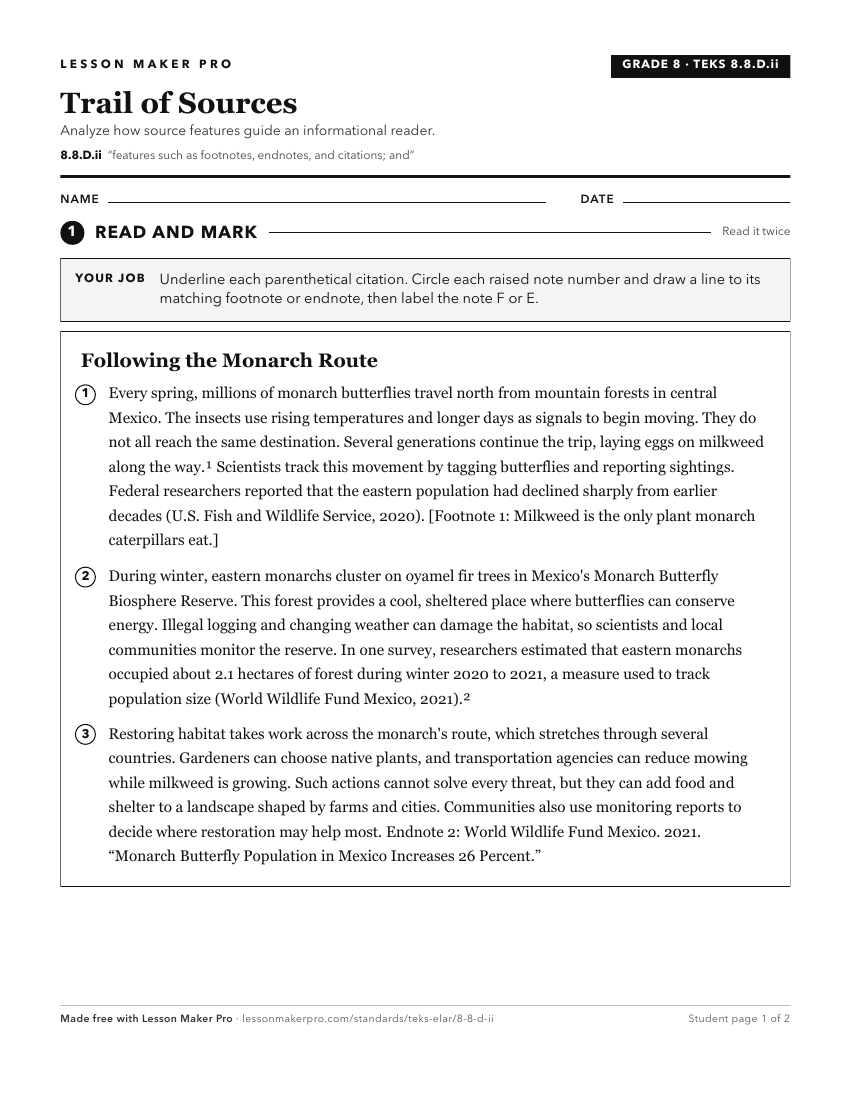
A ready-to-print activity worksheet aligned to 8.8.D.ii, with an answer key for the teacher on its own page. No account needed.
PDF, US Letter, prints cleanly in black and white.
Download the worksheetKeep exploring
Related Standards
- 5.11.D.x
punctuation marks, including commas in compound and complex sentences, quotation marks in dialogue, and italics and underlining for titles and emphasis; and
- 5.9.D.ii
features such as insets, timelines, and sidebars to support understanding; and
- 6.8.D.ii
features such as introduction, foreword, preface, references, or acknowledgements to gain background information; and
- 3.9.D.ii
features such as sections, tables, graphs, timelines, bullets, numbers, and bold and italicized font to support understanding; and
Turn this exact standard into a lesson
Grade, subject, topic, and the complete standard are prefilled. Create one free, no account needed.
Also for this standard:Make a WorksheetMake a QuizMake a Sub Lesson