TEKS ELAR 3.7.D
The Standard
retell and paraphrase texts in ways that maintain meaning and logical order
Texas Essential Knowledge and Skills for English Language Arts and Reading
Teacher's field guide
What This Standard Means
What Students Need to Do
- Students recount key events or ideas from something they read, hear, or view. They use their own words while keeping the meaning and sequence accurate.
What Mastery Looks Like
- Students retell the key events or ideas in the correct sequence. They paraphrase with their own words without changing the author’s meaning or adding unrelated details.
Common Misconceptions
- Students may copy sentences instead of using their own words. They may leave out key events, add opinions, or tell events out of order.
How to Assess It
- Give students a short paragraph to read. Ask them to write the main events in order using different words while keeping the original meaning.
Lesson moves
Ways to Teach It
Give pairs four event cards from a familiar story to sequence, then have them orally retell the story in their own words.
Read a short passage aloud, then ask students to write: What happened first, next, and last, using your own words?
Play Paraphrase Match by having students pair original sentences with meaning-matched sentences written in different words.
Use simple school announcements and ask students to explain each message to a classmate without repeating the exact wording.
Free download
Printable 3.7.D Worksheet
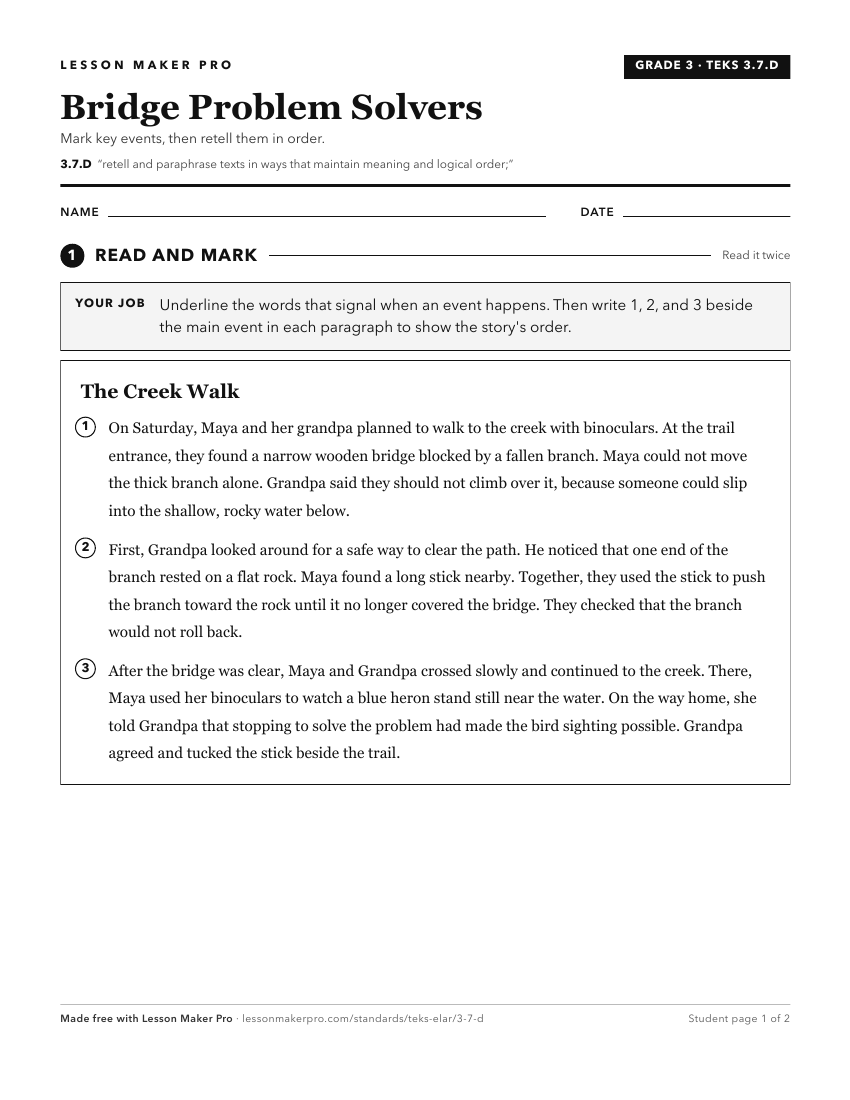
A ready-to-print activity worksheet aligned to 3.7.D, with an answer key for the teacher on its own page. No account needed.
PDF, US Letter, prints cleanly in black and white.
Download the worksheetKeep exploring
Related Standards
- 5.7.D
retell, paraphrase, or summarize texts in ways that maintain meaning and logical order;
- 4.7.D
retell, paraphrase, or summarize texts in ways that maintain meaning and logical order;
- 8.6.D
paraphrase and summarize texts in ways that maintain meaning and logical order;
- 2.7.D
The 2nd Grade version of this standard.
Turn this exact standard into a lesson
Grade, subject, topic, and the complete standard are prefilled. Create one free, no account needed.
Also for this standard:Make a WorksheetMake a QuizMake a Sub Lesson