TEKS ELAR 3.6.E
The Standard
make connections to personal experiences, ideas in other texts, and society
Texas Essential Knowledge and Skills for English Language Arts and Reading
Teacher's field guide
What This Standard Means
What Students Need to Do
- Students link details from a text to their own lives, another text, or events and issues beyond school. They explain how each link helps them understand the text better.
What Mastery Looks Like
- A student names a clear connection and points to the text detail that prompted it. The student explains how the link clarifies a character, event, idea, or lesson.
Common Misconceptions
- Students may retell the text instead of naming a connection. They may give a vague link, such as “I have a dog too,” without explaining how it helps them understand. Some name a connection that is not supported by any text detail.
How to Assess It
- Give students a short passage and three boxes labeled my life, another text, and my community. Ask them to complete two boxes with a connection, a supporting detail, and how the connection helped them understand.
Lesson moves
Ways to Teach It
Give pairs two familiar picture books and yarn, then have them link matching characters, problems, or lessons with labeled sticky notes.
After reading, ask, “What does this remind you of, and how does that connection help you understand the character or event?”
Play Connection Sort: students place response cards under self, another text, or community, then defend one choice with passage evidence.
Read a short article about a local park, then connect its problem to students’ experiences and another story about shared spaces.
Free download
Printable 3.6.E Worksheet
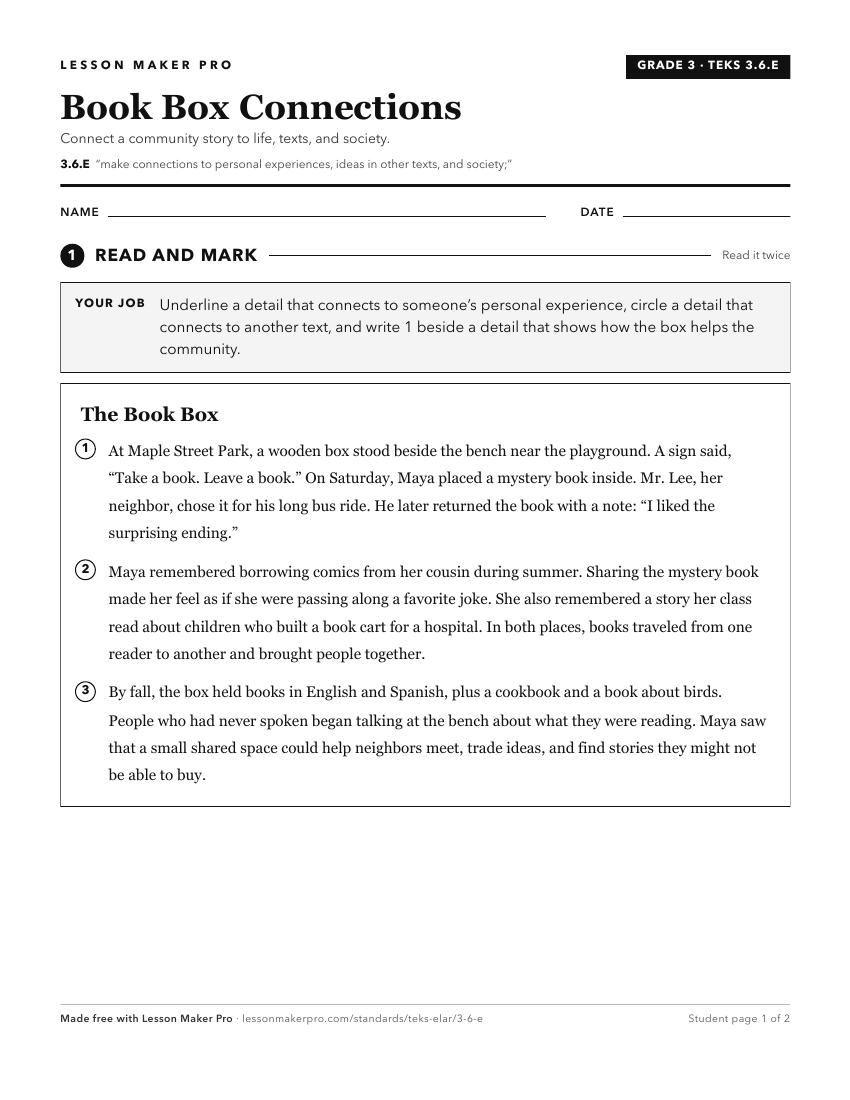
A ready-to-print activity worksheet aligned to 3.6.E, with an answer key for the teacher on its own page. No account needed.
PDF, US Letter, prints cleanly in black and white.
Download the worksheetKeep exploring
Related Standards
Turn this exact standard into a lesson
Grade, subject, topic, and the complete standard are prefilled. Create one free, no account needed.
Also for this standard:Make a WorksheetMake a QuizMake a Sub Lesson