TEKS ELAR 3.4
The Standard
The student reads grade-level text with fluency and comprehension. The student is expected to use appropriate fluency rate, accuracy, and prosody when reading grade-level text.
Texas Essential Knowledge and Skills for English Language Arts and Reading
Teacher's field guide
What This Standard Means
What Students Need to Do
- Students read third-grade text aloud with accurate words, a natural pace, and expression that matches the meaning. They group words into phrases, follow punctuation, and show they understand what they read.
What Mastery Looks Like
- A student reads an unfamiliar third-grade passage accurately, at a steady pace, and in meaningful phrases. The student uses punctuation and expression, then explains the main idea and key details.
Common Misconceptions
- Students may think fluent reading means reading as fast as possible. They may ignore punctuation, read word by word, or use expression without checking accuracy and meaning.
How to Assess It
- Give each student a 100-word passage to read aloud for one minute, then ask, “What happened, and what detail proves it?” Note accuracy, pace, phrasing, expression, and understanding.
Lesson moves
Ways to Teach It
Give pairs a short passage, highlighters, and pencils to mark pauses, underline stressed words, and rehearse an expressive reading.
Ask, “How does punctuation change the way this sentence sounds?” Students read two versions and write which one is clearer.
Play Fluency Replay: students read the same paragraph three times, tracking fewer errors and smoother phrasing on a simple scorecard.
Students rehearse and record a school announcement, then listen for clear words, steady pace, useful pauses, and natural expression.
Free download
Printable 3.4 Worksheet
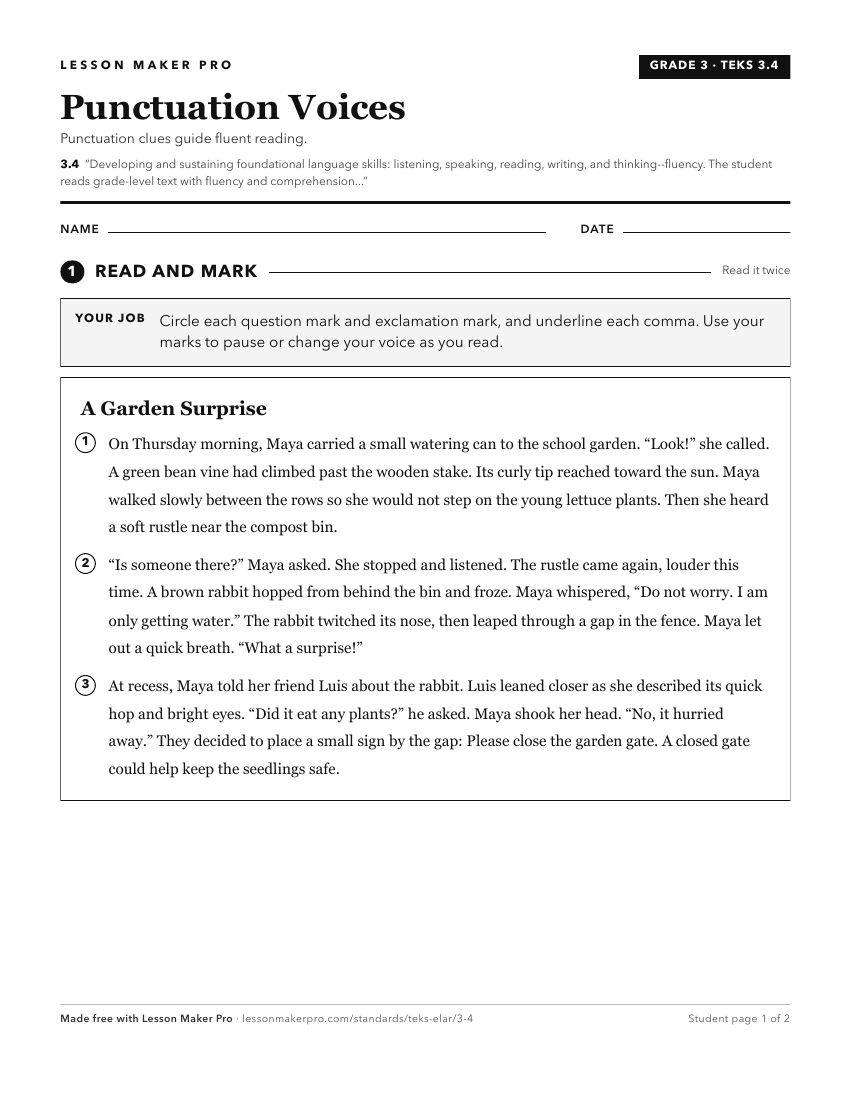
A ready-to-print activity worksheet aligned to 3.4, with an answer key for the teacher on its own page. No account needed.
PDF, US Letter, prints cleanly in black and white.
Download the worksheetKeep exploring
Related Standards
Turn this exact standard into a lesson
Grade, subject, topic, and the complete standard are prefilled. Create one free, no account needed.
Also for this standard:Make a WorksheetMake a QuizMake a Sub Lesson