TEKS ELAR 2.6.G
The Standard
evaluate details read to determine key ideas
Texas Essential Knowledge and Skills for English Language Arts and Reading
Teacher's field guide
What This Standard Means
What Students Need to Do
- Students decide which details carry the most meaning and which are less important. They use the strongest details to state what the text is mainly saying.
What Mastery Looks Like
- Given a short text, a student states the key idea in their own words and selects two strong supporting details. The student explains how each detail supports the idea and leaves out unrelated information.
Common Misconceptions
- Students may choose the first sentence or the most interesting fact as the key idea. They may name only the topic, retell every detail, or include details that do not support the main point.
How to Assess It
- Give students this passage: “Beavers cut branches with sharp teeth. They pile branches and mud across streams. Their dams create safe ponds.” Ask, “What is the key idea? Underline two details that support it.”
Lesson moves
Ways to Teach It
Give pairs sentence strips from a paragraph, then have them sort supporting and extra details under a key idea card.
After a read-aloud, ask, “Which detail best reveals the author’s main point, and why?”
Play Detail Detective by having teams draw detail cards and match each card to one of three posted key ideas.
Use a school notice and have students identify its main message and the details that tell families what to do.
Free download
Printable 2.6.G Worksheet
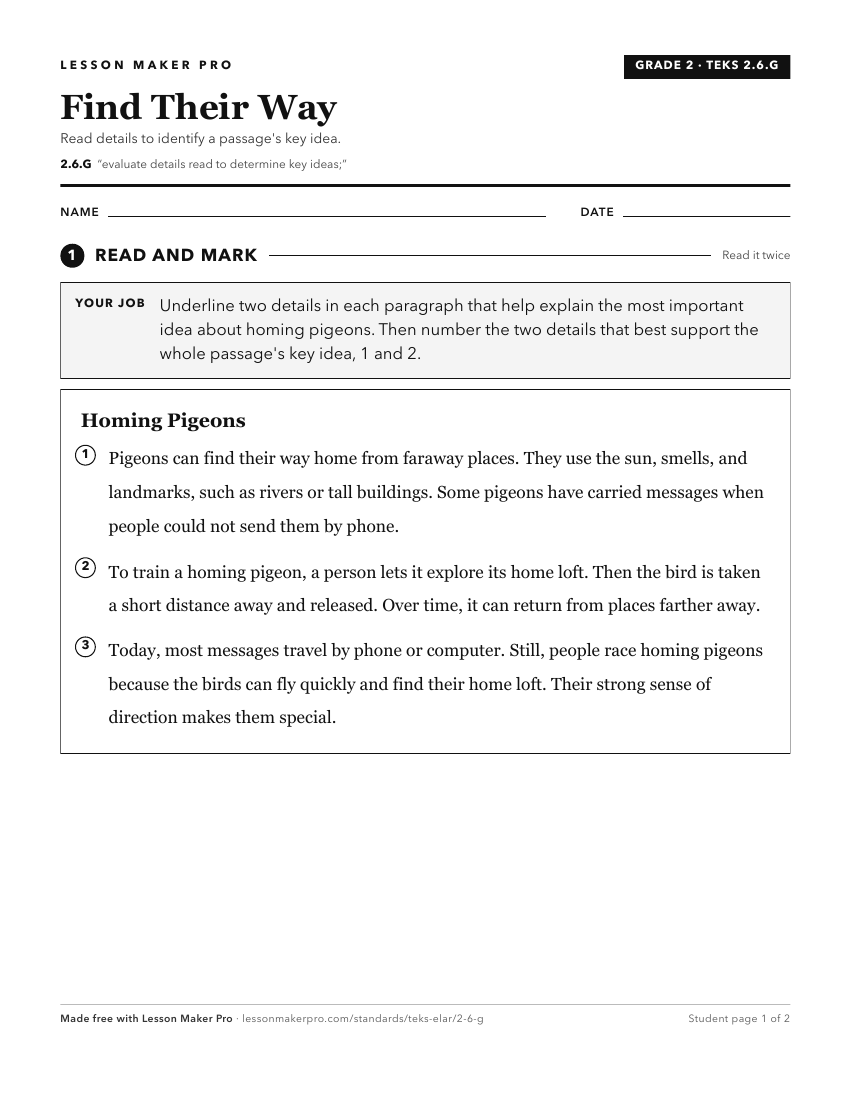
A ready-to-print activity worksheet aligned to 2.6.G, with an answer key for the teacher on its own page. No account needed.
PDF, US Letter, prints cleanly in black and white.
Download the worksheetKeep exploring
Related Standards
Turn this exact standard into a lesson
Grade, subject, topic, and the complete standard are prefilled. Create one free, no account needed.
Also for this standard:Make a WorksheetMake a QuizMake a Sub Lesson