South Dakota Science MS-PS2-1
The Standard
Design a solution to a problem involving the motion of two colliding objects that illustrates Newton’s Third Law. (SEP: 6; DCI: PS2.A, ETS1.B; CCC: Systems) Alignment may include MS-ETS1-1
South Dakota Science Standards (2024) · Motion and Stability: Forces and Interactions
Teacher's field guide
What This Standard Means
What Students Need to Do
- Students design a bumper for two colliding toy cars, then test whether it protects both cars. They explain how each car pushes on the other during the crash.
What Mastery Looks Like
- A student sets a test goal, such as keeping paper passengers on both cars, and improves a bumper after a trial. They show equal, opposite force arrows on the cars, even if one car changes speed more.
Common Misconceptions
- Students may think the heavier or faster car pushes harder, or that a stopped car does not push back. They may also think equal forces mean both cars change speed by the same amount.
How to Assess It
- Exit ticket: Two toy cars collide and both paper passengers fall off. Sketch an index-card bumper, describe one test, and draw the force arrows on both cars during contact.
Lesson moves
Ways to Teach It
Build folded index-card bumpers for two toy cars, then roll the cars together and check whether paper passengers stay on.
Ask: If a heavy car hits a light car, which pushes harder during contact? Have students explain their answer in two sentences.
Give pairs three collision sketches and force-arrow cards; have them match the cards and fix any unequal arrows.
Show a photo of two bumper cars colliding and ask students where they would add padding to reduce jolts to both riders.
Free download
Printable MS-PS2-1 Worksheet
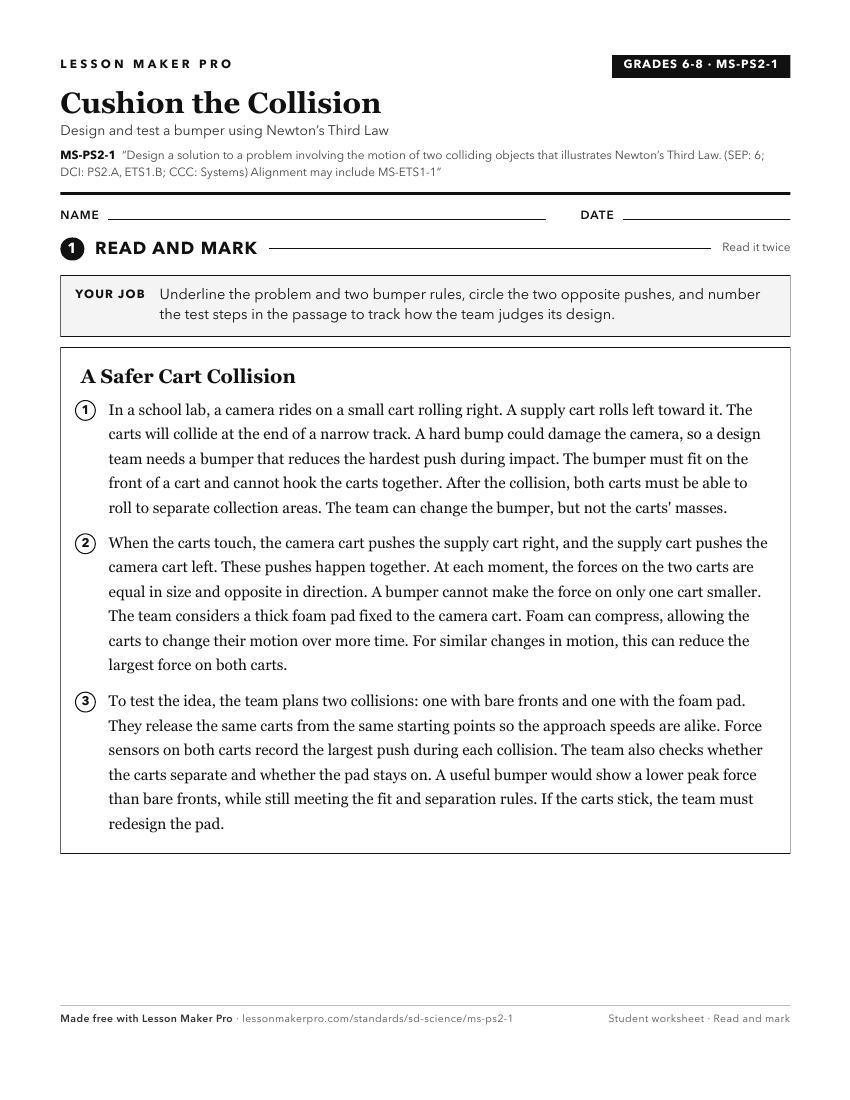
A ready-to-print activity worksheet aligned to MS-PS2-1, with an answer key for the teacher on its own page. No account needed.
PDF, US Letter, prints cleanly in black and white.
Download the worksheetKeep exploring
Related Standards
Turn this exact standard into a lesson
Grade, subject, topic, and the complete standard are prefilled. Create one free, no account needed.
Also for this standard:Make a WorksheetMake a QuizMake a Sub Lesson