South Dakota Science HS-PS1-5
The Standard
Construct an explanation based on evidence about the effects of changing the temperature or concentration of the reacting particles on the rate at which a reaction occurs. (SEP: 6; DCI: PS1.B; CCC: Patterns)
South Dakota Science Standards (2024) · Matter and Its Interactions
Teacher's field guide
What This Standard Means
What Students Need to Do
- Students compare how quickly a reaction happens when temperature or reactant concentration changes. They use measurements to explain the change in terms of particle collisions.
What Mastery Looks Like
- A student can identify the faster reaction from gas produced per minute. They use the numbers to explain that higher concentration causes more collisions, while higher temperature makes more collisions energetic enough to react.
Common Misconceptions
- Students may think a faster reaction always makes more product. Some think warming makes particles bigger, or that a concentrated solution contains particles that react faster on their own.
How to Assess It
- Exit ticket: Equal amounts of the same reactants produce 12 mL of gas in one minute at 20°C and 28 mL at 40°C. Which reacts faster, and how do the data and particle collisions explain it?
Lesson moves
Ways to Teach It
Place equal-sized eggshell pieces in equal volumes of full-strength and diluted vinegar; film the first 30 seconds and compare fizzing.
Show fizz times for equal tablets in cold and warm water; ask students to explain the difference using particle collisions.
Match cards labeled 20°C or 40°C and 1% or 5% acid; predict rates for pairs differing in only one condition.
Compare a cut apple kept in the fridge overnight with one left on the counter; explain the difference in browning.
Free download
Printable HS-PS1-5 Worksheet
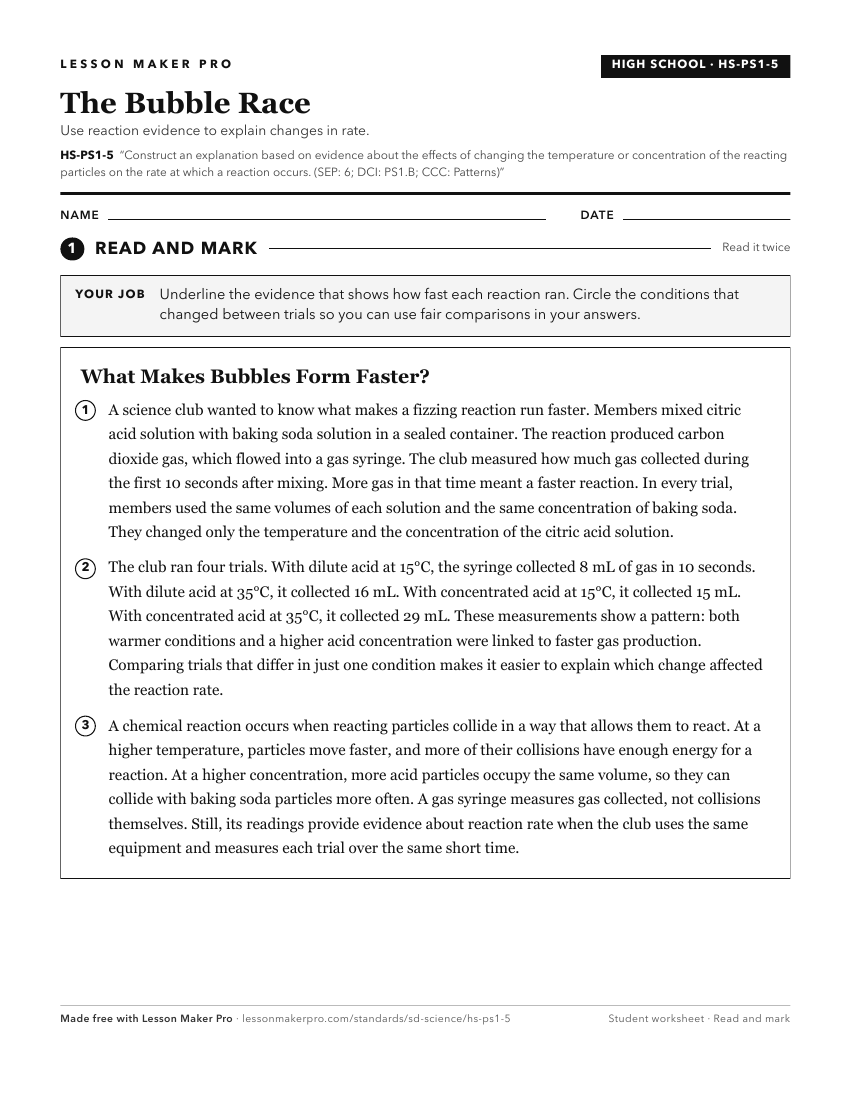
A ready-to-print activity worksheet aligned to HS-PS1-5, with an answer key for the teacher on its own page. No account needed.
PDF, US Letter, prints cleanly in black and white.
Download the worksheetTurn this exact standard into a lesson
Grade, subject, topic, and the complete standard are prefilled. Create one free, no account needed.
Also for this standard:Make a WorksheetMake a QuizMake a Sub Lesson