South Dakota Science HS-LS1-1
The Standard
Construct an evidence-based explanation for how the structure of DNA determines the structure of proteins which carry out the essential functions of life through systems of specialized cells, tissues, and organs. (SEP: 6; DCI: LS1.A; CCC: Structure/Function)
South Dakota Science Standards (2024) · From Molecules to Organisms: Structures and Processes
Teacher's field guide
What This Standard Means
What Students Need to Do
- Students use DNA base pairing to make mRNA, then use codons to build an amino acid chain. They explain how the chain folds into a protein that helps a specialized cell do its job in a tissue or organ. They use sequence data or a cell example as evidence.
What Mastery Looks Like
- Given a DNA sequence and a codon chart, a student can trace the steps from DNA to protein. They can explain how a changed amino acid might affect the protein's shape, a cell's work, and a tissue or organ.
Common Misconceptions
- Students may think DNA makes proteins directly, skipping mRNA and ribosomes. They may assume every DNA change alters a protein or that every cell makes the same proteins.
How to Assess It
- A DNA change makes a hemoglobin mRNA codon change from GAG (glutamate) to GUG (valine). In three sentences, explain how this might affect hemoglobin, red blood cells, and oxygen delivery.
Lesson moves
Ways to Teach It
Give pairs paper DNA template strips, RNA base cards, and a codon chart to build mRNA and an amino acid chain.
Ask students to write: How could one changed DNA base affect hemoglobin, red blood cell shape, and oxygen delivery to a muscle?
Run a codon relay: teams transcribe the DNA template TAC GGA CTT ATT, translate it with a codon chart, and check answers.
Show photos of normal and sickle-shaped red blood cells, then ask students why altered hemoglobin can make oxygen delivery harder during exercise.
Free download
Printable HS-LS1-1 Worksheet
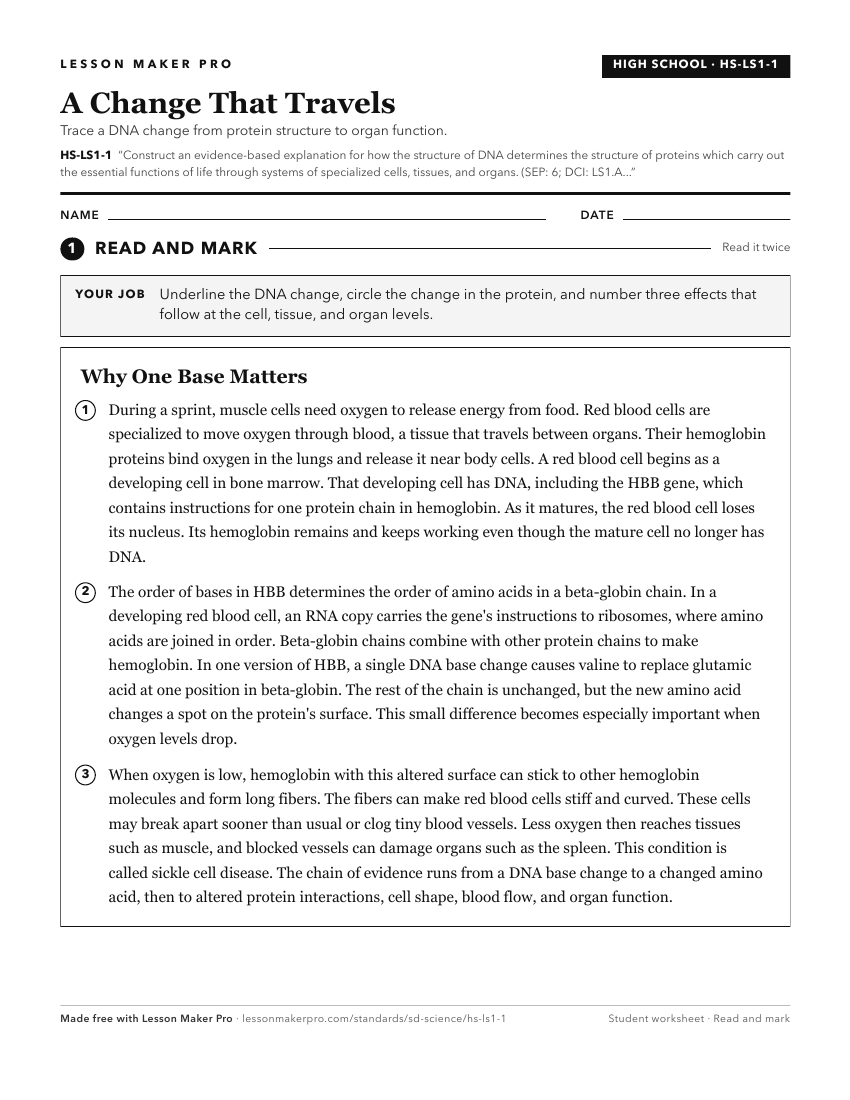
A ready-to-print activity worksheet aligned to HS-LS1-1, with an answer key for the teacher on its own page. No account needed.
PDF, US Letter, prints cleanly in black and white.
Download the worksheetKeep exploring
Related Standards
- MS-LS1-3
Construct an evidence-based argument for how the body is a system of interacting subsystems composed of groups of cells, tissues, and organs.
- MS-LS1-1
Plan and carry out an investigation to provide evidence that living things are made of cells; either one cell or many different types and numbers of cells.
Turn this exact standard into a lesson
Grade, subject, topic, and the complete standard are prefilled. Create one free, no account needed.
Also for this standard:Make a WorksheetMake a QuizMake a Sub Lesson