South Dakota Science HS-ETS1-3
The Standard
Evaluate a solution to a complex real-word problem based on prioritized criteria and trade-offs that account for a range of constraints, including cost, safety, reliability, and aesthetics, as well as social, cultural, and environmental impacts. Alignment may include HS-PS1-6; HS-PS2-3; HS-LS2-7; HS-LS4-6; HS-ESS3-2; HS-ESS3-4
South Dakota Science Standards (2024) · Engineering Design
Teacher's field guide
What This Standard Means
What Students Need to Do
- Students compare designs for a real problem and decide which requirements matter most. They weigh cost, safety, reliability, appearance, access, local culture, and environmental effects, then defend a choice with evidence.
What Mastery Looks Like
- Students rule out designs that fail a safety requirement, then rank the remaining options using a weighted chart. They defend their pick with data and explain who benefits, what the community gains or loses, and what the environmental cost might be.
Common Misconceptions
- Students may pick the cheapest design without checking whether it is safe or will last. They may treat a high total score as enough, even when a design blocks wheelchair access. Some name trade-offs but never use them to explain their choice.
How to Assess It
- Exit ticket: A $2,000 shade sail passes wind tests but covers a neighborhood mural; a $3,000 canopy passes wind tests, keeps the mural visible, and uses more material. With a $3,200 budget, pick one and explain your top two criteria and one trade-off.
Lesson moves
Ways to Teach It
Use cardboard and string to model two bus stop shelters, then test wheelchair clearance with a paper template.
Ask students to write whether saving $1,000 justifies covering a neighborhood mural, and whose views they would seek.
Give pairs three shelter cards with costs, wind ratings, and shade coverage; have them rank the designs under a fixed budget.
Use a photo of a nearby bus stop to mark where a shelter could block access, cover artwork, or change rainwater drainage.
Free download
Printable HS-ETS1-3 Worksheet
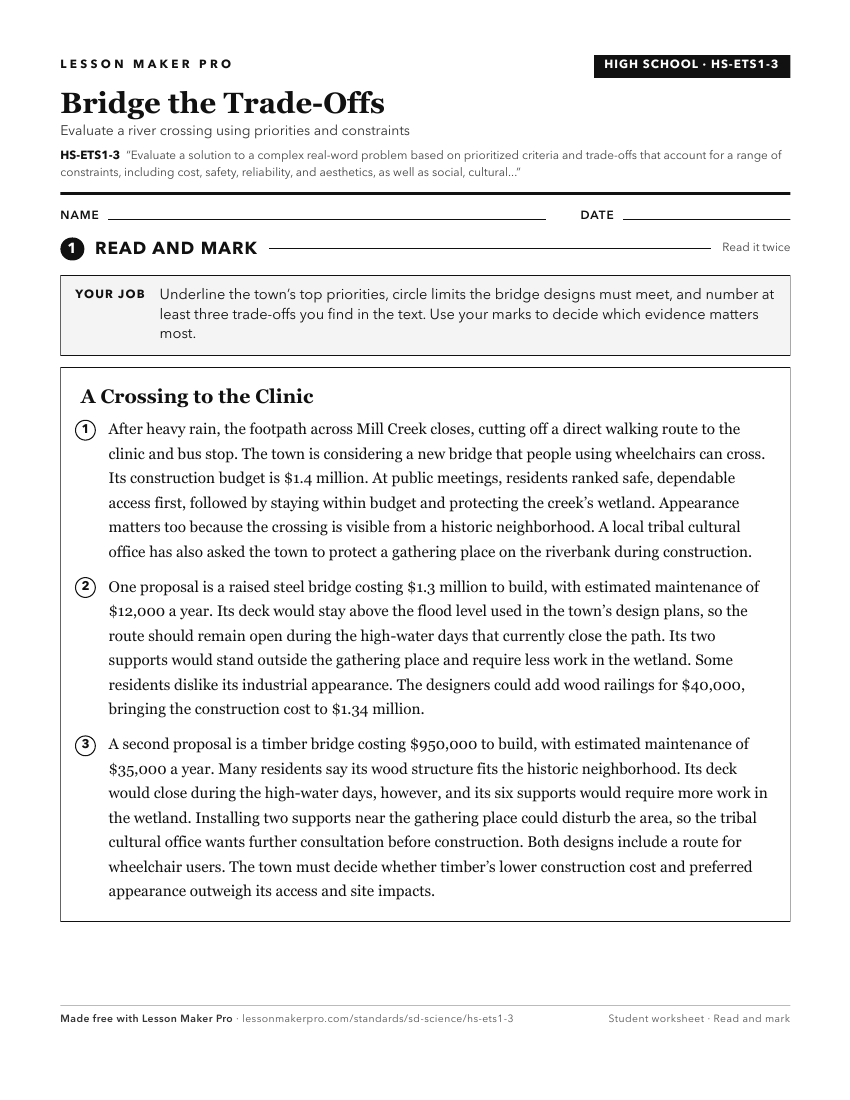
A ready-to-print activity worksheet aligned to HS-ETS1-3, with an answer key for the teacher on its own page. No account needed.
PDF, US Letter, prints cleanly in black and white.
Download the worksheetKeep exploring
Related Standards
Turn this exact standard into a lesson
Grade, subject, topic, and the complete standard are prefilled. Create one free, no account needed.
Also for this standard:Make a WorksheetMake a QuizMake a Sub Lesson