South Dakota Science 1-PS4-2
The Standard
Construct an evidence-based account for how objects can be seen only when illuminated. (SEP: 6; DCI: PS4.B; CCC: Cause/Effect)
South Dakota Science Standards (2024) · Waves and Their Applications in Technologies for Information Transfer
Teacher's field guide
What This Standard Means
What Students Need to Do
- Students look for a toy in a dark box, then look again when a flashlight lights it. They use what they observed to explain why they could see it.
What Mastery Looks Like
- A student says they could not see the toy in the dark box but could see it when the flashlight was on. They name the light as the reason it became visible.
Common Misconceptions
- Some students think eyes make their own light, so they should be able to see in total darkness. Others think an object disappears in the dark or that a shiny object makes its own light.
How to Assess It
- After the box test, ask students to draw what they saw before and after the flashlight was turned on. Have them tell you what changed.
Lesson moves
Ways to Teach It
Put a toy in a shoebox with a peephole; have students look before and after shining a flashlight through a second hole.
Ask partners, 'Why could you see the toy after the flashlight turned on?' Have them name what they observed both times.
Give pairs cards showing a ball in a lit room or an unlit closet; have them sort where the ball could be seen.
Place a pencil under a desk, dim the room, and use a flashlight to find it; ask what made it visible.
Free download
Printable 1-PS4-2 Worksheet
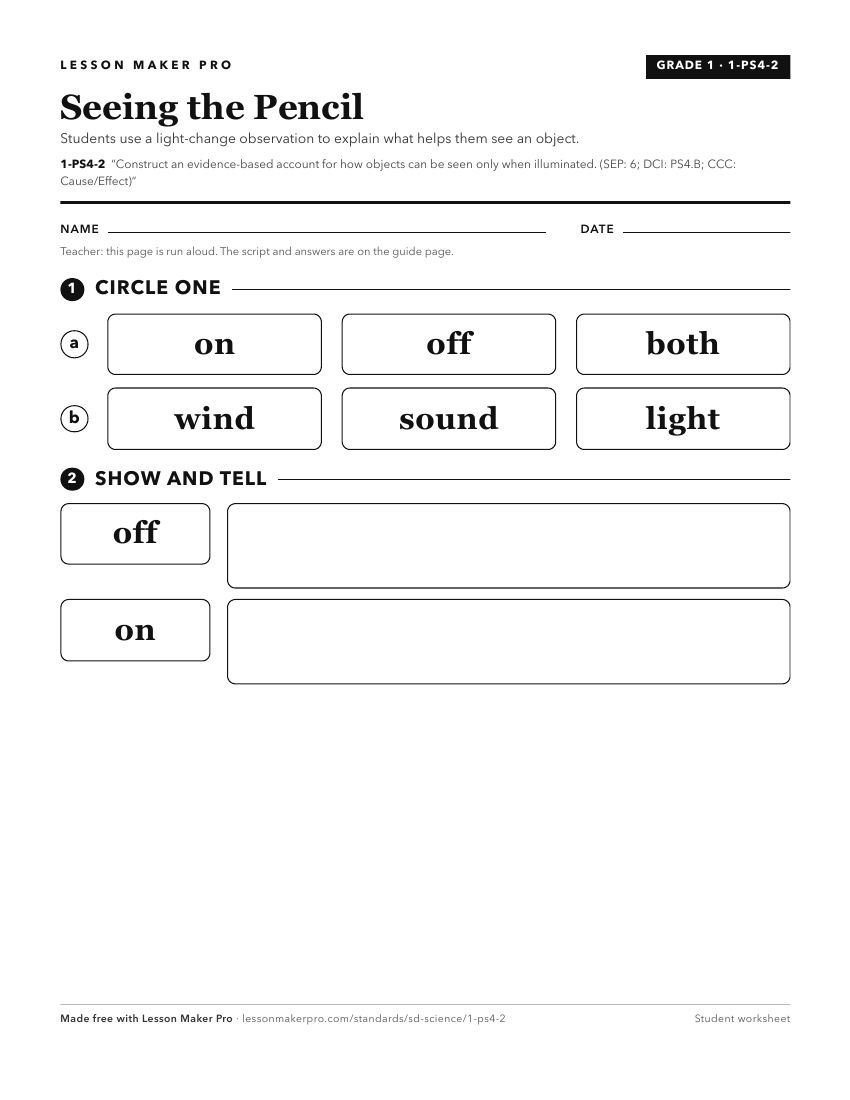
A ready-to-print activity worksheet aligned to 1-PS4-2, with an answer key for the teacher on its own page. No account needed.
PDF, US Letter, prints cleanly in black and white.
Download the worksheetKeep exploring
Related Standards
Turn this exact standard into a lesson
Grade, subject, topic, and the complete standard are prefilled. Create one free, no account needed.
Also for this standard:Make a WorksheetMake a QuizMake a Sub Lesson