South Dakota ELA 9-10.W.1.c
The Standard
- 9-10.W.1
- Write arguments to support claims in an analysis of substantive topics or texts, using valid reasoning and relevant and sufficient evidence.
Use appropriate and varied transitional words, phrases, and clauses to link the major sections of the text, create cohesion, and clarify the relationships between claim(s) and reasons, between reasons and evidence, and between claim(s) and counterclaims.
South Dakota English Language Arts Standards (2025)
Teacher's field guide
What This Standard Means
What Students Need to Do
- Students revise an argument so readers can follow its logic. They use different linking words, phrases, or clauses to connect a claim to reasons, reasons to evidence, and the claim to an opposing view.
What Mastery Looks Like
- A student chooses a transition that fits each connection, rather than starting every paragraph with “also.” Their reader can tell when a reason begins, why a detail supports it, and when an opposing view enters.
Common Misconceptions
- Students may put “however” before evidence that supports their point. They may use “for example” to introduce a new reason, or drop in an opposing view without linking it to the claim.
How to Assess It
- Exit ticket: Put these four lines on the board: “School should start later,” “Teens need more sleep,” “A sample survey found 20 of 30 teens sleep under eight hours,” and “Early start times help families with bus schedules.” Have students join them with three different transitions and label what each one connects.
Lesson moves
Ways to Teach It
Pairs sort claim, reason, evidence, and counterclaim strips, then add transition cards between them to show each link.
Ask students to explain why “however” misleads readers before supporting evidence, then write a better transition.
Play Transition Match: read paired argument sentences aloud, then have teams hold up “one reason,” “for example,” or “however” cards.
Have students draft a three-sentence email to the principal about lunch lines, linking a proposal, a reason, and a possible objection.
Free download
Printable 9-10.W.1.c Worksheet
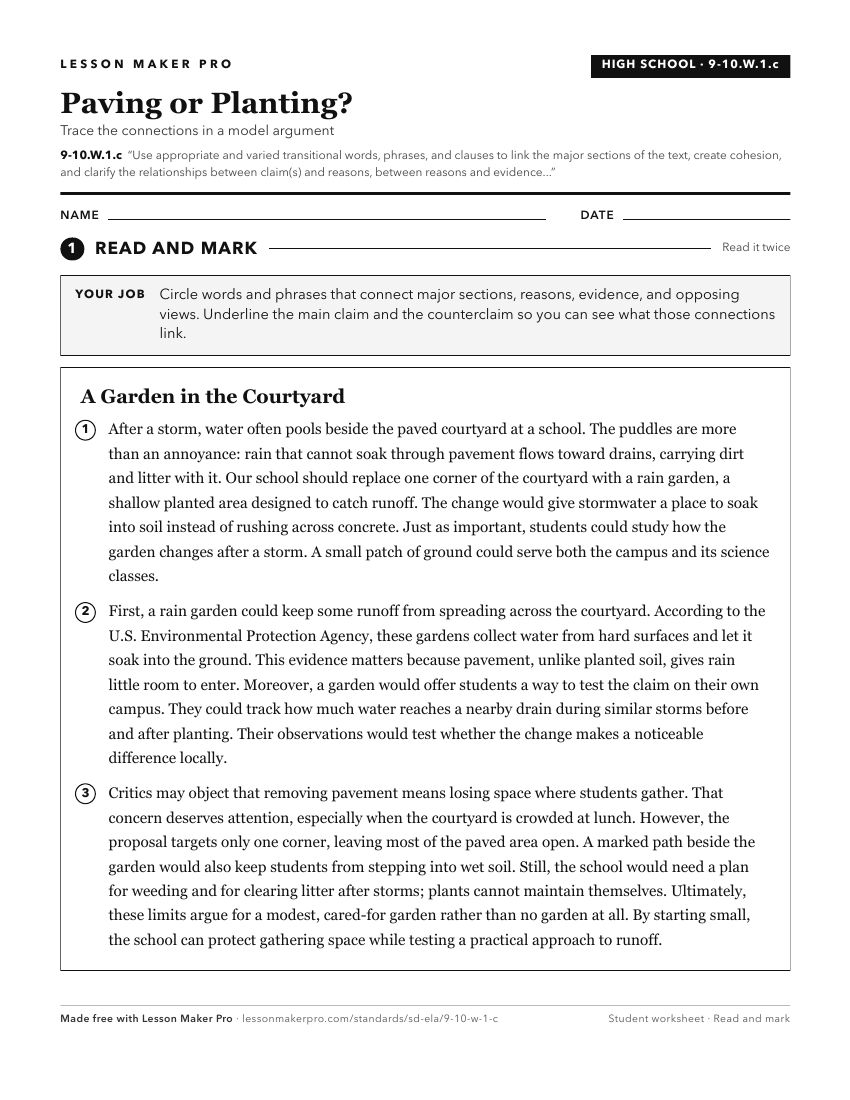
A ready-to-print activity worksheet aligned to 9-10.W.1.c, with an answer key for the teacher on its own page. No account needed.
PDF, US Letter, prints cleanly in black and white.
Download the worksheetKeep exploring
Related Standards
- 11-12.W.1.c
Use appropriate and varied transitions and syntax to fluently link the major sections of the text, create cohesion, and clarify the relationships between claim(...
- 11-12.WHST.1.c
Use appropriate and varied transitional words, phrases, and clauses to link the major sections of the text, create cohesion, and clarify the relationships betwe...
- 7.W.1.c
Use transitional words, phrases, and clauses to create cohesion and clarify the relationships among claim(s), reasons, and evidence.
- 9-10.WHST.1.c
Use appropriate and varied transitional words, phrases, and clauses to link the major sections of the text, create cohesion, and clarify the relationships betwe...
Turn this exact standard into a lesson
Grade, subject, topic, and the complete standard are prefilled. Create one free, no account needed.
Also for this standard:Make a WorksheetMake a QuizMake a Sub Lesson