South Dakota ELA 9-10.RH.6
The Standard
Compare the point of view of two or more authors for how they treat the same or similar topics, including which details they include and emphasize in their respective accounts. Evaluate the texts for bias.
South Dakota English Language Arts Standards (2025) · Literacy in History/Social Studies, Science, and Technical Subjects
Teacher's field guide
What This Standard Means
What Students Need to Do
- Students read two accounts of the same event and track what each writer includes, stresses, or leaves out. They use evidence to explain how those choices may favor one side.
What Mastery Looks Like
- A student can name a detail both accounts share and a detail each writer stresses. They can quote wording that favors one side and explain its effect on a reader.
Common Misconceptions
- Students may assume a firsthand account cannot be biased, or that two different accounts mean one writer is lying. They may call an account biased without pointing to its wording or choice of details.
How to Assess It
- Using two Boston Massacre accounts from class, ask students to name one detail each writer stresses and quote one phrase that may sway the reader.
Lesson moves
Ways to Teach It
Print a colonial newspaper account and a British soldier's account of the Boston Massacre; pairs highlight details found in only one.
Ask, 'How does each writer describe the crowd?' Have students cite a phrase from each account and discuss the difference.
Play an evidence sort: teams place six details under 'both accounts,' 'colonial only,' or 'British only,' then defend their choices.
Print two news stories about the same city council vote; students list whose voices each quotes and which facts each leaves out.
Free download
Printable 9-10.RH.6 Worksheet
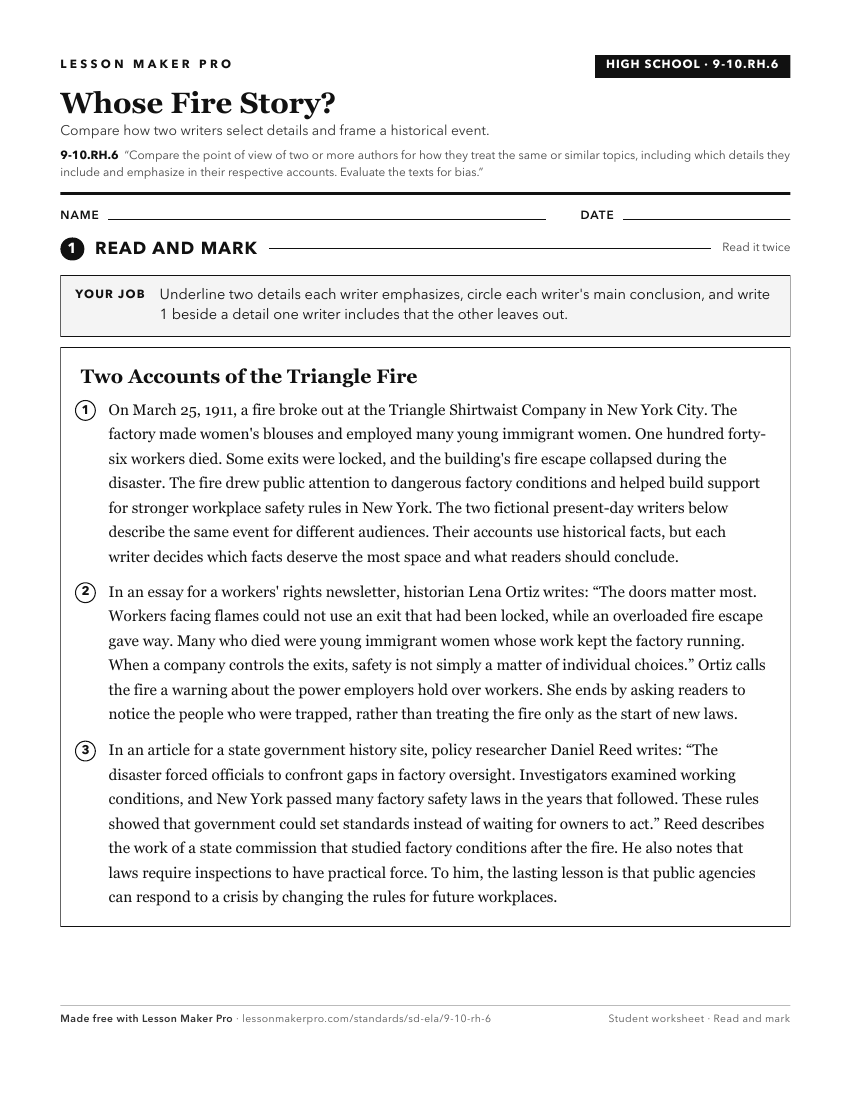
A ready-to-print activity worksheet aligned to 9-10.RH.6, with an answer key for the teacher on its own page. No account needed.
PDF, US Letter, prints cleanly in black and white.
Download the worksheetKeep exploring
Related Standards
- 11-12.RH.6
Evaluate differing points of view on the same historical event or issue by assessing the authors’ claims, reasoning, and evidence. Evaluate a text for bias, mis...
- 11-12.RL.6
Analyze how the author's background, point of view, and/or purpose shapes the content and style from diverse texts. Evaluate the author's choice of what is stat...
Turn this exact standard into a lesson
Grade, subject, topic, and the complete standard are prefilled. Create one free, no account needed.
Also for this standard:Make a WorksheetMake a QuizMake a Sub Lesson