South Dakota ELA 9-10.L.2.b
The Standard
- 9-10.L.2
- Demonstrate command of standard English mechanics and conventions; consult references as needed.
Use colons correctly.
South Dakota English Language Arts Standards (2025)
Teacher's field guide
What This Standard Means
What Students Need to Do
- Students use a colon to introduce a list or an explanation. They check that the words before the colon could stand alone as a sentence.
What Mastery Looks Like
- A student writes, 'Pack three things: water, a snack, and a jacket.' They can fix 'We need: water and snacks' and explain why the colon does not belong there.
Common Misconceptions
- Students often put a colon right after a verb, as in 'We need: pencils and paper.' Some add a colon before every list, even when the words before it are not a complete sentence.
How to Assess It
- Ask students to punctuate both sentences and explain which takes a colon: 'Bring these supplies pencils paper and tape.' 'We need pencils paper and tape.'
Lesson moves
Ways to Teach It
Give pairs strips reading 'Pack these items' and 'a pencil, tape, and scissors'; have them join the strips with a colon.
Ask students to compare 'We bought: paint and brushes' with 'We bought supplies: paint and brushes' and explain which colon works.
Sort six printed sentences into 'colon works' and 'colon does not work,' then have students fix the incorrect ones.
Give students a school announcement draft, 'The gym is closed because the floor is wet,' and ask them to rewrite it with a colon.
Free download
Printable 9-10.L.2.b Worksheet
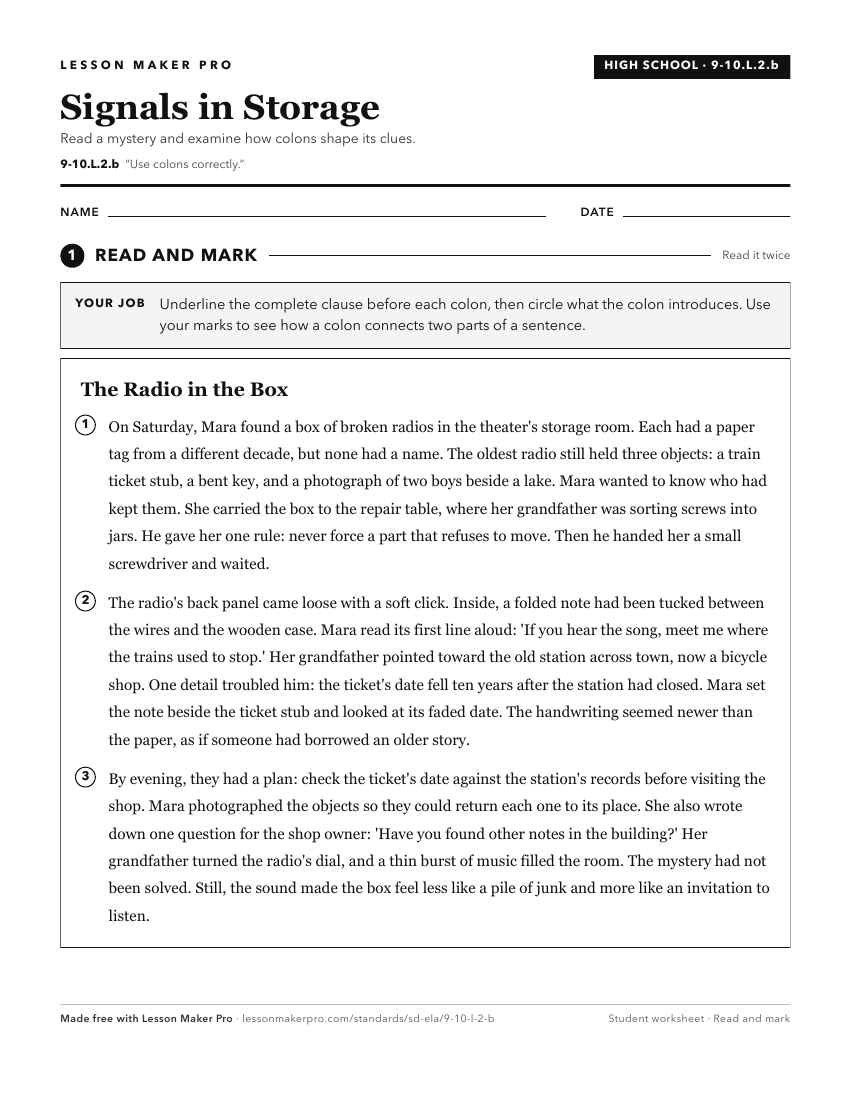
A ready-to-print activity worksheet aligned to 9-10.L.2.b, with an answer key for the teacher on its own page. No account needed.
PDF, US Letter, prints cleanly in black and white.
Download the worksheetKeep exploring
Related Standards
Turn this exact standard into a lesson
Grade, subject, topic, and the complete standard are prefilled. Create one free, no account needed.
Also for this standard:Make a WorksheetMake a QuizMake a Sub Lesson