South Dakota ELA 6-8.RH.8
The Standard
Distinguish among fact, opinion, bias, and reasoned judgment in a text.
South Dakota English Language Arts Standards (2025) · Literacy in History/Social Studies, Science, and Technical Subjects
Teacher's field guide
What This Standard Means
What Students Need to Do
- Students identify facts, opinions, bias, and reasoned judgments in a history text. They check which claims can be verified and spot words or missing details that push a viewpoint.
What Mastery Looks Like
- A student can label a claim and point to the words that support the choice. They can explain why a conclusion backed by evidence differs from a personal preference.
Common Misconceptions
- Students may call a claim a fact because they agree with it. They may call any judgment an opinion, even when the writer gives a reason, or miss bias in a passage with accurate dates.
How to Assess It
- Exit ticket: Label each claim as fact, opinion, bias, or reasoned judgment: “The 19th Amendment was ratified in 1920”; “It is my favorite amendment”; “Only fools opposed it”; “It was a turning point because it barred voting restrictions based on sex.” Ask students to explain their labels for the last two claims.
Lesson moves
Ways to Teach It
Give pairs a short passage on the 19th Amendment and four highlighters to mark checkable claims, preferences, loaded wording, and evidence-backed conclusions.
Ask students to explain why calling the 19th Amendment a turning point can be a reasoned judgment rather than a fact.
Play four-corner sort with claim cards about the 19th Amendment; students choose a label and point to words that justify it.
Bring a local election headline and article; students compare the headline’s wording with two checkable facts in the article.
Free download
Printable 6-8.RH.8 Worksheet
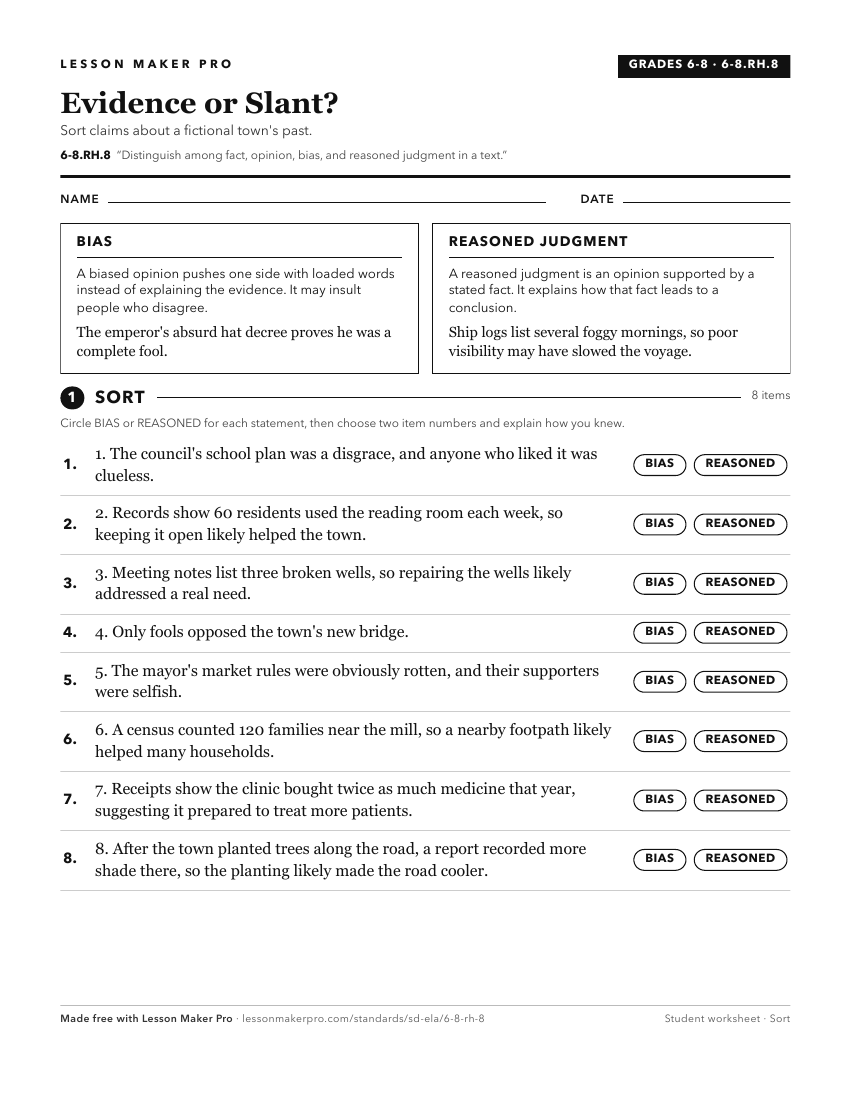
A ready-to-print activity worksheet aligned to 6-8.RH.8, with an answer key for the teacher on its own page. No account needed.
PDF, US Letter, prints cleanly in black and white.
Download the worksheetKeep exploring
Related Standards
- 1.RI.6
Identify the purpose of and/or point of view in a text.
- 3.RI.6
Identify the author's point of view based on text evidence and distinguish the student's point of view from that of the author.
- 6-8.RST.8
Distinguish among facts, reasoned judgment based on research findings, bias, and speculation in a text.
Turn this exact standard into a lesson
Grade, subject, topic, and the complete standard are prefilled. Create one free, no account needed.
Also for this standard:Make a WorksheetMake a QuizMake a Sub Lesson