South Dakota ELA 4.RL.5
The Standard
Explain major differences between stories, dramas, and poems, and refer to the structural elements of poems and dramas (e.g., casts of characters, settings, descriptions, dialogue, stage directions) when writing or speaking about a text.
South Dakota English Language Arts Standards (2025)
Teacher's field guide
What This Standard Means
What Students Need to Do
- Students tell stories, plays, and poems apart by looking at how each is laid out. They explain the differences using details such as paragraphs, stanzas, character names, and stage directions.
What Mastery Looks Like
- A student can point to narration in a story, line breaks in a poem, and speaker labels in a play. They can explain how those features help a reader follow the text.
Common Misconceptions
- Students may read stage directions as if a character says them. They may call any short text a poem or mistake a poem's line breaks for paragraph breaks. Some confuse a play's cast list with the dialogue.
How to Assess It
- Give students a story paragraph, a short play scene, and a two-stanza poem. Ask them to label each, underline one structural clue in each, and write how the play and poem each differ from the story.
Lesson moves
Ways to Teach It
Hand pairs a story paragraph, a play scene, and a two-stanza poem; have them sort the texts and underline structural clues.
Ask, “How does a stage direction tell us something a story narrator might describe?” Have partners point to a line in each text.
Play Structure Bingo with cards labeled stanza, stage direction, narrator, and cast; read brief excerpts and have students mark the matching clue.
Bring in a school play program and script; students match cast names to dialogue labels and circle a stage direction an actor follows.
Free download
Printable 4.RL.5 Worksheet
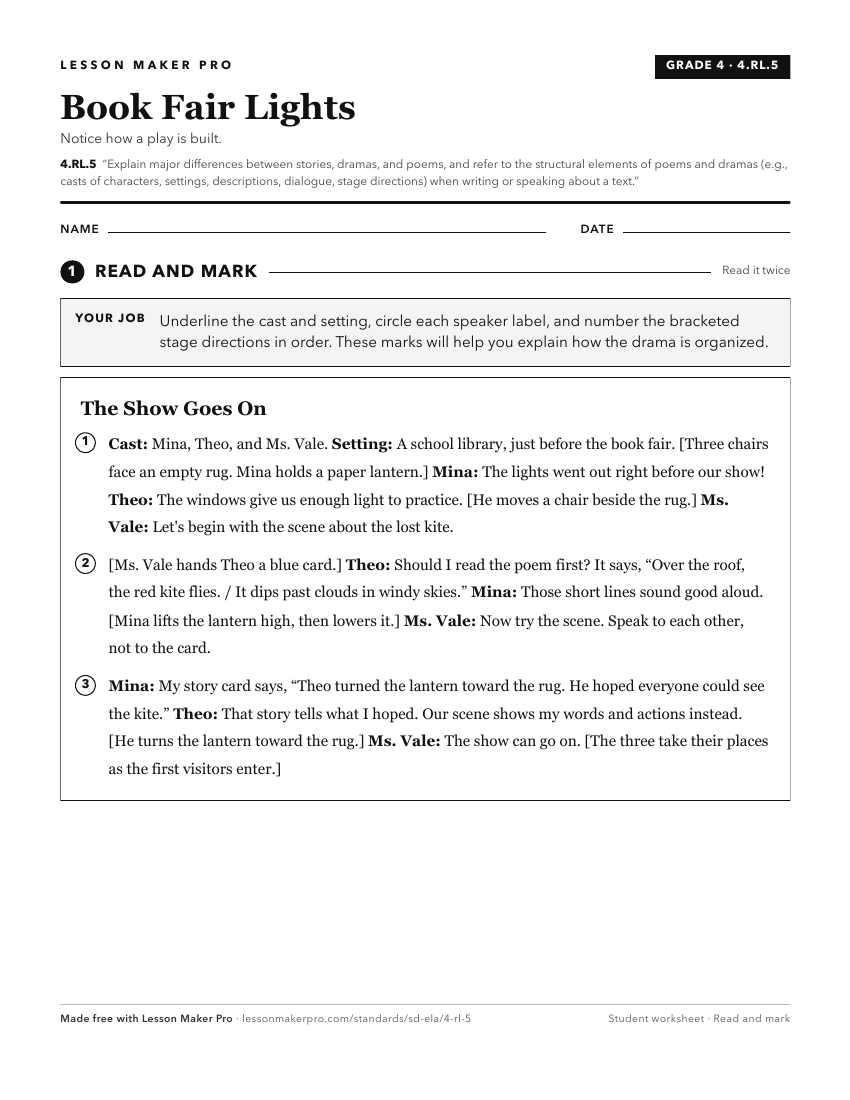
A ready-to-print activity worksheet aligned to 4.RL.5, with an answer key for the teacher on its own page. No account needed.
PDF, US Letter, prints cleanly in black and white.
Download the worksheetTurn this exact standard into a lesson
Grade, subject, topic, and the complete standard are prefilled. Create one free, no account needed.
Also for this standard:Make a WorksheetMake a QuizMake a Sub Lesson