South Dakota ELA 3.SL.5
The Standard
Create audio recordings of stories or poems that demonstrate fluid reading at an understandable pace; add visual displays when appropriate to emphasize or enhance certain facts or details.
South Dakota English Language Arts Standards (2025)
Teacher's field guide
What This Standard Means
What Students Need to Do
- Students record themselves reading a story or poem so listeners can follow it. They read smoothly at a clear pace and add a picture when it helps a detail stand out.
What Mastery Looks Like
- A listener can understand the recording without asking for a line to be repeated. The student reads in phrases, pauses at punctuation, and chooses a picture that points to a detail in the text.
Common Misconceptions
- Some students race to finish or read one word at a time. Others add a picture that looks nice but has no clear link to the story or poem.
How to Assess It
- Ask students to record these lines: “Rain taps softly on my door. Puddles spread across the floor. A robin hops along the street. It splashes water on its feet.” Have them draw the robin splashing to highlight that detail.
Lesson moves
Ways to Teach It
Give pairs a tablet and a short poem; have each student record it twice, then draw an image that shows one detail.
Play two readings of the same sentence, one rushed and one paced; ask, “Which helps you picture the scene, and why?”
Give partners sentence cards; they take turns recording a line and earn a point when the listener hears the pauses.
Make a recording for a younger class’s listening station, with one drawing that helps them notice a detail in the story.
Free download
Printable 3.SL.5 Worksheet
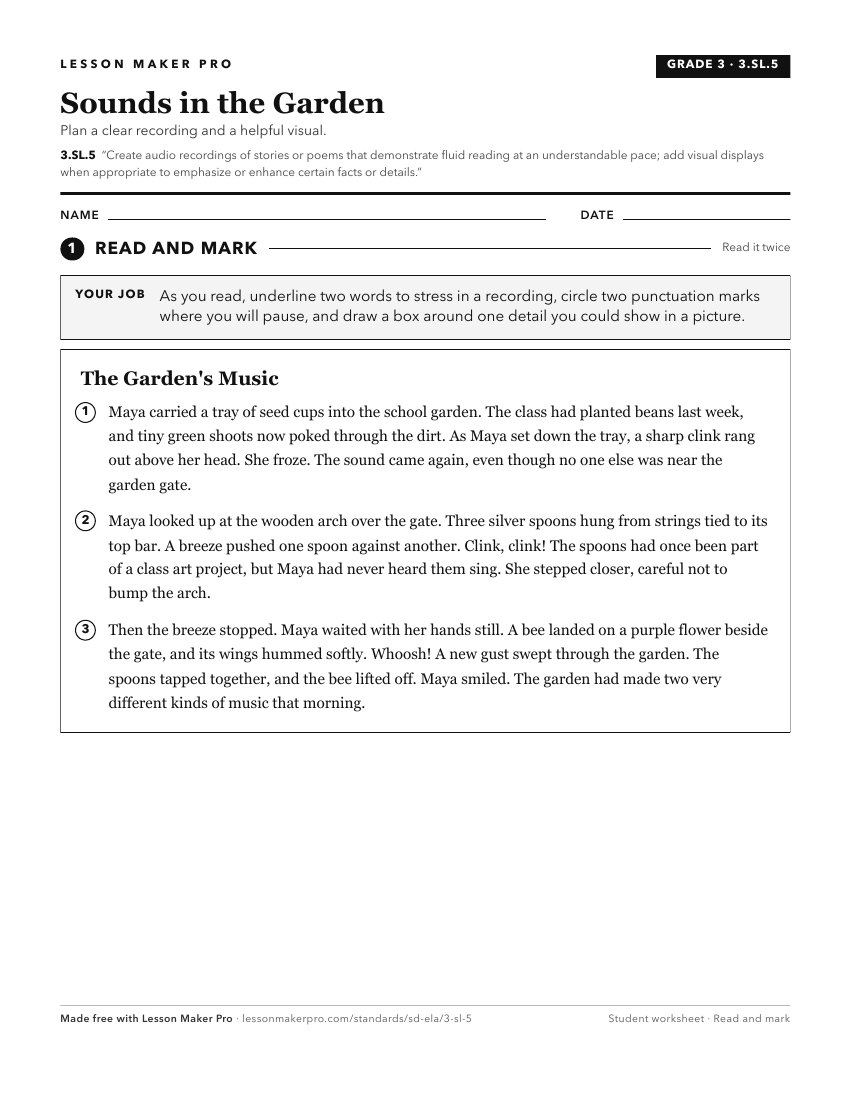
A ready-to-print activity worksheet aligned to 3.SL.5, with an answer key for the teacher on its own page. No account needed.
PDF, US Letter, prints cleanly in black and white.
Download the worksheetKeep exploring
Related Standards
- 1.RF.4.b
Read grade-appropriate text orally with accuracy, appropriate rate, and prosody (stress, phrasing, intonation, and expression) on consecutive readings.
- 2.SL.5
Create audio recordings, visual displays, performances, or media presentations of stories or poems to express ideas, thoughts, and feelings.
- K.RF.4.b
Read grade-appropriate texts orally with accuracy, appropriate rate, and prosody (stress, phrasing, intonation and expression) on consecutive readings.
- 2.RF.4.b
Read grade-appropriate text orally with accuracy, appropriate rate, and prosody (stress, phrasing, intonation, and expression) on consecutive readings.
Turn this exact standard into a lesson
Grade, subject, topic, and the complete standard are prefilled. Create one free, no account needed.
Also for this standard:Make a WorksheetMake a QuizMake a Sub Lesson