South Dakota ELA 11-12.RH.3
The Standard
Evaluate various explanations for events, ideas, or individual actions. Determine what text(s) state expressly and inferentially, acknowledging where the text is open for interpretation.
South Dakota English Language Arts Standards (2025) · Literacy in History/Social Studies, Science, and Technical Subjects
Teacher's field guide
What This Standard Means
What Students Need to Do
- Students compare explanations for why an event happened or why a person acted. They separate what a source says outright from what it suggests. They also notice where the evidence leaves room for more than one reading.
What Mastery Looks Like
- A student can cite a line for a stated cause and explain an inferred motive without calling it a fact. They can weigh two explanations and say when the sources cannot settle which mattered more.
Common Misconceptions
- Students may treat a guessed motive as if the source stated it. They may choose the most dramatic account or assume two different explanations cannot both be partly true.
How to Assess It
- Exit ticket: Read A, “Colonists dumped the tea to protest a tax set by a Parliament in which they had no vote,” and B, “Colonial merchants opposed the Tea Act because it let a British company bypass their businesses.” Name each stated reason, then use a phrase from each account to explain whether these lines show which reason drove the protest.
Lesson moves
Ways to Teach It
Print two short Boston Tea Party accounts, cut them into sentences, and have pairs sort claims into stated reasons, inferred motives, and unanswered questions.
Ask, “Was the protest mainly about taxes or control of tea sales?” Students cite both accounts and name one uncertainty.
Give teams four claims about the protest on cards; award points when they label each stated, inferred, or unsupported and cite a line.
Compare a company’s product recall notice with a news report; identify each stated cause, possible inferred motives, and what neither source settles.
Free download
Printable 11-12.RH.3 Worksheet
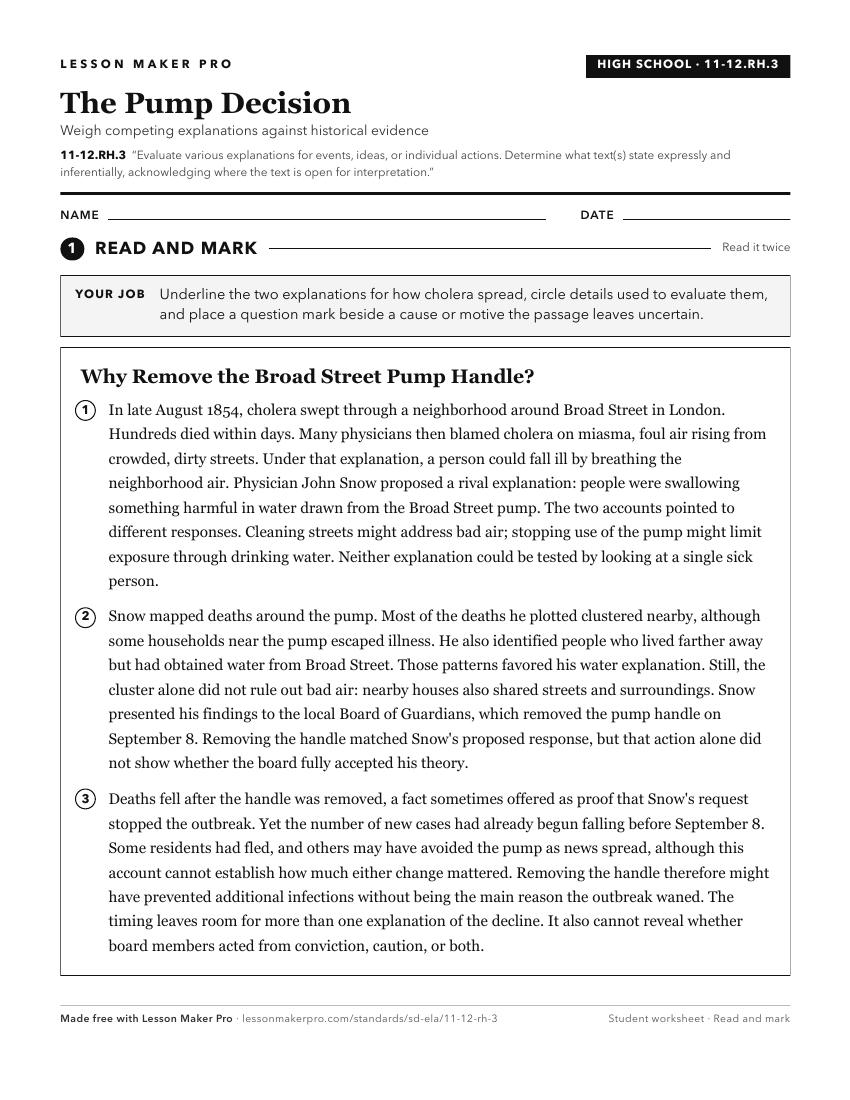
A ready-to-print activity worksheet aligned to 11-12.RH.3, with an answer key for the teacher on its own page. No account needed.
PDF, US Letter, prints cleanly in black and white.
Download the worksheetKeep exploring
Related Standards
- 11-12.RL.6
Analyze how the author's background, point of view, and/or purpose shapes the content and style from diverse texts. Evaluate the author's choice of what is stat...
- 11-12.RL.1
Accurately cite strong, relevant, and thorough textual evidence to support analysis of what the text says explicitly and inferentially, including determining wh...
Turn this exact standard into a lesson
Grade, subject, topic, and the complete standard are prefilled. Create one free, no account needed.
Also for this standard:Make a WorksheetMake a QuizMake a Sub Lesson