Oklahoma Science ES.ESS1.6
The Standard
Apply scientific reasoning and evidence from ancient Earth materials, meteorites, and other planetary surfaces to construct an account of changes in Earth’s formation and early history.
Oklahoma Academic Standards for Science (2026)
Teacher's field guide
What This Standard Means
What Students Need to Do
- Students use meteorite ages, ancient Earth materials, and photos of planetary surfaces to piece together Earth’s early history. They explain what each clue supports and where the evidence leaves gaps.
What Mastery Looks Like
- A student places Earth’s formation near 4.6 billion years ago and recognizes that crust existed by about 4.4 billion years ago. They use Moon craters as evidence of ancient impacts without claiming that crater counts give an exact date.
Common Misconceptions
- Students may think the oldest surviving Earth material formed when Earth formed. They may also assume meteorites came from Earth or that counting craters gives an exact age.
How to Assess It
- Exit ticket: A meteorite dates to 4.56 billion years ago, an Earth zircon to 4.4 billion years ago, and a Moon photo shows many craters. In three sentences, explain what each clue suggests about early Earth.
Lesson moves
Ways to Teach It
Build a paper timeline with 4.56-billion-year meteorite and 4.4-billion-year zircon cards, then mark when Earth must have had crust.
Ask pairs: Why does a 4.4-billion-year-old zircon not tell us when Earth formed? Have them use the meteorite age in their answer.
Play evidence match: pair meteorite ages, zircon ages, and Moon crater photos with claims about formation, crust, and impacts.
Show a museum meteorite label and have students write a new label explaining what its age can tell visitors about Earth.
Free download
Printable ES.ESS1.6 Worksheet
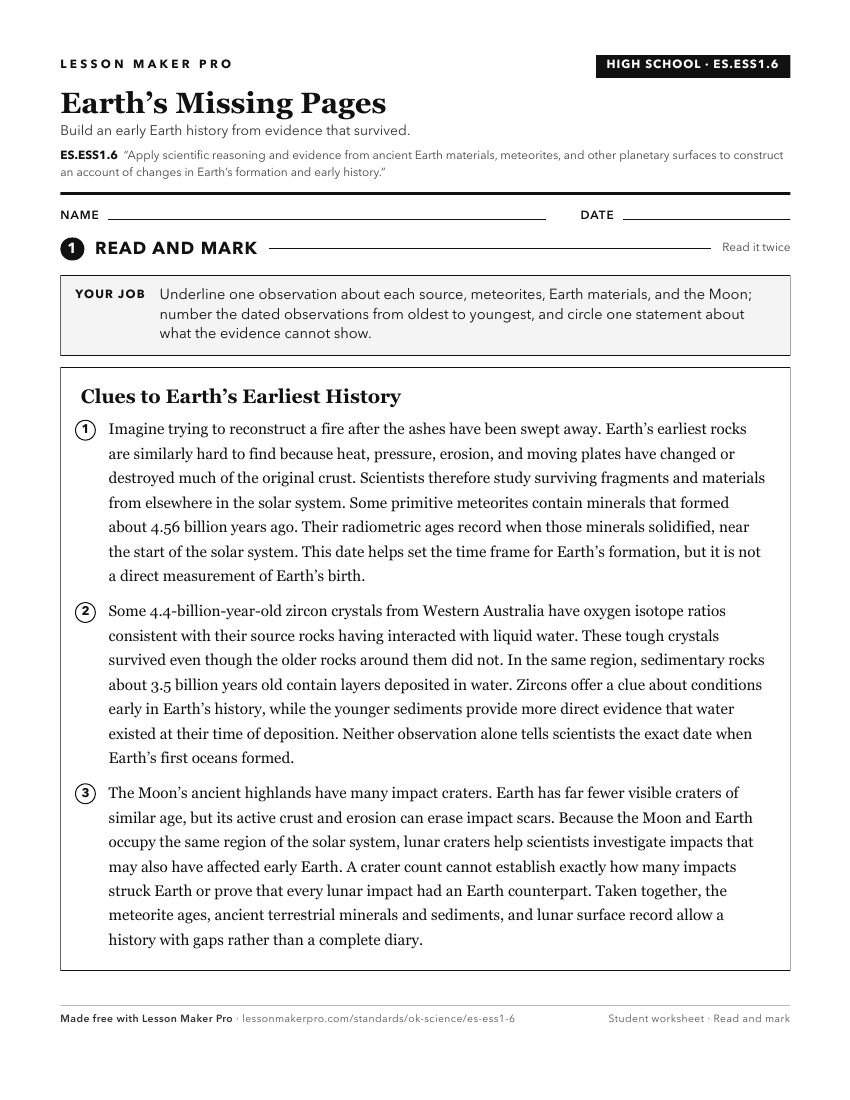
A ready-to-print activity worksheet aligned to ES.ESS1.6, with an answer key for the teacher on its own page. No account needed.
PDF, US Letter, prints cleanly in black and white.
Download the worksheetKeep exploring
Related Standards
- ES.ESS2.7
Engage in argument from evidence for how the simultaneous co-evolution of Earth's systems and life on Earth led to periods of stability and change over geologic...
- EN.ESS2.7
Engage in argument from evidence for how the simultaneous co-evolution of Earth's systems and life on Earth led to periods of stability and change over geologic...
Turn this exact standard into a lesson
Grade, subject, topic, and the complete standard are prefilled. Create one free, no account needed.
Also for this standard:Make a WorksheetMake a QuizMake a Sub Lesson