Oklahoma Science EN.ESS2.5
The Standard
Plan and conduct investigations of how the structure and resulting properties of water interact with the Earth’s materials and surface processes.
Oklahoma Academic Standards for Science (2026)
Teacher's field guide
What This Standard Means
What Students Need to Do
- Students plan and run fair tests of how water moves through soil or dissolves minerals. They measure results and use water's bent, polar molecules to explain what they observe.
What Mastery Looks Like
- Students change one variable, keep the water volume and timing the same, and record measurements. They explain why clay drains more slowly than sand using pore size and water's attraction to particles. They explain why water dissolves salt but not sand.
Common Misconceptions
- Students may think water dissolves every mineral or that all soils drain at the same rate. Some think water shrinks when it freezes, so they cannot explain how ice widens cracks in rock.
How to Assess It
- Give pairs one teaspoon each of salt and sand, two cups with 50 mL of water, and one minute to stir each. Ask them to record what remains, name two things they kept the same, and explain the difference using water's polarity.
Lesson moves
Ways to Teach It
Pour 50 mL of water through equal cups of sand and clay, time the drainage, and compare how much water each holds.
Show a photo of a cracked winter sidewalk and ask, "How does the open structure of ice widen a water-filled crack?"
Give pairs property and observation cards to match, such as water polarity with salt dissolving and ice expansion with cracked rock.
Use a photo of a salted road and storm drain; sketch the runoff path and explain how dissolved salt reaches the drain.
Free download
Printable EN.ESS2.5 Worksheet
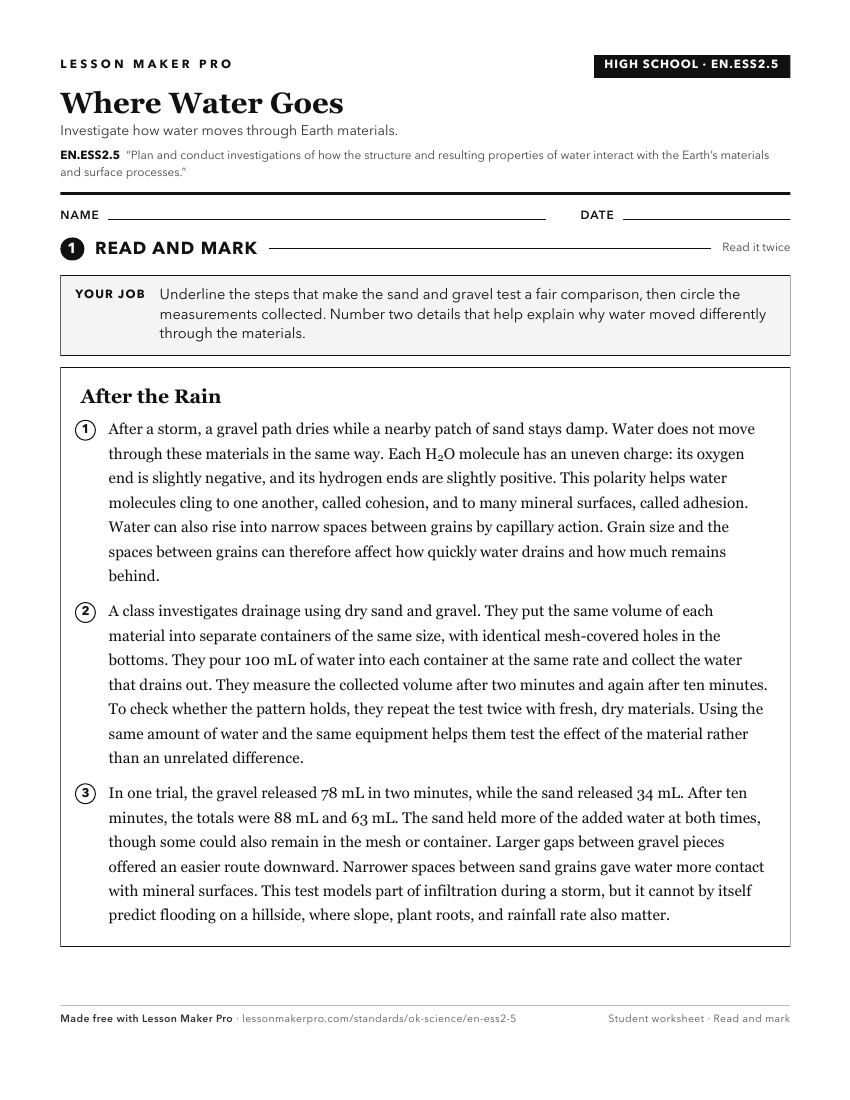
A ready-to-print activity worksheet aligned to EN.ESS2.5, with an answer key for the teacher on its own page. No account needed.
PDF, US Letter, prints cleanly in black and white.
Download the worksheetKeep exploring
Related Standards
- 4.ESS2.1
Plan and conduct an investigation to gather evidence on the effects of water, ice, wind, and vegetation on the rate of weathering and erosion.
- ES.ESS2.5
Plan and conduct investigations of how the structure and resulting properties of water interact with the Earth's materials and surface processes.
Turn this exact standard into a lesson
Grade, subject, topic, and the complete standard are prefilled. Create one free, no account needed.
Also for this standard:Make a WorksheetMake a QuizMake a Sub Lesson