Oklahoma Science CH.PS4.3
The Standard
Develop an argument for how scientific evidence supports the explanation that electromagnetic radiation can be described either by the wave model or the particle model, and in some situations one model is more useful than the other.
Oklahoma Academic Standards for Science (2026)
Teacher's field guide
What This Standard Means
What Students Need to Do
- Students use evidence to explain when light acts like a wave and when it acts like packets of energy called photons. They connect interference patterns to waves and electron emission to photons. They choose the model that best explains each observation.
What Mastery Looks Like
- A student points to alternating bright and dark bands as evidence of wave behavior. They explain why bright light below a metal’s cutoff frequency ejects no electrons, while dim light above it can. They defend their choice of model with evidence.
Common Misconceptions
- Students may think brighter light always has more energy per photon. Some think light switches between being a wave and being a particle, rather than using each model to explain different evidence. Others think the emitted electrons come from the light instead of the metal.
How to Assess It
- Exit ticket: A narrow slit produces alternating bright and dark bands. Bright red light cannot eject electrons from a metal, but dim violet light can. Which model explains each result, and what evidence supports your choices?
Lesson moves
Ways to Teach It
Shine a flashlight on a CD, sketch the colored bands, and label how the closely spaced tracks make light waves interfere.
Give students slit-pattern and metal-emission data, then ask them to write which model explains each result and cite one observation.
Sort cards showing slit fringes, CD colors, electron emission, and a frequency cutoff into wave or photon piles, then defend one choice.
Show a phone camera sensor diagram and a radio tuning dial, then ask which model explains charge production and station selection.
Free download
Printable CH.PS4.3 Worksheet
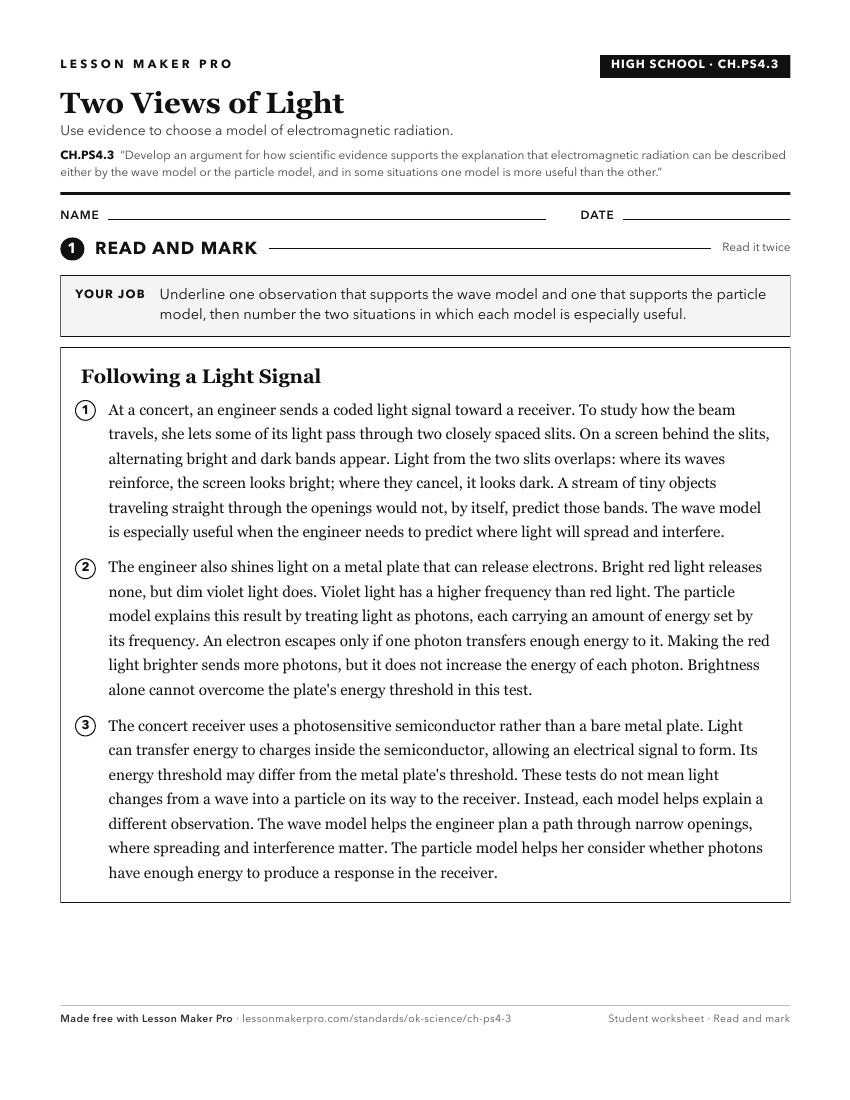
A ready-to-print activity worksheet aligned to CH.PS4.3, with an answer key for the teacher on its own page. No account needed.
PDF, US Letter, prints cleanly in black and white.
Download the worksheetKeep exploring
Related Standards
- PH.PS4.3
Develop an argument for how scientific evidence supports the explanation that electromagnetic radiation can be described either by the wave model or the particl...
- AR.PS4.3
Develop an argument for how scientific evidence supports the explanation that electromagnetic radiation can be described either by a wave model or the particle ...
- PH.PS3.2
Develop and use models to illustrate that energy at the macroscopic scale can be accounted for as either motions of particles or energy stored in fields.
Turn this exact standard into a lesson
Grade, subject, topic, and the complete standard are prefilled. Create one free, no account needed.
Also for this standard:Make a WorksheetMake a QuizMake a Sub Lesson