Oklahoma Science B.LS2.2
The Standard
Use mathematical representations as evidence to support and revise explanations about factors affecting biodiversity and populations in ecosystems.
Oklahoma Academic Standards for Science (2026)
Teacher's field guide
What This Standard Means
What Students Need to Do
- Students graph population counts and calculate changes before and after runoff or drought. They use the numbers to explain changes in species variety and individual populations, then revise a claim if the data disagree.
What Mastery Looks Like
- A student can calculate percent change, count how many species remain, and identify which populations rose or fell. They use specific numbers to revise a claim without treating a pattern as proof of cause.
Common Misconceptions
- Students may think more algae means greater biodiversity, even when other species disappear. They may confuse the number of organisms with the number of species, or assume runoff caused a decline just because both happened together.
How to Assess It
- Exit ticket: Before runoff, a pond has four species, 40 fish, and 20 algae; afterward, it has three species, 10 fish, and 100 algae. Calculate the percent change in fish, then use both the fish and species counts to revise the claim, 'More algae means greater biodiversity.'
Lesson moves
Ways to Teach It
Use counters to model drought counts: fish 10 to 4, insects 8 to 2, frogs 6 to 0; then tally species.
Show algae rising from 20 to 40 and frogs falling from 6 to 0; ask whether biodiversity improved and why.
Give pairs cards marked fish 40 to 10, algae 20 to 100, and frogs 6 to 0; race to calculate fish change and species lost.
Graph pond nitrate levels (2, 5, 9 mg/L) and fish counts (40, 28, 12) across three years; write a resident notice.
Free download
Printable B.LS2.2 Worksheet
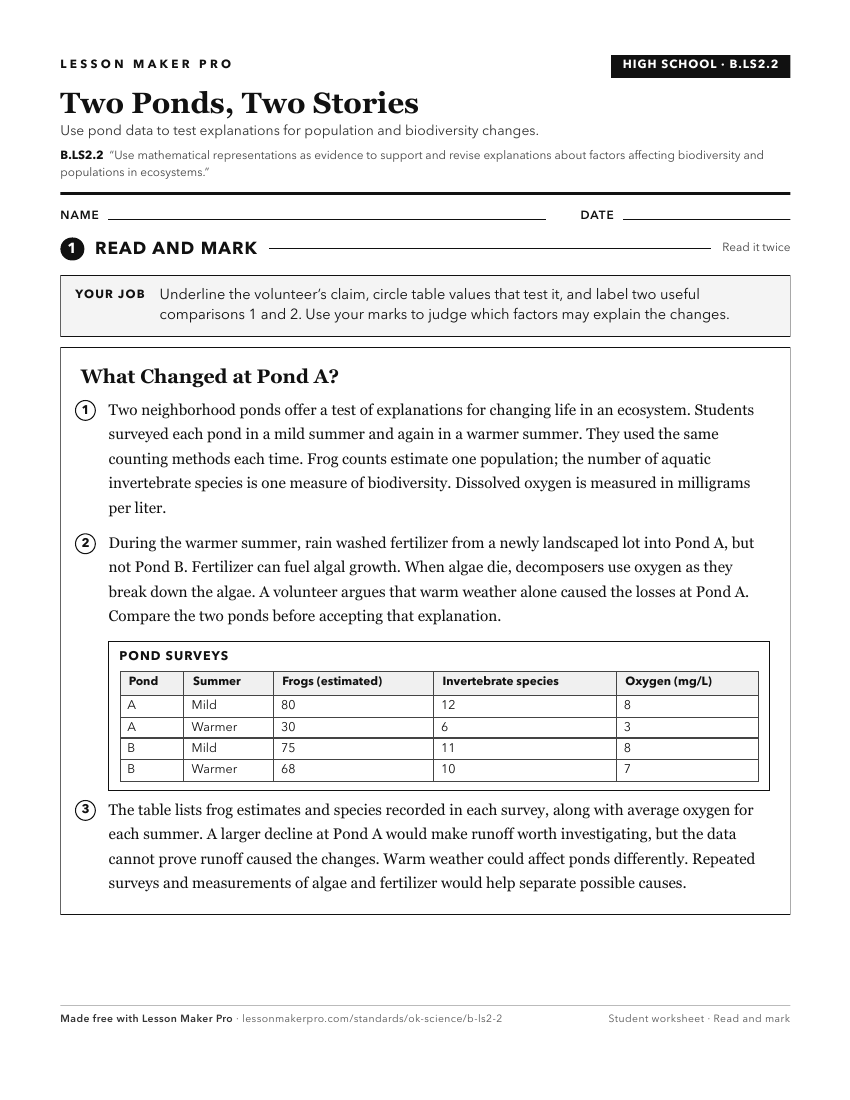
A ready-to-print activity worksheet aligned to B.LS2.2, with an answer key for the teacher on its own page. No account needed.
PDF, US Letter, prints cleanly in black and white.
Download the worksheetTurn this exact standard into a lesson
Grade, subject, topic, and the complete standard are prefilled. Create one free, no account needed.
Also for this standard:Make a WorksheetMake a QuizMake a Sub Lesson