Oklahoma Science 8.PS4.1
The Standard
Use mathematical representations to describe patterns in a simple model for waves that includes how the amplitude of a wave is related to the energy in a wave.
Oklahoma Academic Standards for Science (2026)
Teacher's field guide
What This Standard Means
What Students Need to Do
- Students measure amplitude from a wave's rest position to a crest. They use a table or graph to describe how amplitude relates to wave energy.
What Mastery Looks Like
- A student can graph wave amplitudes of 1, 2, and 3 cm paired with energies of 1, 4, and 9 units. They can explain that doubling amplitude from 1 to 2 cm gives four times the energy in this model.
Common Misconceptions
- Students may measure from crest to trough and call that amplitude. They may think twice the amplitude means twice the energy, or confuse closely spaced crests with taller waves.
How to Assess It
- Exit ticket: Graph these amplitude and energy pairs: (1 cm, 1 unit), (2 cm, 4 units), and (3 cm, 9 units). What happens to energy when amplitude doubles from 1 to 2 cm?
Lesson moves
Ways to Teach It
Tape a ruler beside a rope, send a small pulse and a large pulse, then record each crest's distance from the resting rope.
Ask students why a wave with a 4 cm amplitude carries more energy than a 2 cm wave on the same rope.
Play match-up with amplitude cards labeled 1, 2, and 3 cm and energy cards labeled 1, 4, and 9 units.
Print sound waveforms from soft and hard drum hits recorded with identical settings; students circle the larger amplitude and predict the higher-energy sound.
Free download
Printable 8.PS4.1 Worksheet
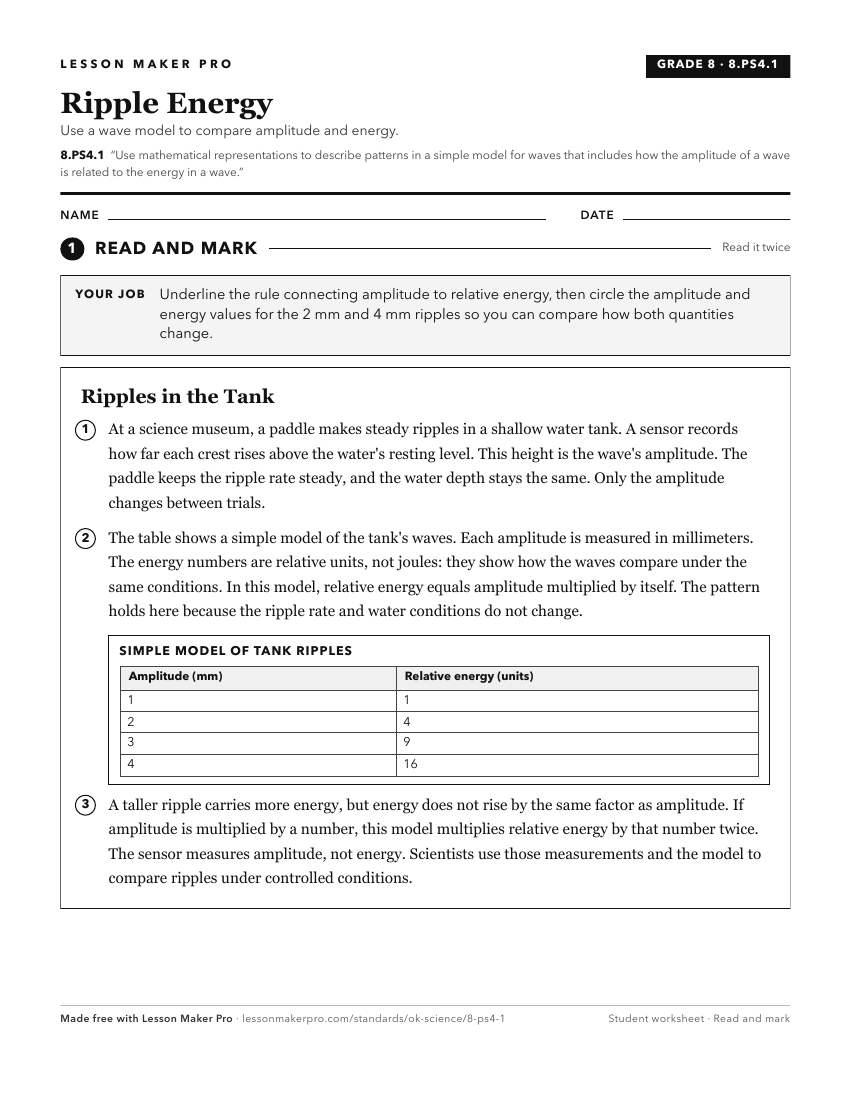
A ready-to-print activity worksheet aligned to 8.PS4.1, with an answer key for the teacher on its own page. No account needed.
PDF, US Letter, prints cleanly in black and white.
Download the worksheetKeep exploring
Related Standards
- 4.PS4.1
Develop and use a model of waves to describe patterns in terms of amplitude and wavelength, and to show that waves can cause objects to move.
- PS.PS4.1
Use mathematical representations to explain both qualitative and quantitative relationships among frequency, wavelength, and speed of waves traveling in various...
Turn this exact standard into a lesson
Grade, subject, topic, and the complete standard are prefilled. Create one free, no account needed.
Also for this standard:Make a WorksheetMake a QuizMake a Sub Lesson