Oklahoma Science 7.PS3.1
The Standard
Construct and interpret graphical displays of data to describe the proportional relationships of kinetic energy to the mass of an object and the speed of an object.
Oklahoma Academic Standards for Science (2026)
Teacher's field guide
What This Standard Means
What Students Need to Do
- Students graph kinetic energy against mass while speed stays the same. Then they graph kinetic energy against speed while mass stays the same and describe the patterns.
What Mastery Looks Like
- Students label axes, plot the data, and read values from each graph. They show that doubling mass doubles energy, while doubling speed makes energy four times as large.
Common Misconceptions
- Students may think doubling speed only doubles kinetic energy. They may also compare objects with different masses and speeds, then blame the energy difference on just one change.
How to Assess It
- Exit ticket: Plot mass 1, 2, 3 kg against energy 2, 4, 6 J, then plot speed 1, 2, 3 m/s against energy 1, 4, 9 J. Ask students to describe each pattern.
Lesson moves
Ways to Teach It
Give pairs 12 counters and mass labels 1, 2, 3 kg; build energy bars of 2, 4, 6 counters at a fixed speed.
Ask: If speed doubles from 1 to 2 m/s, does energy double? Use the points (1, 1) and (2, 4).
Give pairs three graph cards; have them match the table pairing speeds 1, 2, 3 m/s with energies 1, 4, 9 J.
Graph a 50 kg bike and rider at 2, 4, and 6 m/s, with energies of 100, 400, and 900 J; discuss braking.
Free download
Printable 7.PS3.1 Worksheet
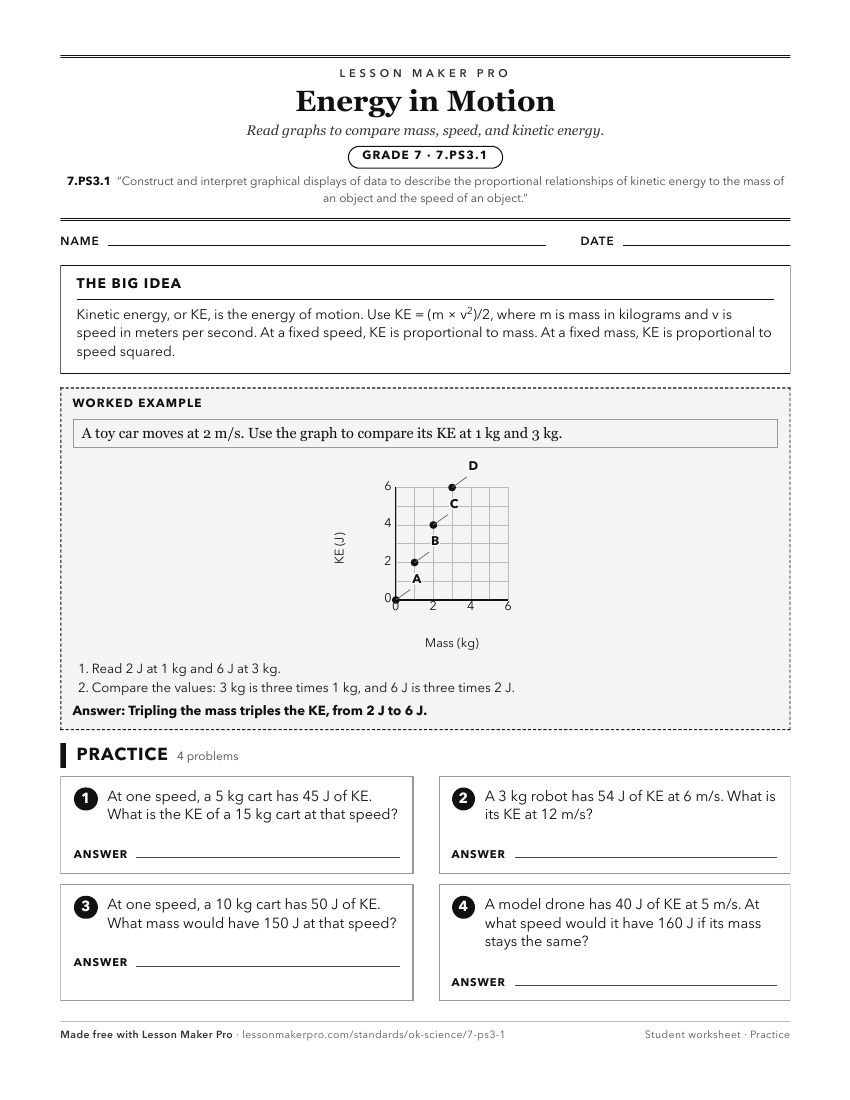
A ready-to-print activity worksheet aligned to 7.PS3.1, with an answer key for the teacher on its own page. No account needed.
PDF, US Letter, prints cleanly in black and white.
Download the worksheetTurn this exact standard into a lesson
Grade, subject, topic, and the complete standard are prefilled. Create one free, no account needed.
Also for this standard:Make a WorksheetMake a QuizMake a Sub Lesson