Oklahoma Math A2.F.2
Standard Cluster
Analyze functions through algebraic combinations, compositions, and inverses if they exist. Add, subtract, multiply, and divide functions using function notation and recognize domain restrictions. Combine functions by composition and recognize that g(x) = f⁻¹(x), the inverse function of f(x), if and only if f(g(x)) = g(f(x)) = x. Find and graph the inverse of a function, if it exists, in mathematical models. Know that the domain of a function f is the range of the inverse function f⁻¹ and the range of the function f is the domain of the inverse function f⁻¹. Apply the inverse relationship between exponential and logarithmic functions to convert from one form to another.
Oklahoma Academic Standards for Mathematics (2022)
Cluster contents
Standards in This Cluster
A2.F.2 is a cluster heading. These are the individual standards under it.
- A2.F.2.1
Add, subtract, multiply, and divide functions using function notation and recognize domain restrictions.
- A2.F.2.2
Combine functions by composition and recognize that g(x) = f⁻¹(x), the inverse function of f(x), if and only if f(g(x)) = g(f(x)) = x.
- A2.F.2.3
Find and graph the inverse of a function, if it exists, in mathematical models. Know that the domain of a function f is the range of the inverse function f⁻¹ an...
- A2.F.2.4
Apply the inverse relationship between exponential and logarithmic functions to convert from one form to another.
Teacher's field guide
What This Cluster Means
What Students Need to Do
- Students add, subtract, multiply, divide, and compose functions. They identify inputs that make a result undefined. They find inverses when possible and rewrite exponential equations in logarithmic form.
What Mastery Looks Like
- Given two formulas, a student finds their combinations and compositions, with the correct domains. They explain why x² has no inverse over all real numbers, then find √x as its inverse when x≥0. They rewrite 2³=8 as log₂(8)=3.
Common Misconceptions
- Students confuse composition with multiplication or reverse its order. They forget to exclude zeros of the divisor and nonpositive inputs to a logarithm. They assume every function has an inverse, even x² on all real numbers.
How to Assess It
- Exit ticket: Let f(x)=2x+3 and g(x)=x−1; find (f/g)(x), its domain restriction, (f∘g)(x), and f⁻¹(x). Rewrite 2³=8 in logarithmic form.
Lesson moves
Ways to Teach It
Give pairs cards labeled f(x)=2x+3 and g(x)=x−1; students pass input cards through both orders and record the outputs.
Ask students to write why x² needs x≥0 to have an inverse, then compare explanations with a partner.
Play a matching game with function-operation cards and answer cards, including division cards whose domain restrictions students must supply.
Use a $100 balance growing 5% yearly; students set 100(1.05)^t=200 and use logarithms to find when it doubles.
Free download
Printable A2.F.2 Worksheet
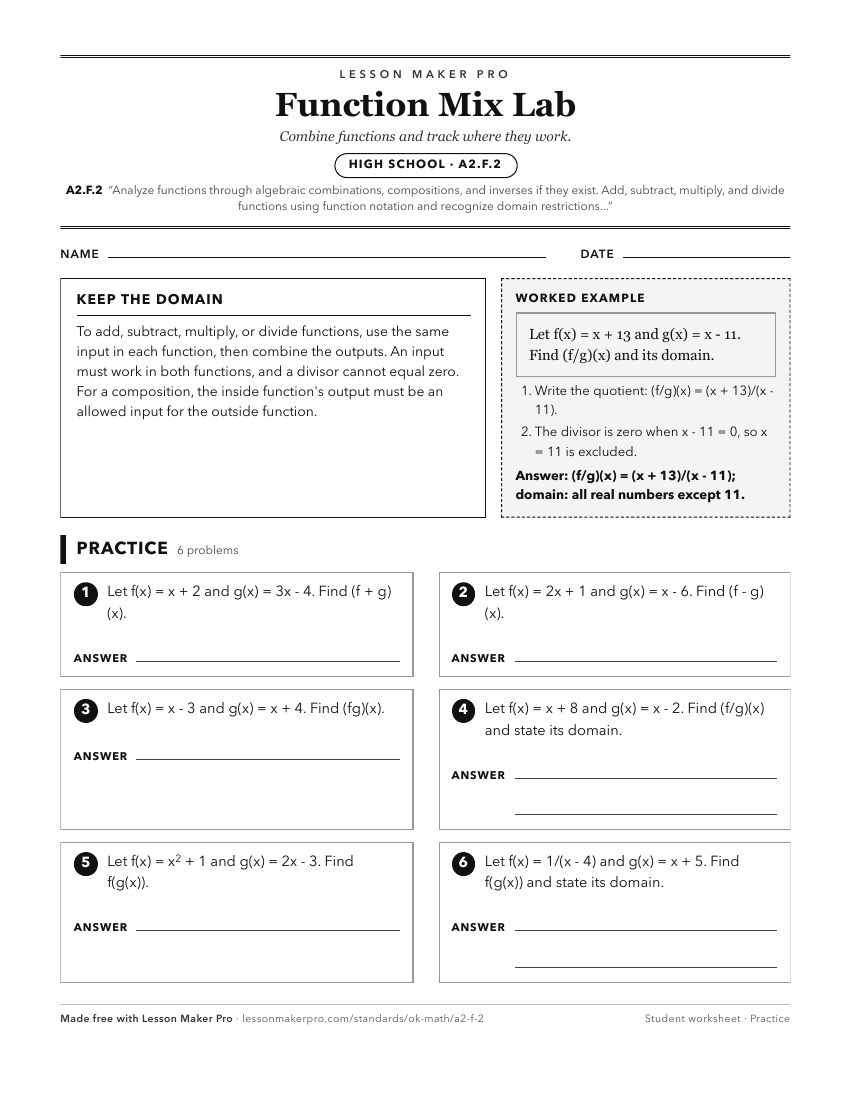
A ready-to-print activity worksheet aligned to A2.F.2, with an answer key for the teacher on its own page. No account needed.
PDF, US Letter, prints cleanly in black and white.
Download the worksheetKeep exploring
Related Standards
- PC.F.2.3
Interpret the meanings of quantities involving functions and their inverses.
- PC.F.1
Analyze functions and relations.
- PC.F.3.3
Algebraically verify solutions involving functions that are quadratic, polynomial of higher order, rational, exponential, and logarithmic.
- PC.F.2.4
Verify by analytical methods that one function is the inverse of another.
Turn this cluster into a lesson
Grade, subject, topic, and the complete cluster are prefilled. Create one free, no account needed.
Also for this cluster:Make a WorksheetMake a QuizMake a Sub Lesson