Oklahoma Math 7.GM.1
Standard Cluster
Develop and understand the concept of surface area and volume of rectangular prisms with rational-valued edge lengths. Recognize that the surface area of a rectangular prism can be found by finding the area of each component of the net of that figure. Know that rectangular prisms of different dimensions can have the same surface area. Using a variety of tools and strategies, develop the concept that surface area of a rectangular prism can be found by wrapping the figure with same-sized square units without gaps or overlap. Use appropriate measurements (e.g., cm²). Using a variety of tools and strategies, develop the concept that the volume of rectangular prisms can be found by counting the total number of same-sized unit cubes that fill a shape without gaps or overlaps. Use appropriate measurements (e.g., cm³).
Oklahoma Academic Standards for Mathematics (2022)
Cluster contents
Standards in This Cluster
7.GM.1 is a cluster heading. These are the individual standards under it.
- 7.GM.1.1
Recognize that the surface area of a rectangular prism can be found by finding the area of each component of the net of that figure. Know that rectangular prism...
- 7.GM.1.2
Using a variety of tools and strategies, develop the concept that surface area of a rectangular prism can be found by wrapping the figure with same-sized square...
- 7.GM.1.3
Using a variety of tools and strategies, develop the concept that the volume of rectangular prisms can be found by counting the total number of same-sized unit ...
Teacher's field guide
What This Cluster Means
What Students Need to Do
- Students find surface area by adding the areas of the six faces in a prism's net. They find volume by counting equal-sized cubes or by multiplying the edge lengths. They use square units for the outside and cubic units for the space inside.
What Mastery Looks Like
- For a 1.5 cm by 2 cm by 3 cm prism, a student finds 27 cm² of surface area and 9 cm³ of volume. They can explain why 1 cm by 2 cm by 3 cm and 1 cm by 1 cm by 5 cm prisms have the same surface area but different volumes.
Common Misconceptions
- Students may add edge lengths instead of face areas or count only the faces they can see. They may use square units for volume or assume prisms with the same surface area have the same volume.
How to Assess It
- Give students a 1.5 cm by 2 cm by 3 cm prism. Ask them to sketch its net, label all six face areas, and find its surface area and volume with units.
Lesson moves
Ways to Teach It
Build a 1 cm by 2 cm by 3 cm prism with centimeter cubes, then cover its outside with square-centimeter paper tiles.
Compare 1 cm by 2 cm by 3 cm and 1 cm by 1 cm by 5 cm prisms; explain why their surface areas match.
Play card match with prism dimensions, six face areas, and surface area totals, including a 1.5 cm by 2 cm by 3 cm prism.
Measure a closed shoebox, then estimate wrapping paper in square centimeters and storage space in cubic centimeters.
Free download
Printable 7.GM.1 Worksheet
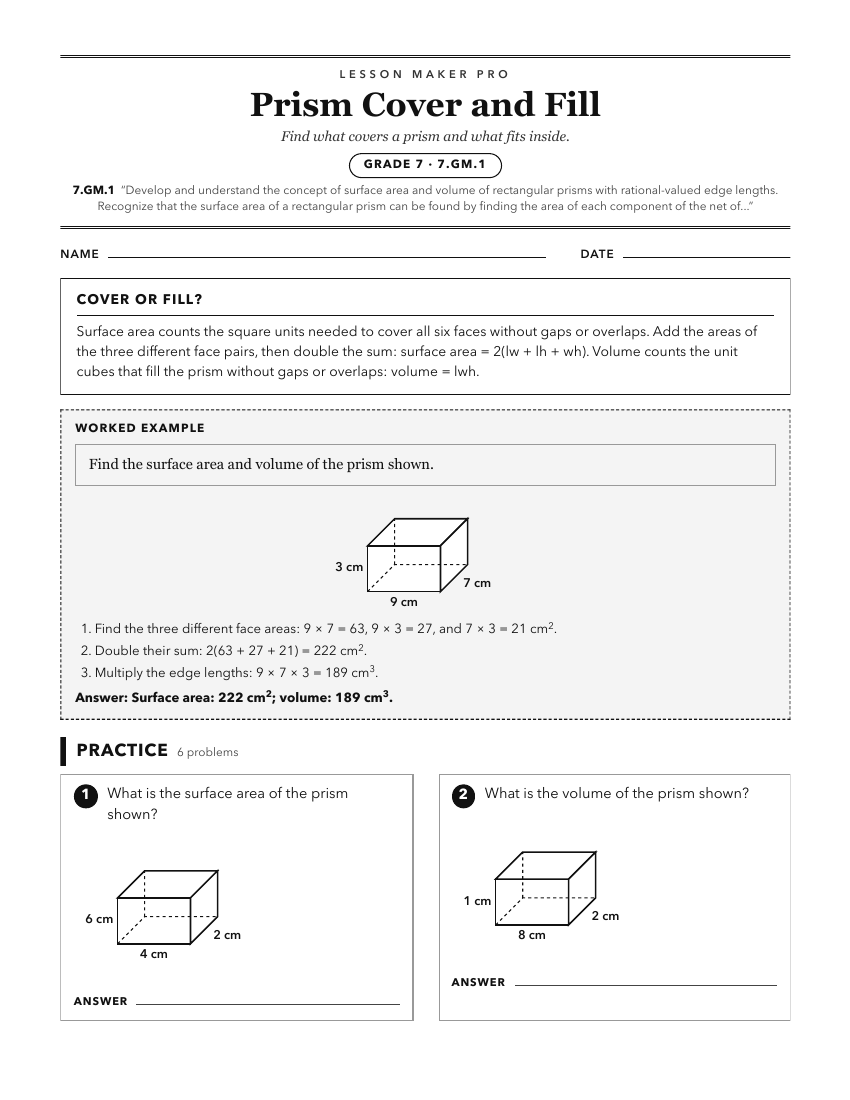
A ready-to-print activity worksheet aligned to 7.GM.1, with an answer key for the teacher on its own page. No account needed.
PDF, US Letter, prints cleanly in black and white.
Download the worksheetKeep exploring
Related Standards
- 4.GM.2.3
Develop the concept that the volume of rectangular prisms with whole-number edge lengths can be found by counting the total number of same-sized unit cubes that...
- 5.GM.2
Determine volume using the object's dimensions. Compare and analyze rectangular prisms with equivalent volume to recognize their different dimensions.
Turn this cluster into a lesson
Grade, subject, topic, and the complete cluster are prefilled. Create one free, no account needed.
Also for this cluster:Make a WorksheetMake a QuizMake a Sub Lesson