Oklahoma Math 6.N.3
Standard Cluster
Explain and use the concept of ratio and its relationship to other rational numbers and to the multiplication and division of whole numbers. Use ratios to solve problems. Identify and use ratios to compare and relate quantities in multiple ways. Recognize that multiplicative comparison and additive comparison are different. Determine the unit rate for ratios. Apply the relationship between ratios, equivalent fractions, unit rates, and percents to solve problems in various contexts.
Oklahoma Academic Standards for Mathematics (2022)
Cluster contents
Standards in This Cluster
6.N.3 is a cluster heading. These are the individual standards under it.
- 6.N.3.1
Identify and use ratios to compare and relate quantities in multiple ways. Recognize that multiplicative comparison and additive comparison are different.
- 6.N.3.2
Determine the unit rate for ratios.
- 6.N.3.3
Apply the relationship between ratios, equivalent fractions, unit rates, and percents to solve problems in various contexts.
Teacher's field guide
What This Cluster Means
What Students Need to Do
- Students use ratios to compare two quantities and name what each number counts. They multiply and divide to make equivalent ratios, find unit rates, and connect ratios to fractions and percents. They tell “3 more” apart from “3 times as many.”
What Mastery Looks Like
- Given 4 red counters and 6 blue counters, a student writes 4:6 for red to blue, 4/10 for red out of all counters, and 40% red. They can scale the ratio and find a price per item.
Common Misconceptions
- Students may write 4/6 as the fraction that is red when 4 of 10 counters are red. They may add the same number to both parts of a ratio and think it stays equivalent. Some confuse “3 more” with “3 times as many” or divide in the wrong order for a unit rate.
How to Assess It
- Exit ticket: A jar has 4 red and 6 blue beads. Write the red-to-blue ratio, blue beads per red bead, the fraction and percent that are red, and explain the difference between “2 more blue” and “1.5 times as many blue.”
Lesson moves
Ways to Teach It
Give pairs 3 red and 6 blue counters; students build an equivalent set and label red-to-blue and red-to-total ratios.
Ask, “A recipe uses 2 cups juice and 3 cups water. Is that 1 more cup of water or 1.5 times as much?”
Hand out cards showing 3:4, 6:8, 3/4, 0.75, and 75%; students match equivalents and name what each number compares.
Show prices of $3 for 12 ounces and $4 for 20 ounces; students find the cost per ounce and choose the cheaper item.
Free download
Printable 6.N.3 Worksheet
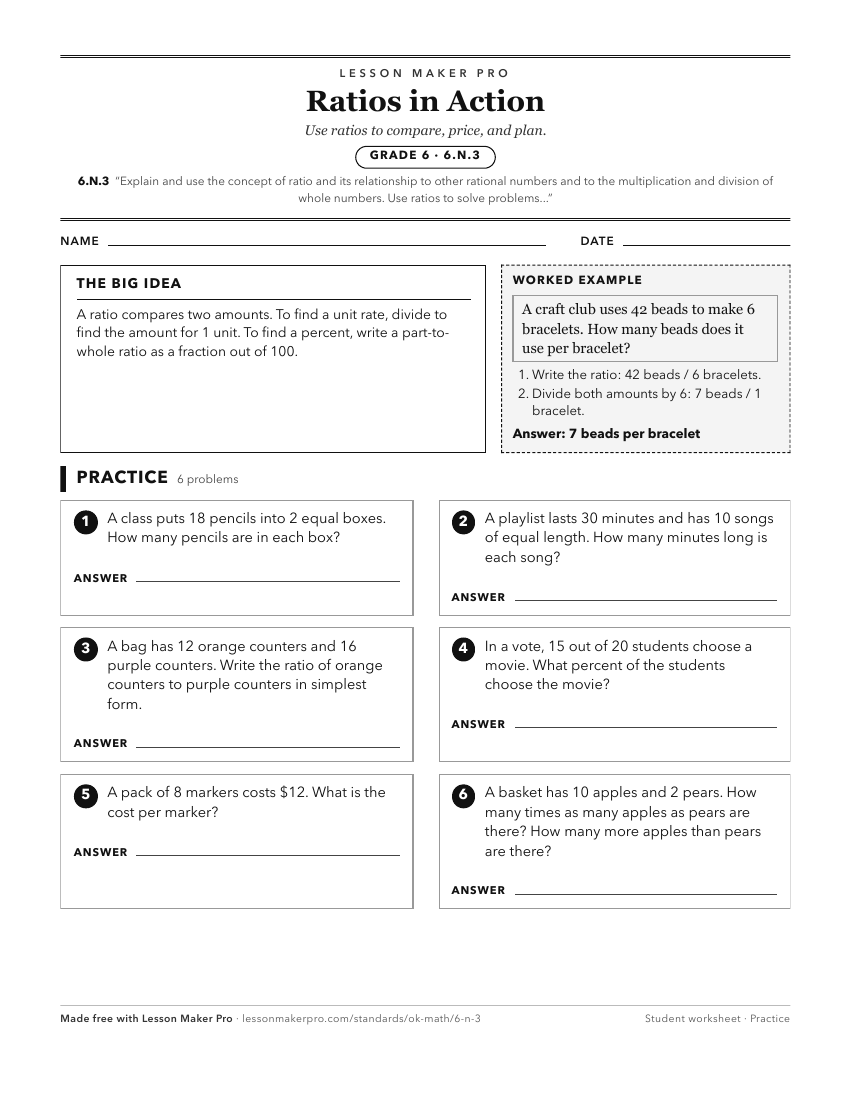
A ready-to-print activity worksheet aligned to 6.N.3, with an answer key for the teacher on its own page. No account needed.
PDF, US Letter, prints cleanly in black and white.
Download the worksheetKeep exploring
Related Standards
Turn this cluster into a lesson
Grade, subject, topic, and the complete cluster are prefilled. Create one free, no account needed.
Also for this cluster:Make a WorksheetMake a QuizMake a Sub Lesson