Oklahoma Math 5.GM.3.1
The Standard
- 5.GM.3
- Understand angle, length, weight, and capacity as measurable attributes of real-world and mathematical objects, using various tools to measure them. Solve real-world problems of length.
Measure and compare angles according to size using various tools.
Oklahoma Academic Standards for Mathematics (2022)
Teacher's field guide
What This Standard Means
What Students Need to Do
- Students measure angles in degrees with a protractor. They compare angles by the size of the opening, even when the rays have different lengths or point in different directions.
What Mastery Looks Like
- A student places the protractor’s center on the vertex and lines up its zero mark with one ray. They read the correct scale, label the angle in degrees, and identify the larger of two angles.
Common Misconceptions
- Students may think longer rays make a larger angle. They may also read the wrong scale on a protractor or place its center away from the vertex.
How to Assess It
- Draw two unlabeled angles on an exit slip, one 40° and one 110°. Ask students to measure both with a protractor, label them, and circle the larger angle.
Lesson moves
Ways to Teach It
Give pairs paper angle cutouts and protractors; have them measure, label, and order the cutouts from smallest to largest.
Show two angles with different ray lengths but the same opening; ask, “Which angle is larger, and how do you know?”
Play angle match: students measure four angle cards with protractors, then match each card to a degree card.
Have students trace a book opened to two positions, measure each angle at the spine, and decide which opening is wider.
Free download
Printable 5.GM.3.1 Worksheet
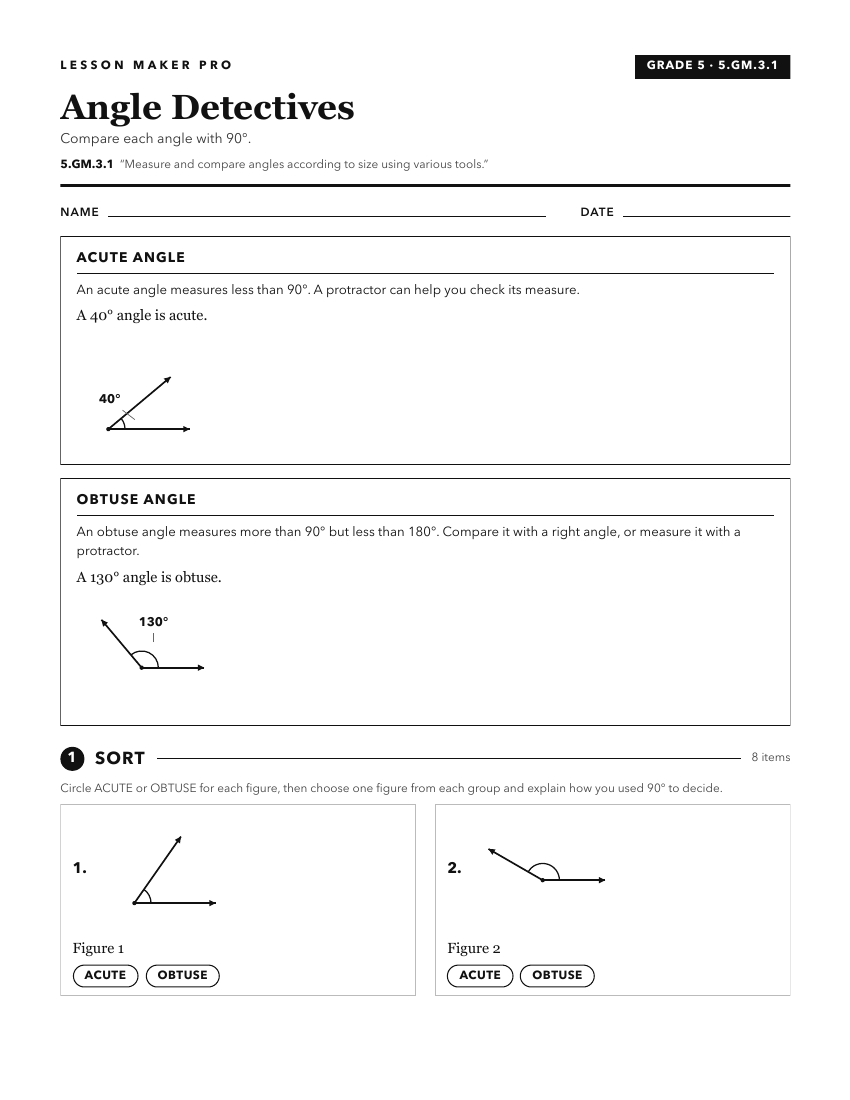
A ready-to-print activity worksheet aligned to 5.GM.3.1, with an answer key for the teacher on its own page. No account needed.
PDF, US Letter, prints cleanly in black and white.
Download the worksheetKeep exploring
Related Standards
- 4.GM.2.1
Measure angles in geometric figures and real-world objects with a protractor or angle ruler.
- 1.GM.2.1
Use nonstandard and standard measuring tools to measure the length of objects.
- 2.GM.1.5
Recognize right angles and classify angles as smaller or larger than a right angle.
- 6.GM.3
Understand and use relationships between angles in geometric figures.
Turn this exact standard into a lesson
Grade, subject, topic, and the complete standard are prefilled. Create one free, no account needed.
Also for this standard:Make a WorksheetMake a QuizMake a Sub Lesson