Oklahoma Math 4.N.4
Standard Cluster
Determine the value of bills and coins in order to solve monetary transactions. Select the fewest number of coins for a given amount of money up to one dollar. Given a total cost (dollars and coins up to twenty dollars) and amount paid (dollars and coins up to twenty dollars), find the change required in a variety of ways.
Oklahoma Academic Standards for Mathematics (2022)
Cluster contents
Standards in This Cluster
4.N.4 is a cluster heading. These are the individual standards under it.
Teacher's field guide
What This Cluster Means
What Students Need to Do
- Students add the values of bills and coins to find an amount of money. They find change after a purchase and make amounts under $1 using the fewest coins.
What Mastery Looks Like
- A student finds change by subtracting or counting up, then checks that the price and change add to the amount paid. For 37 cents, they choose a quarter, a dime, and two pennies.
Common Misconceptions
- Students may count a dime as one cent or write $3.07 as $3.70. Some subtract the amount paid from the price or use five nickels when one quarter would do.
How to Assess It
- Write on the board: “A notebook costs $6.63. You pay with a $10 bill. How much change do you get? List the fewest coins for the cents in your change.”
Lesson moves
Ways to Teach It
Give pairs play bills and coins and a $6.63 price tag; one student pays $10, and the other makes the change.
Ask: “Why do a quarter, a dime, and two pennies use fewer coins for 37 cents than three dimes and seven pennies?”
Call out 37, 62, and 86 cents; partners build each amount with the fewest quarters, dimes, nickels, and pennies.
Use a menu item priced at $8.42; students pay with a play $10 bill and count back the change.
Free download
Printable 4.N.4 Worksheet
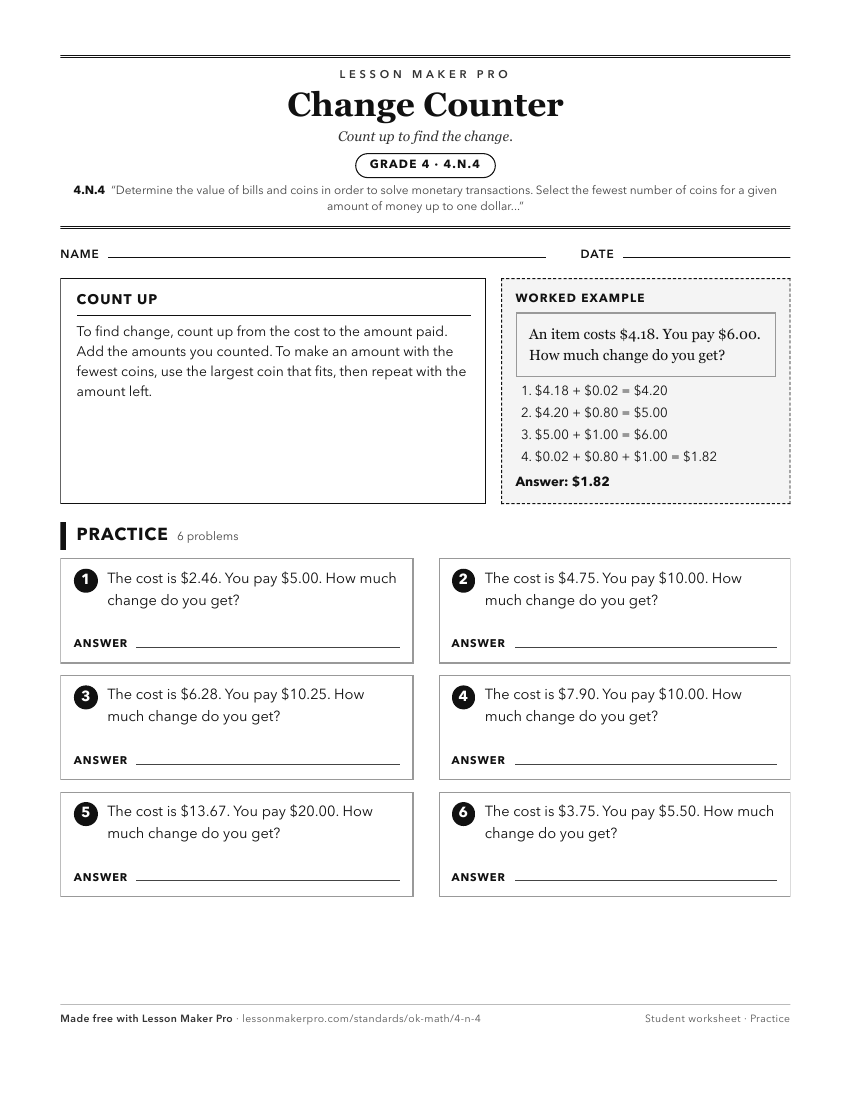
A ready-to-print activity worksheet aligned to 4.N.4, with an answer key for the teacher on its own page. No account needed.
PDF, US Letter, prints cleanly in black and white.
Download the worksheetKeep exploring
Related Standards
- 3.N.4
Determine the value of a set of coins and determine the value of a set of bills in monetary transactions.
- 2.N.4
Determine the value of a set of coins.
- 3.N.4.2
Add and subtract a collection of bills up to twenty dollars using whole dollars in monetary transactions.
- 3.N.4.1
Use addition and subtraction to determine the value of a collection of coins up to one dollar using the cent symbol and in monetary transactions.
Turn this cluster into a lesson
Grade, subject, topic, and the complete cluster are prefilled. Create one free, no account needed.
Also for this cluster:Make a WorksheetMake a QuizMake a Sub Lesson