Oklahoma Math 3.A.2.1
The Standard
- 3.A.2
- Use number sentences involving multiplication and unknowns to represent and solve real-world and mathematical problems.
Use number sense with the properties of addition, subtraction, and multiplication, to find unknowns (represented by symbols) in one-step equations. Generate real-world situations to represent number sentences.
Oklahoma Academic Standards for Mathematics (2022)
Teacher's field guide
What This Standard Means
What Students Need to Do
- Students find a missing number in a one-step addition, subtraction, or multiplication equation. They use number facts or the opposite operation to check their answer. They make a story that matches an equation.
What Mastery Looks Like
- Students solve □ + 9 = 17 and 20 - □ = 8, even though the blank is not at the end. They use 6 × 4 = 24 to solve 4 × □ = 24. They can tell a story that matches the numbers and operation.
Common Misconceptions
- Students may assume the symbol always stands for the final answer. They may subtract in the wrong order when solving 20 - □ = 8. They may write an addition story for a multiplication equation.
How to Assess It
- Exit ticket: Solve □ + 7 = 19, 18 - △ = 11, and 4 × ○ = 24. Write a story that matches 4 × ○ = 24.
Lesson moves
Ways to Teach It
Give pairs 18 counters and cups. Have them model 3 × □ = 18, then swap the factors and check the total.
Ask students to write a story for 20 - □ = 8, then explain why the missing number is 12.
Play equation match with cards showing one-step equations and answer cards. Partners solve, match, and check with counters.
Show a $12 receipt for four identical notebooks. Students write 4 × □ = 12 and find the price of one notebook.
Free download
Printable 3.A.2.1 Worksheet
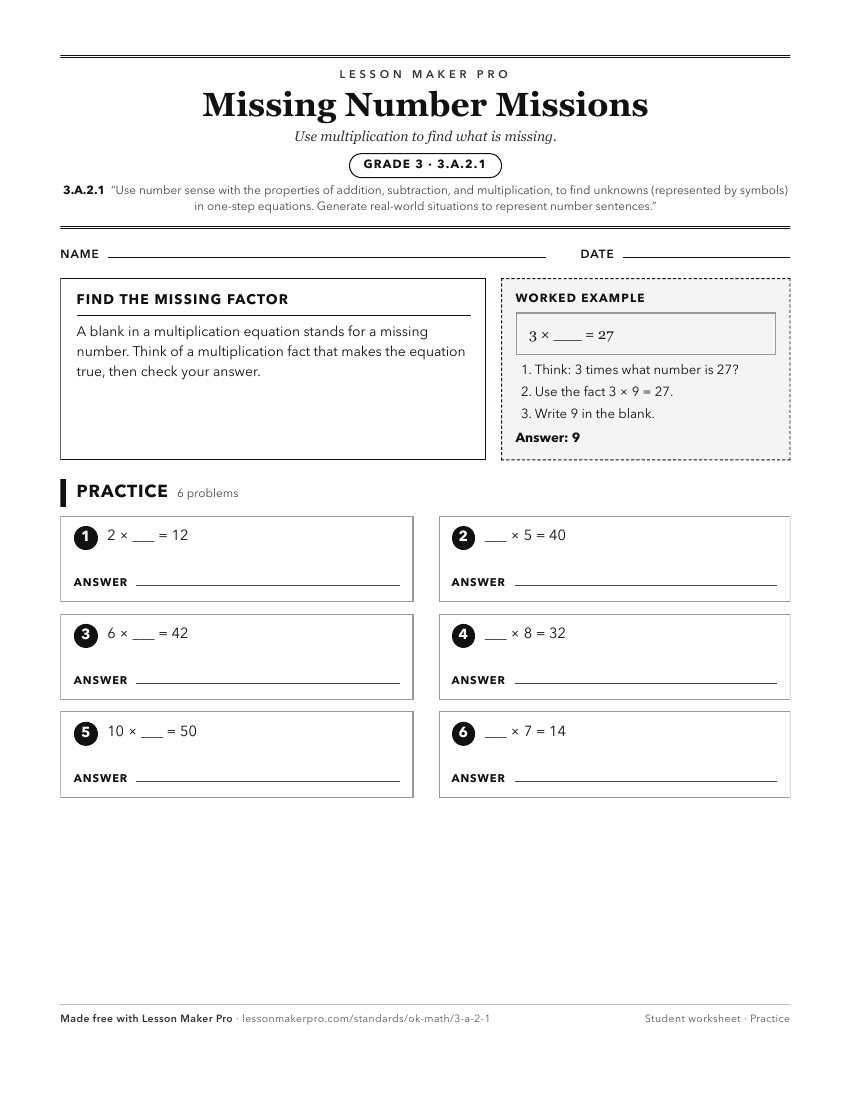
A ready-to-print activity worksheet aligned to 3.A.2.1, with an answer key for the teacher on its own page. No account needed.
PDF, US Letter, prints cleanly in black and white.
Download the worksheetKeep exploring
Related Standards
- 3.A.2
Use number sentences involving multiplication and unknowns to represent and solve real-world and mathematical problems.
- 2.A.2
Use number sentences involving unknowns to represent and solve realworld and mathematical problems.
- 4.A.2.2
Solve for a variable in an equation involving addition, subtraction, multiplication, or division with whole numbers. Analyze models to represent number sentence...
- 4.A.2
Use multiplication and division with variables to create number sentences representing a given mathematical situation.
Turn this exact standard into a lesson
Grade, subject, topic, and the complete standard are prefilled. Create one free, no account needed.
Also for this standard:Make a WorksheetMake a QuizMake a Sub Lesson