Oklahoma Math 1.N.2.2
The Standard
- 1.N.2
- Solve addition and subtraction problems with sums and minuends of up to 10 in real-world and mathematical contexts.
Determine if equations involving addition and subtraction are true.
Oklahoma Academic Standards for Mathematics (2022)
Teacher's field guide
What This Standard Means
What Students Need to Do
- Students find the value on each side of an addition or subtraction equation using numbers up to 10. They decide whether the two sides are equal.
What Mastery Looks Like
- A student can show that 3 + 2 = 6 - 1 is true because both sides make 5. They can explain why 7 - 3 = 2 + 1 is false.
Common Misconceptions
- Some students think an equals sign means an answer must come next, so they miss equations with expressions on both sides. Others check only one side or subtract in the wrong order.
How to Assess It
- Exit ticket: Mark 3 + 2 = 6 - 1 and 7 - 3 = 2 + 1 true or false. Show the value of each side.
Lesson moves
Ways to Teach It
Give pairs ten counters and two paper plates to build each side of 4 + 1 = 7 - 2, then compare.
Ask, "Is 5 = 8 - 3 true? How do you know?" Have students write one sentence.
Play a true-or-false card sort with equations such as 2 + 4 = 3 + 3 and 9 - 2 = 6.
Place three pencils beside two more, then compare them with five pencils and write an equation showing whether the groups match.
Free download
Printable 1.N.2.2 Worksheet
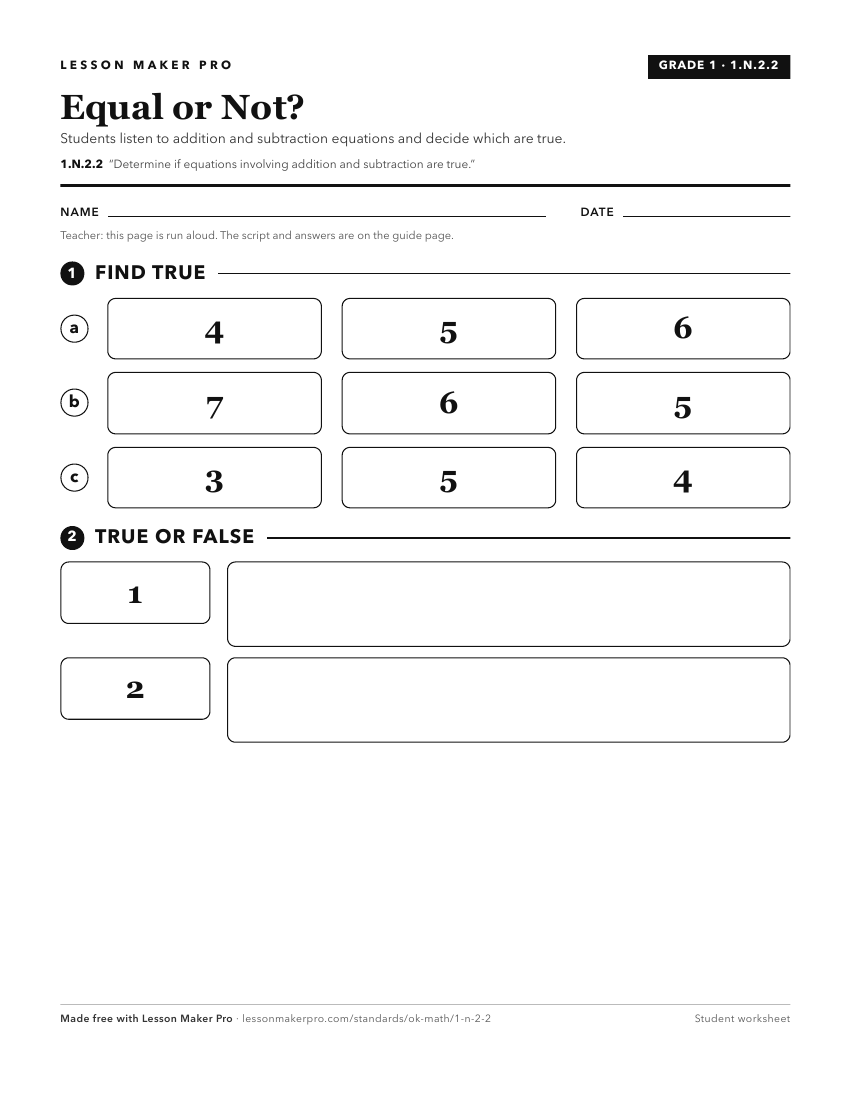
A ready-to-print activity worksheet aligned to 1.N.2.2, with an answer key for the teacher on its own page. No account needed.
PDF, US Letter, prints cleanly in black and white.
Download the worksheetKeep exploring
Related Standards
- 6.N.2.1
Estimate solutions for integer addition and subtraction of problems in order to assess the reasonableness of results.
- 2.A.2.3
Apply the commutative property, identity property, and number sense to find values for unknowns that make addition and subtraction number sentences true or fals...
- 5.A.2.2
Determine whether an equation or inequality involving a variable is true or false for a given value of the variable.
- 4.A.2.3
Determine the unknown addend or factor in equivalent and non-equivalent expressions (e.g., 5 + 6 = 4 + __, 3 ∙ 8 < 3 ∙ __).
Turn this exact standard into a lesson
Grade, subject, topic, and the complete standard are prefilled. Create one free, no account needed.
Also for this standard:Make a WorksheetMake a QuizMake a Sub Lesson