Oklahoma Math 1.GM.3
Standard Cluster
Describe and measure concepts of time. Tell time to the hour and half-hour (analog and digital). Describe and measure calendar time by days, weeks, months, and years.
Oklahoma Academic Standards for Mathematics (2022)
Cluster contents
Standards in This Cluster
1.GM.3 is a cluster heading. These are the individual standards under it.
Teacher's field guide
What This Cluster Means
What Students Need to Do
- Students read and show times to the hour and half-hour on analog and digital clocks. They use a calendar to name days, months, and years, and count days and weeks between dates.
What Mastery Looks Like
- A student reads 7:00 and 7:30, places the clock hands correctly, and writes the matching digital times. They can find a date one week later on a calendar and name its month and year.
Common Misconceptions
- Some students read 3:30 as 3:06 because the minute hand points to 6, or leave the hour hand right on 3. Others count a week as five school days or assume every month has the same number of days.
How to Assess It
- On an exit ticket, ask students to show 2:30 on a blank clock, write 8 o'clock in digital form, and find the date one week after November 10 on a calendar.
Lesson moves
Ways to Teach It
Give pairs paper clocks with movable hands; call out 4:00 and 4:30, then have students show each time and write it digitally.
Show a clock set to 6:30 and ask, "Why is the hour hand between 6 and 7?"
Play a matching game with cards showing analog clocks, digital times, and phrases like half past nine.
Use the class calendar to circle today's date, count days until Friday, and name the current month and year.
Free download
Printable 1.GM.3 Worksheet
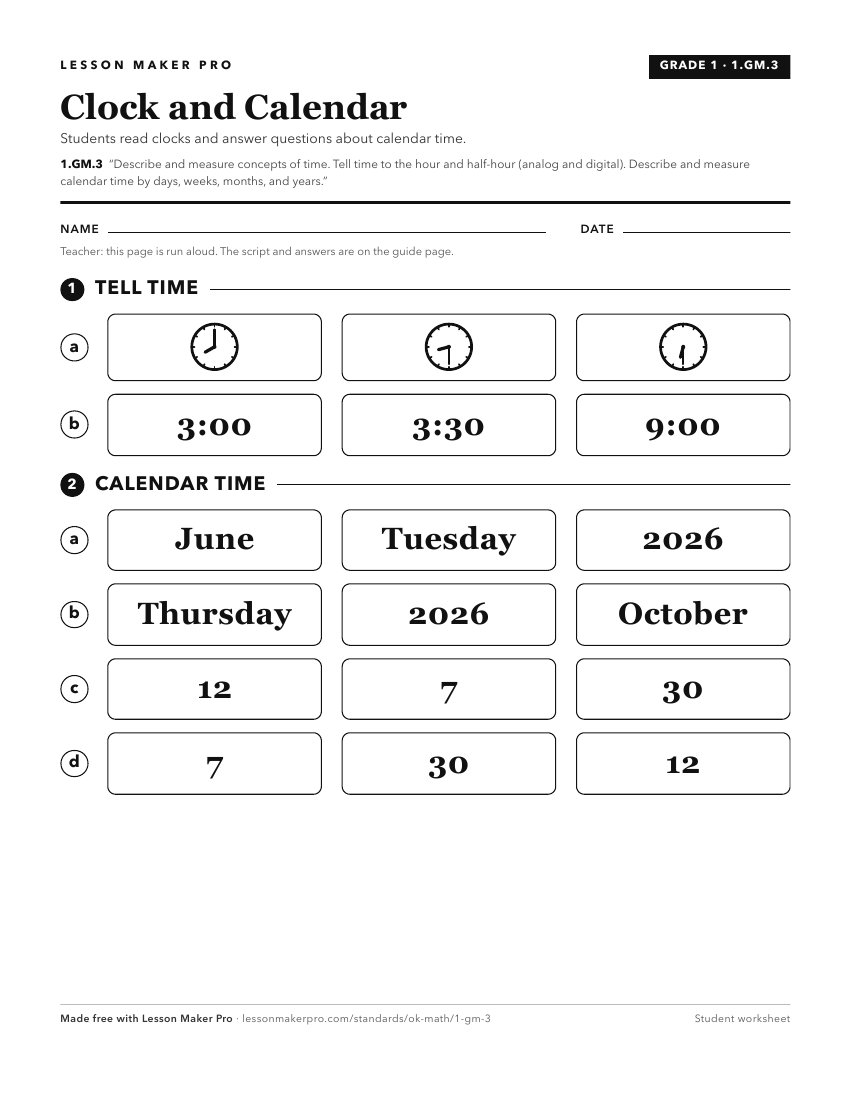
A ready-to-print activity worksheet aligned to 1.GM.3, with an answer key for the teacher on its own page. No account needed.
PDF, US Letter, prints cleanly in black and white.
Download the worksheetKeep exploring
Related Standards
- K.GM.3
Tell time as it relates to daily life.
- 4.GM.3.2
Convert one measure of time to another including seconds to minutes, minutes to hours, hours to days, and vice versa, using various models.
- K.GM.3.1
Develop an awareness of simple time concepts within daily life, using age-appropriate vocabulary (e.g., yesterday, today, tomorrow, morning, afternoon, night).
Turn this cluster into a lesson
Grade, subject, topic, and the complete cluster are prefilled. Create one free, no account needed.
Also for this cluster:Make a WorksheetMake a QuizMake a Sub Lesson