Oklahoma ELA K.2.PC.5
The Standard
Students will recognize the distinguishing features of a sentence (e.g., capitalization of the first word, ending punctuation: period, exclamation point, question mark) with prompting.
Oklahoma Academic Standards for English Language Arts (2021)
Teacher's field guide
What This Standard Means
What Students Need to Do
- Students look at the first word and the mark at the end of a sentence. With a prompt, they point to the capital letter and identify a period, question mark, or exclamation point.
What Mastery Looks Like
- Given a printed sentence, a student points to the capital at the start and the mark at the end. They can spot a missing capital or end mark when shown two versions of the sentence.
Common Misconceptions
- Students may mistake a capital in the middle of a sentence, such as Mom, for the start. They may think a question mark or exclamation point works the same as a period.
How to Assess It
- Show students “The cat sleeps.”, “Is it raining?”, and “Wow!” Ask them to point to the first capital and name the end mark on each card.
Lesson moves
Ways to Teach It
Give pairs word cards for “The dog runs” and three punctuation tiles; have them choose the period and circle the capital T.
Show “Where is my hat?” and ask, “What tells you where this sentence starts and ends?”
Play punctuation detective: display “Run!”, “I see it.”, and “Can you go?” as students hold up matching punctuation cards.
Post a “Please wash your hands.” sign; have students point to its first capital and ending period before lining up.
Free download
Printable K.2.PC.5 Worksheet
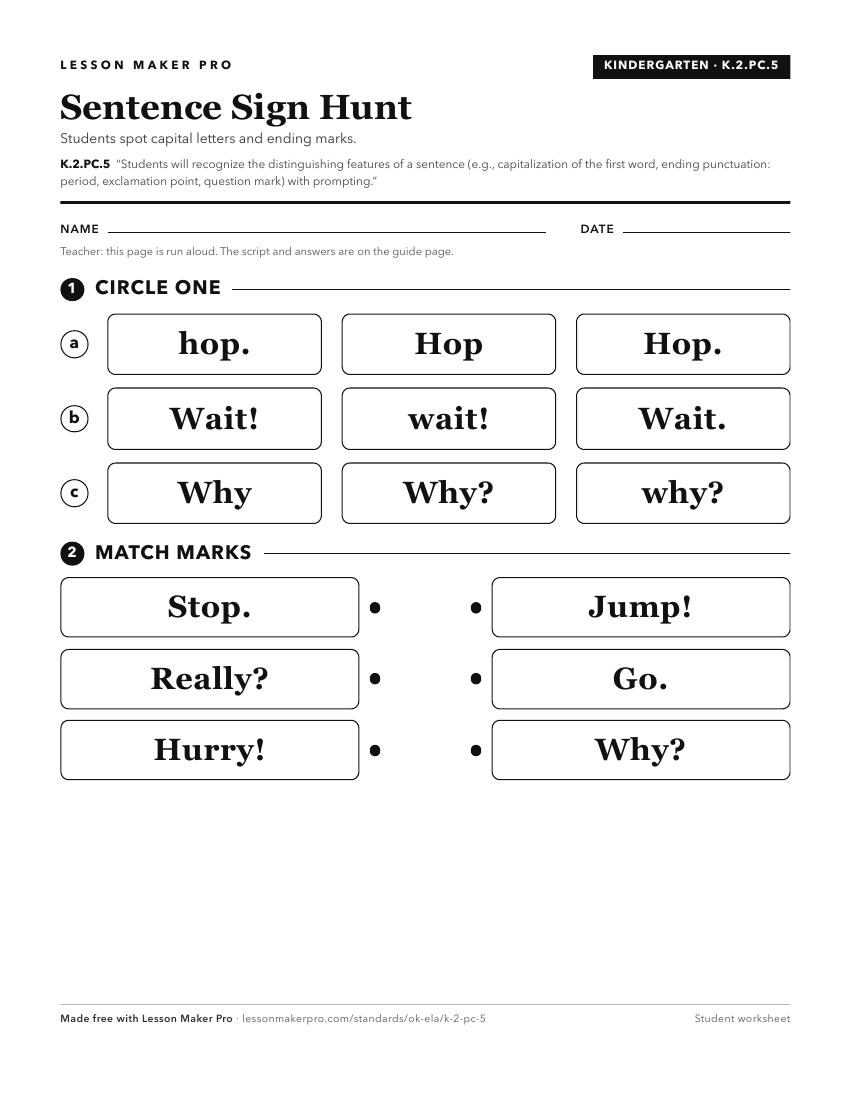
A ready-to-print activity worksheet aligned to K.2.PC.5, with an answer key for the teacher on its own page. No account needed.
PDF, US Letter, prints cleanly in black and white.
Download the worksheetKeep exploring
Related Standards
- K.5.R.1
Recognize simple sentences with prompting.
- K.5.W.3
Recognize and begin to use periods, question marks, and exclamation points.
- K.5.R.2
Recognize parts of speech in sentences with prompting: • concrete objects as persons, places, or things (i.e., nouns) • words as actions (i.e., verbs) • color a...
Turn this exact standard into a lesson
Grade, subject, topic, and the complete standard are prefilled. Create one free, no account needed.
Also for this standard:Make a WorksheetMake a QuizMake a Sub Lesson