Oklahoma ELA 9.5.W.11
The Standard
Students will write using correct semicolon mechanics.
Oklahoma Academic Standards for English Language Arts (2021)
Teacher's field guide
What This Standard Means
What Students Need to Do
- Students use semicolons to join closely related complete sentences. They also use them to separate list items that contain commas.
What Mastery Looks Like
- A student can put a semicolon between two complete sentences and explain why it belongs there. They can write a list of cities and states without confusing the reader. They use a semicolon before however and a comma after it when linking complete sentences.
Common Misconceptions
- Students may put a semicolon before a sentence fragment because it looks like a stronger comma. They may also join two complete sentences with only a comma or forget the comma after however.
How to Assess It
- Exit ticket: Correct “I studied hard, however I still missed two questions.” Ask students to explain why the semicolon belongs where they put it.
Lesson moves
Ways to Teach It
Give pairs strips reading “The bell rang” and “Nobody moved”; have them connect the strips with a semicolon card.
Ask, “Why does ‘The bell rang; nobody moved’ work, but ‘After the bell rang; nobody moved’ does not?”
Play a punctuation sort with eight cards that show comma splices, correct semicolons, and semicolons before fragments.
Have students fix a field trip itinerary listing “Tulsa, Oklahoma, Wichita, Kansas, and Dallas, Texas” so each stop is clear.
Free download
Printable 9.5.W.11 Worksheet
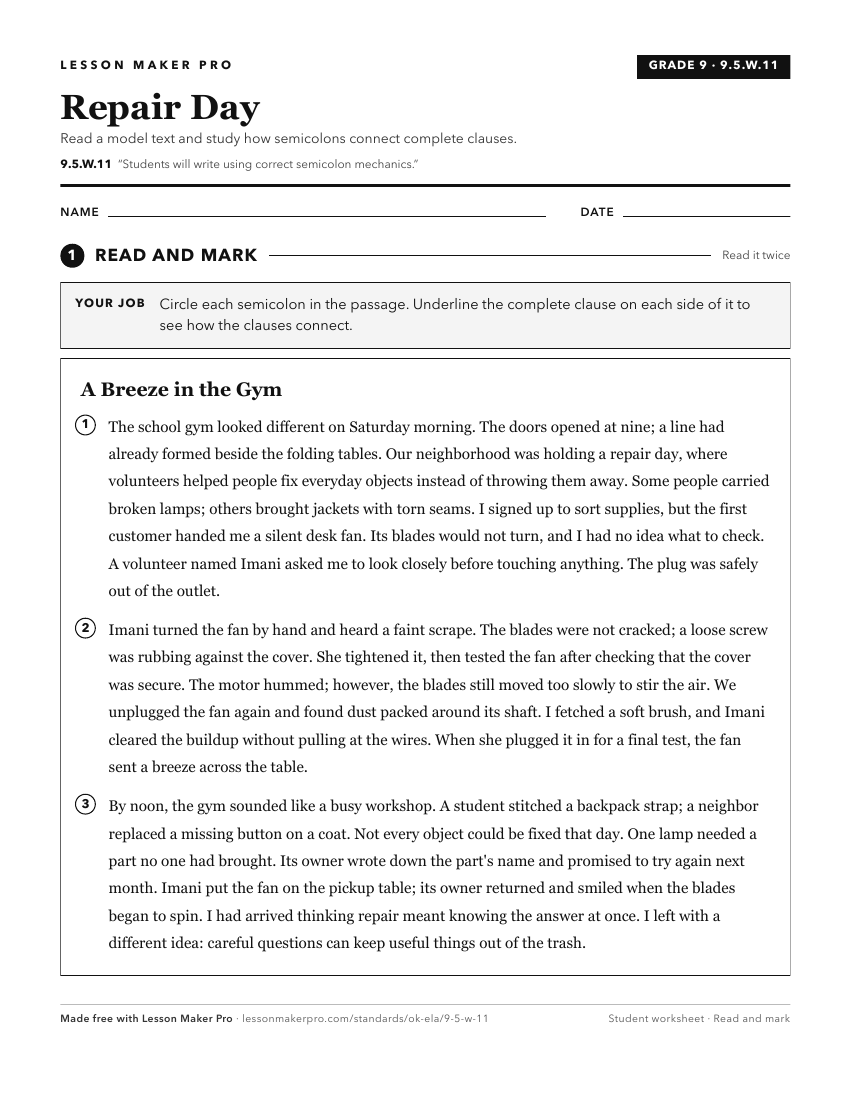
A ready-to-print activity worksheet aligned to 9.5.W.11, with an answer key for the teacher on its own page. No account needed.
PDF, US Letter, prints cleanly in black and white.
Download the worksheetKeep exploring
Related Standards
Turn this exact standard into a lesson
Grade, subject, topic, and the complete standard are prefilled. Create one free, no account needed.
Also for this standard:Make a WorksheetMake a QuizMake a Sub Lesson