Oklahoma ELA 8.3.R.3
The Standard
Students will analyze literary elements to support interpretations of a literary text: • setting • plot • characters (i.e., protagonist, antagonist) • characterization • conflict (i.e., internal, external) • point of view (i.e., third person limited and omniscient, second person, and unreliable narrator)
Oklahoma Academic Standards for English Language Arts (2021)
Teacher's field guide
What This Standard Means
What Students Need to Do
- Students explain how setting, plot, characters, conflict, and narration shape a story’s meaning. They use details from the text to support their reading.
What Mastery Looks Like
- A student can point to a character’s actions or words to explain what that character wants and what stands in the way. They can tell who knows what in the story and explain how the narrator affects what readers believe.
Common Misconceptions
- Students may call any disliked character the antagonist, even when the main obstacle is the protagonist’s own fear. They may confuse third-person limited with omniscient because both use he, she, or they. They may also assume a narrator’s account is always true.
How to Assess It
- Give students a short story passage. Ask: “What does the narrator know, and which two details help you explain the main conflict?”
Lesson moves
Ways to Teach It
Give groups scene strips from a short story to arrange in plot order, then have them label setting clues, character traits, and conflicts.
After reading “The Tell-Tale Heart,” ask: “Which details make the narrator hard to trust, and how does that change your reading of the conflict?”
Play a narrator sort with four paragraph cards: second person, third-person limited, third-person omniscient, and unreliable first person; have students defend each match.
Have students write two witness accounts of a cafeteria argument, then compare which details change their view of who caused it.
Free download
Printable 8.3.R.3 Worksheet
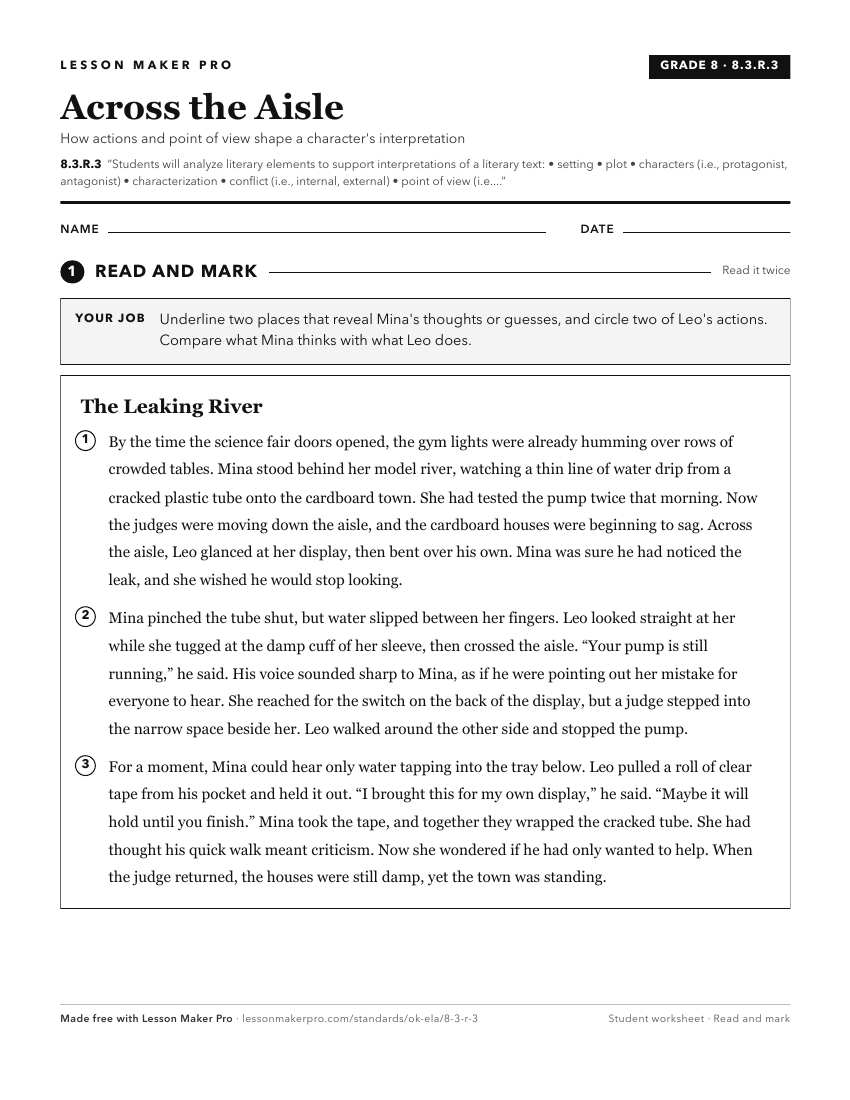
A ready-to-print activity worksheet aligned to 8.3.R.3, with an answer key for the teacher on its own page. No account needed.
PDF, US Letter, prints cleanly in black and white.
Download the worksheetKeep exploring
Related Standards
- 7.3.R.3
Analyze literary elements to support an interpretation of a text:- setting- plot- characters (i.e., protagonist, antagonist)- characterization- conflict (i.e., ...
- 6.3.R.3
Analyze how literary elements contribute to the meaning of a literary text:- setting- plot- characters (i.e., protagonist, antagonist)- characterization- confli...
- 5.3.R.3
Determine how literary elements contribute to the meaning of a literary text:- setting- plot- characters (i.e., protagonist, antagonist)- characterization- conf...
- 4.3.R.3
Find textual evidence of literary elements:- setting- plot- characters (i.e., protagonist, antagonist)- characterization- conflict
Turn this exact standard into a lesson
Grade, subject, topic, and the complete standard are prefilled. Create one free, no account needed.
Also for this standard:Make a WorksheetMake a QuizMake a Sub Lesson