Oklahoma ELA 6.4.R.3
The Standard
Students will use word parts (e.g., affixes, Latin roots, stems) to define and determine the meaning of increasingly complex words.
Oklahoma Academic Standards for English Language Arts (2021)
Teacher's field guide
What This Standard Means
What Students Need to Do
- Students split unfamiliar words into prefixes, roots, and suffixes. They use those parts to work out a likely meaning, then check it against the sentence.
What Mastery Looks Like
- A student can identify trans as across, port as carry, and able as can be in transportable. They explain that it means able to be carried from place to place and check that meaning against the passage.
Common Misconceptions
- Students may read port in portable as a harbor instead of carry. They may assume in always means not, even in inspect, or name the parts without checking the sentence.
How to Assess It
- Exit ticket: “The storm’s path was unpredictable, so the team prepared for several outcomes.” Have students split unpredictable into parts and explain its meaning in the sentence.
Lesson moves
Ways to Teach It
Give students paper cards labeled trans, port, and able to build portable and transportable, then write a meaning for each.
Ask students why in means into in inspect but means not in invisible, using spect and vis to support their answers.
In pairs, match reconstruction, inspection, and portable to root cards struct, spect, and port, then write definitions.
Show a portable charger box and a school transportation notice. Students underline port in both words and explain what gets carried.
Free download
Printable 6.4.R.3 Worksheet
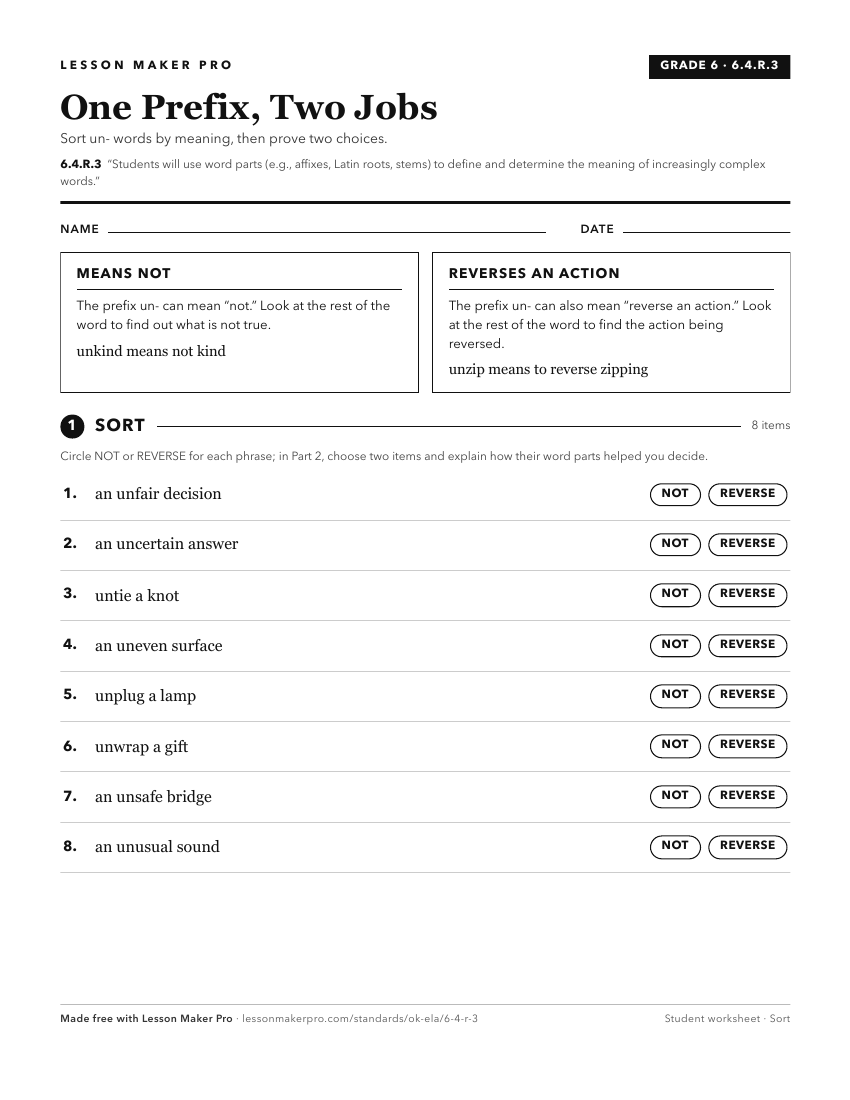
A ready-to-print activity worksheet aligned to 6.4.R.3, with an answer key for the teacher on its own page. No account needed.
PDF, US Letter, prints cleanly in black and white.
Download the worksheetKeep exploring
Related Standards
- 8.4.R.3
Use word parts (e.g., affixes, Greek roots, stems) to define and determine the meaning of increasingly complex words.
- 7.4.R.3
Use word parts (e.g., affixes, Greek roots, stems) to define and determine the meaning of increasingly complex words.
- 9.4.R.3
Use word parts (e.g., affixes, Anglo-Saxon, Greek, and Latin roots, stems) to define and determine the meaning of increasingly complex words.
- 12.4.R.3
Use word parts (e.g., affixes, Anglo-Saxon, Greek, and Latin roots, stems) to define and determine the meaning of increasingly complex words.
Turn this exact standard into a lesson
Grade, subject, topic, and the complete standard are prefilled. Create one free, no account needed.
Also for this standard:Make a WorksheetMake a QuizMake a Sub Lesson